
Imagine a new theater company that sees “theater as a civic act” and has as its mission “to make the classics radical again.” Now imagine that new theater company takes on, as its inaugural production, an antiwar comedy nearly 24 centuries old and invigorates it into a spectacularly entertaining production that feels ripped from today’s headlines.
In a most impressive debut, Glass Canon Theatre Company has staged its own ribald and radical adaptation of Lysistrata, the 5th-century BCE play by Aristophanes named after its fiercely pacifist and protofeminist heroine, Lysistrata — she who rallies women to go on a sex strike until men stop their incessant warring.
Weaponizing intimacy against men’s violence, what a concept — it’s dead serious but also, as it turns out, funny AF.
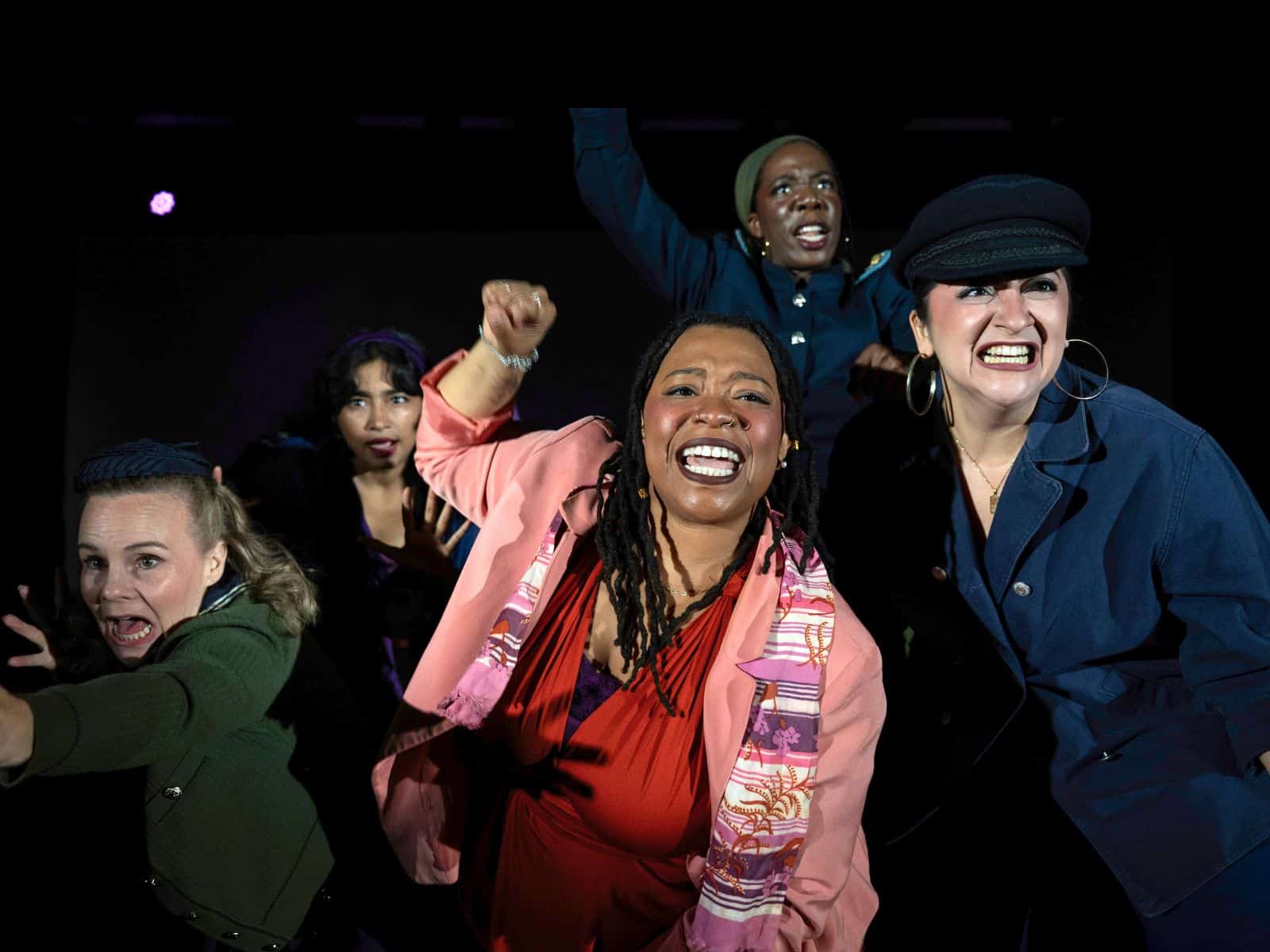
Performing on the spacious black box stage at Dance Loft on 14 against a plain white cyclorama (lighting design by Niya John), the seven-member ensemble starts off by donning helmets and other military headwear, an assortment ancient and recent, and play-acting silly war games like kids at recess. (The company-created choreography throughout the show is delightful.) Abruptly, we hear guns and bombs, the sobering soundscape of a real war zone (Chelsea Prillerman’s sound design is fantastic), and the cast forms a mournful tableau as one sings the lullaby “Hush, Little Baby.”
That dialogue-less opener sets the tone of the show that is to follow — an engrossing mashup of frolicsome and gravitas.
The first of several wildly hilarious scenes has Lysistrata trying to recruit women by calling them on her mobile, but the voicemails she keeps getting indicate the women are preoccupied having sex — abundantly, in hetero positions graphically depicted by shadow puppets as on a Grecian urn.
A note about Lysistrata’s “phone”: it’s an elongated eggplant, as in the emoji for dick. There will be countless eggplants to come. Just as phalli were a prominent prop in ancient Greek comedy, rubber eggplants feature prominently here. They pop up all over the place, representing torches, spearheads, and whatnot (the clever prop design is by Sabrina Mandell, who also did the classy contemporary costumes).
Once Lysistrata gathers the women, she gives them a stemwinder of a speech about the hardship of war and exorts them to help end it by forgoing sex (the script’s wordplay and sexual innuendo are a kick):
LYSISTRATA: We must give up the Joy of the Johnson.
close up the tender tulip!
The sensation of the sausage. The ecstasy of the eggplant.
And much humor is milked from the women’s reluctance.

In broad strokes, the plot has the women coming around to Lysistrata’s urging, seizing the Acropolis and treasury to cut off funding for war, a confrontation wherein the men set fire to the Acropolis, lots of Loony Tunes–like stage combat, and a couple of comic interludes in which the frustratedly horny men are basically prick-teased by their principled wives (Bess Kaye choreographed both the show’s fights and intimacy superbly).
The story unfolds in a variety-show’s worth of fun forms: a podcast, a press conference, livestream news coverage, plus beautiful vocals on folk songs such as (“There’d be no war today, If mothers all would say,”) “I Didn’t Raise My Boy to Be a Soldier” and traditional spirituals such as “Down by the Riverside” (“I ain’t gonna study war no more”).
Besides Lysistrata (a queenly Aja Goode), the women are terrifically represented by a street-tough military defector, Lampito (Pauline Lamb); Nikki (Tracy Coffey), the sprightly wife of a general; Myrrhine (Surasree Das), the sensuous wife of a senator; and Cali (Cristina Sánchez), a Sappho who works as a guard at the Acropolis. Two very good sports play the men: the general Dictonius (Michael Allen Chamberlin) and the senator Kinesias (Clint Blakely, who also served as musical director).
Amid all the raunchy wit are some remarkable passages of antiwar radicalism, including when the women ask the Oracle: “Have women successfully waged for peace by not giving men a piece?” The Oracle’s Siri-like answer is an eye-opening summary of actual historical precedents. At another point, the audience is invited to participate in some real-world resistance having to do with an interactive QR code in the program.
This marvelously playful peace-fest text, adapted from Aristophanes, is credited to Emma Jaster (who directs brilliantly) and the company’s artistic director, Gil Mitchells, and is based on versions by Sarah Ruden, Stephen Halliwell, and the Athenian Society, with additional material by the Ensemble.
I cannot imagine a more auspicious new company debut nor a more timely civic act.
Running Time: 90 minutes, no intermission
Lysisistrata plays through June 7, 2026, presented by Glass Canon Theatre Company performing at Dance Loft on 14 (4618 14th Street NW, Washington, DC). Purchase tickets (general, $32–$75; students with ID, $0) online.
Performances run Thursdays through Sundays, with Industry Night and a celebration of Glass Canon Theatre Company’s first anniversary on Monday, June 1 at 7:30 PM, Women and Nonbinary Affinity Night on May 28, BIPOC Affinity Night on June 5, and Pride Night on June 6.
The program is online here.
CAST
Aja Goode: Lysistrata
Surasree Das: Myrrhine
Tracy Coffey: Nikki
Cristina Sánchez: Cali
Pauline Lamb: Lampito
Clint Blakely: Kinesias
Michael Allen Chamberlin: Dictonius
Hana Clarice: Understudy Kinesias, Dictonius
María del Mar Rodríguez: Understudy Nikki, Cali
Layali Aljirafi: Understudy Lysistrata, Myrrhine, Lampito
CREATIVE TEAM
Director: Emma Jaster
Costume Designer: Sabrina Mandell
Musical Director: Clint Blakely
Sound Designer: Chelsea Prillerman
Composer: Emily Erickson
Lighting Designer: Niya John
Fight Choreographer: Bess Kaye
Intimacy Choreographer: Bess Kaye
Assistant Director: Layali Aljirafi
Adapted by Emma Jaster and Gil Mitchell
Additional Material: The Ensemble
Adapted from Aristophanes, Sarah Ruden, Stephen Halliwell, Athenian Society
Production Manager: Paige Washington
Stage Manager: Paige Washington
Dramaturg: Gil Mitchell
Props Designer/Master: Sabrina Mandell
Lead Producer: Emily Erickson
SEE ALSO:
Glass Canon Theatre Company launches in DC (news story, November 5, 2025)