It’s not so sexy that you can’t take the kids — have you seen what’s on television lately? It is, however, sexier than I anticipated, what with one thing and another, and the slithering, sinuous movements all over three levels of stage are sensual and do much to energize the deliberate pace of the story, and make the show’s length a pleasantly thrilling sojourn.
In a treatment that’s largely faithful to Bram Stoker’s original novel, including frequent letters and journal entries, Laurel Mill Playhouse’s production of Dracula, by Steven Dietz, is full of gothic sensibilities, impassioned speeches, intense expressions, prosthetic teeth, and a gratifying bit of gore.
What director Tatum Moss, producer Maureen Rogers, and Laurel Mill Playhouse have done with this production is a thing not commonly seen in adult theater. I do not know the reasons for Moss et al. to double-cast the major character roles, resulting in a Yellow Cast and a Pink Cast. I did greatly enjoy the performance of the Yellow Cast I saw.
The shortest version of the story that I can possibly tell is this: a young woman’s fiancé (Jonathan) writes her letters as he goes to the Carpathians to work a real estate deal for a dude (Dracula) whom he’s never met. She (Mina) shares this news with her best friend (Lucy), who is engaged to a guy (Jack) in charge of a mental facility, where he tries to puzzle out the workings of a particular maniac (Renfield). Spookiness ensues, a specialist (Van Helsing) arrives, lust and gore follow closely.
The characters who appear in both casts are excellent — first, Dracula is played by Joe Downs, and he is mysterious, enigmatic and fully in command of many dramatic gestures and poses. His deliberate intonations are everything one expects of the infamous Count. His cohorts, referred to as “Vixens” in this treatment, are adoring, sensuous, and beautiful. Wes Dennis, Jessie Duggan, and Syd Johnson are silent and deadly, and their attacks are full of dark passion.
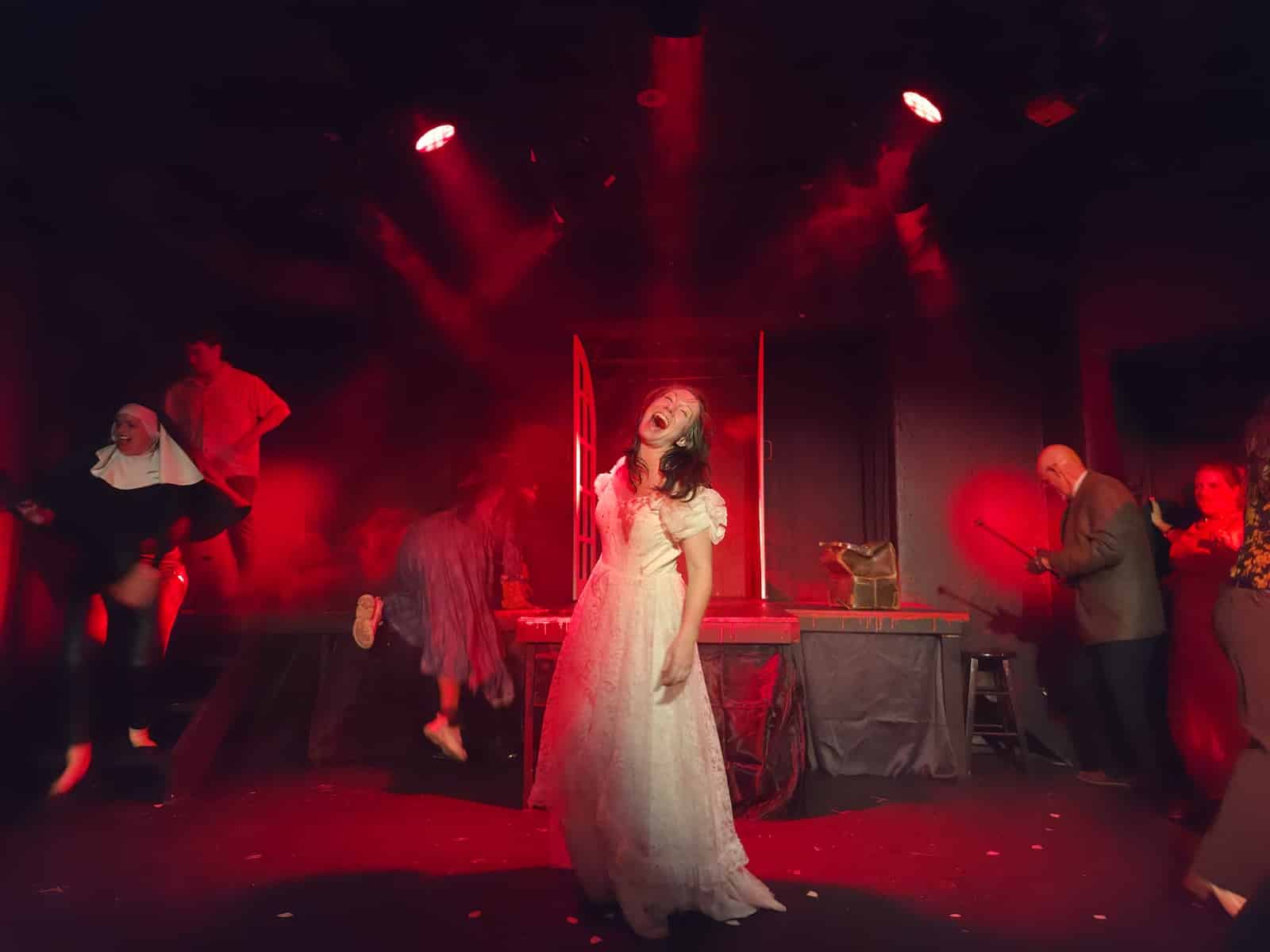
Jenny Ephrussi, Sara Worley, Zach Shields, and Lacy Shown as Ensemble are strong performers and physically diverse, making for dynamic visuals. Selah Holland, playing Lucy’s Maid, is engaging to watch, and her transformation is exquisite.
Our Yellow Cast opens the show in the person of Jonathan Harker, played with steady commitment by Andrew Rappa. His eventual cohort, Dr. Jack Seward, is played by John Mathews with overtones of pomposity and an underlying tenderness. The two ingenues of the piece, Lucy and Mina, played by Camille Wharff and Dana Fleischer, respectively, are both lovely to watch and distinct enough that they and their characters remain separate. As Lucy, Camille Wharff is bright and bubbly, with some degree of sophistication, leading into a believable frenzy. In contrast, Dana Fleischer’s Mina is naive and intense, and, as her naivete wears off, her intensity increases, and the gradual progression is beautifully performed.
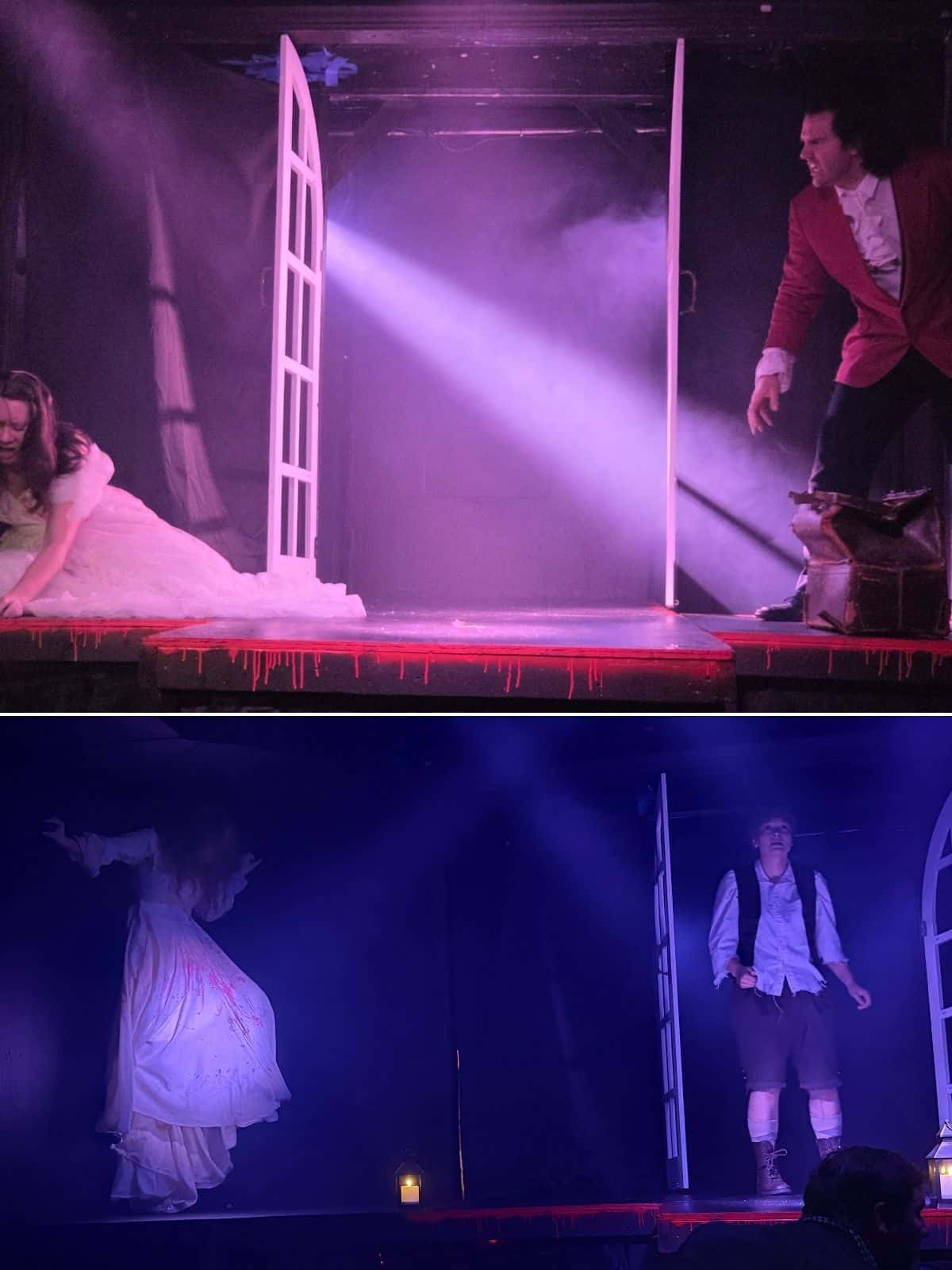
Renfield, in a bid to remain plot-relevant in the context of the show, opens with a monologue. He becomes our touchstone character, and we return to him many times, often without additional enlightenment. Playing Renfield is Daniel Schall, who is wild-eyed and frantic, yet completely intelligible, giving us an air of madness without sacrificing exposition.
John Cholod as Professor Van Helsing is excitable and impassioned, and his expressive face as he warns his reluctantly believing young friends is inspiring.
Be prepared for high-energy delivery and florid, bombastic dialogue, both of which are in keeping with the Gothic ethos of the book, the mythology, and this production. If you are the sort of person who wields words like “florid” and “bombastic” in your everyday vocabulary, chances are, you’ll enjoy this show. If you want a happy little musical where everyone ends up married and nobody’s dead, stop reading right now. This is not that. This is rather the reverse of that.
Lighting, by lighting designers Lori Brunn and Tatum Moss (with assistance from consultants Jen Sizer and Patrick Pase), is appropriately moody and dramatic, and frequently crucial to both plot and pacing. Set design, by director Tatum Moss, features prominent French doors upstage center, which are used to excellent effect, a Murphy bed, ditto, and effectively three levels of performance area by employing a raised platform adorned with dripping red paint. The set is spare and functional, a wise choice with a script composed of many short sequences that flutter like postcards across the stage.
I’m pleased to have a second-row seat, as much of the action happens on the stage floor. Whether the rise of the seating allows for good viewing angles of this action further back in the audience, I am unsure.
Costume designer Lacy Shown is ambiguous as to the exact time period, though the script is quite specific. I like the idea that the undead are ever-present in every age, and Shown certainly delivers a romantic look that can be safely characterized as “the past” and gives us a lovely, character-specific wardrobe as well as super-saturated color. The result is visual texture for the performance, and, as I’d anticipated, a preponderance of black on black, a delightful treat for the eyes.
Much of the appeal of this show stems from the work of Gavin Shown and Sarah Luckadoo, the fight choreographers, and Luckadoo’s skill as intimacy choreographer.
Sound design, also by director Tatum Moss, is atmospheric and does much to set the scene as well as the mood. It never tips overboard into haunted-house excess, and I admire the delicate touch on all of the effects. To overdo these things creates silliness instead of sensationalism.
Again, this is no light, fluffy piece to distract you from a bad week at the office. No, Dracula is a dark piece with heavy themes of evil, corruption, sacrifice, foreboding, and supernatural powers of frightful scope. It is long, it is loud, it is sometimes shrill. It has excellent sequences of vampiric assault and a Buffy-worthy melee, all executed with commitment and awe, creating a dynamic pastiche of melodrama. This is not a campy comedic treatment, but a full-on Gothic indulgence.
If the sunny blooms and bright bouquets of summertime are not to your liking, if your tastes run more to the morose and malfeasant, if your predilection is for pulchritude and puncture wounds, please treat yourself to the delicious darkness of Dracula at Laurel Mill Playhouse.
Running Time: Two hours and 15 minutes, with one intermission.
Dracula plays through June 7, 2026, at Laurel Mill Playhouse, 508 Main Street, Laurel, MD. Tickets ($20, general admission; $15, children 18 and under, seniors 65 and over, active and retired military, and American Legion Post 60 Members) can be purchased online or by calling 301-617-9906. Street parking is available but not plentiful.
Performance dates and times:
Saturday, June 6, 2026, at 8 pm
Sunday, June 7, 2026, at 2 pm (Pink cast)
Friday, June 5, 2026, at 8 pm
Saturday, June 6, 2026 at 2 pm (Yellow cast)
The program for Dracula is online here.
Disclaimer from Laurel Mills Playhouse: This production features violence, intimacy, flashing lights, gore effects, and water-based haze. Parental guidance is suggested for viewers under 10.