Conceived and written by Julia May Jonas as a contemporary female-centric counterpoint to Arthur Miller’s 1946 American classic All My Sons, A Woman Among Women (the title inspired by a quote from Miller’s original stage directions) considers a community destroyed by revelations about the psychologist and founder of a local woman’s wellness center in Northampton, Massachusetts, which she devoted herself to building. Presented in partnership with the Bushwick Starr (where it made its debut in 2024) and New Georges, the newly revised work – part of the playwright’s series All Long True American Stories, consisting of the reimaginings of five 20th-century male-based dramas – is now playing a limited Off-Broadway engagement at Lincoln Center’s Clair Tow Theater.
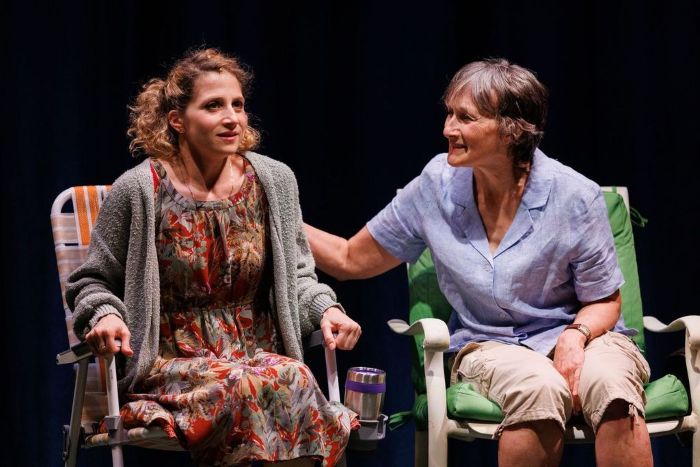
Directed by Sarah Cameron Hughes with biting humor and increasing tension, the cast of nine embraces the initial sense of no-holds-barred openness, sharing, and laughably unrestrained behavior in the predominantly female community, the twists and turns in the plot, and the ultimately fractured relationships of friends, neighbors, and generations of a family, triggered by the actions of one woman, exposed by another, and reflected in the collective impact and catharsis it has on all. The dramatic downfall of Cleo, the tragic heroine at the center of the story, unfolds on a summer day and night in her backyard and on her back porch, where her welcome guests pass through, her son-in-law Roy (husband of her unseen bipolar daughter Jo, serving a 20-year prison sentence for beating an elderly man) returns to the hometown from which he had moved with their now four-year-old daughter Frances, and Christine, a lawyer who lives next door and uncovers a significant reason to appeal Jo’s conviction (with the support of her wife, Tammy, and Tina, Cleo’s decades-long friend and housemate, who helped raise Jo and her sister Grace), delivers the hard truths of which the others were previously unaware.
Dee Pelletier stars as Cleo, a take-charge leader who, along with Roy, believes Jo’s brutal attack warrants the sentence she received, for reasons that eventually surface and cause her to be seen in a new light. Brittany K. Allen as Christine is professional, smart, and determined in her investigation of Jo’s arrest, leading to lines being drawn between those who agree with her (most notably Tina Chilip as the feisty Tina and Lucy Kaminsky as the uninhibited Tammy, who removes her sweaty top in front of everyone to sunbathe on the grass) and those who don’t (specifically Gabriel Brown as Roy, who married Jo on a whim at nineteen and doesn’t want her released or anywhere near Frances).
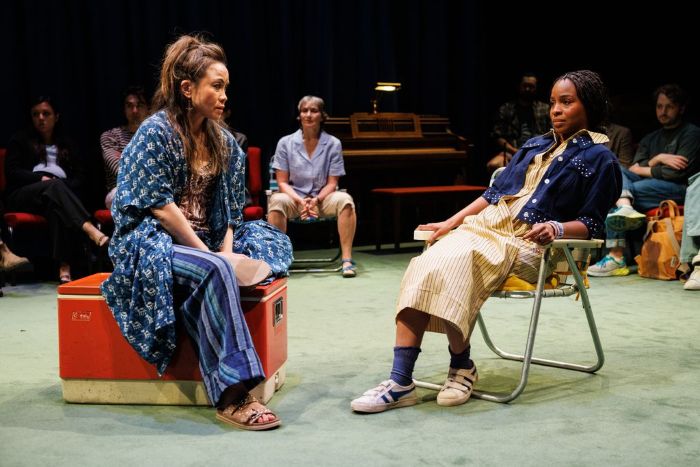
Rounding out the cast are Zoë Geltman as the neurotic and insecure Grace, who works at her mother’s wellness center, questions her love, and lusts after her sister’s very attractive husband; Hannah Heller as “Doc” Sarah, who, now sober and caring about what people think of her, also works with them at the center; Drew Lewis as Lane, Sarah‘s belittled stay-at-home husband and musician; and the excellent Morgan Siobhan Green in the dual roles of the precocious Rida, one of the neighborhood children, and Roy’s mother Trisha, who believes that Jo has changed since the violent incident, embracing and distinguishing each with age-appropriate speech patterns and demeanors.
The performance alternates between direct address to the audience and enacted scenes that introduce the characters and display their inter-relationships and backgrounds, mundane chit-chat, and foul-mouthed conversations, insults, and confrontations. Those are interspersed with segments of song and dance (one in the historical guise of the original women who settled the town, another led by Lane, who instructs the audience to accompany him with body percussion), contributing a surreal sensibility that clashes with the more natural tone of the central tragicomedy or creates a lengthy metatheatrical pause, presumably intended to engender a sense of community in the room but instead feels unnecessarily distracting.
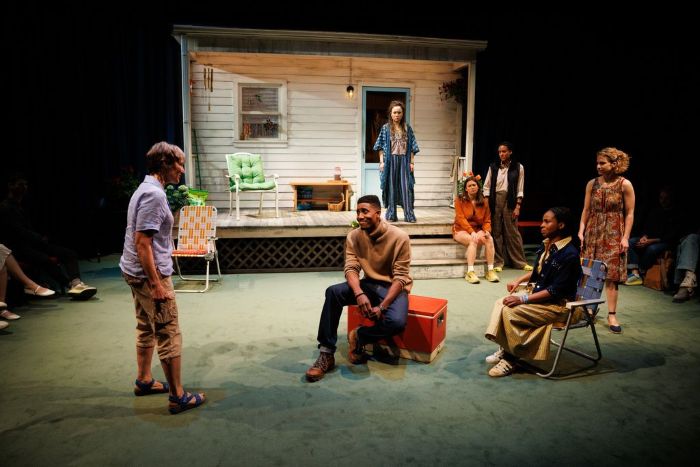
A minimalist set (by Brittany Vasta) consists of a circle of chairs that recalls a therapy session, in which audience members are seated among the actively moving cast, then later changes to the back of Cleo’s house and time-worn back porch, where the downfallen woman is left sitting alone. Lighting (by Jeanette Oi-Suk Yew) shifts from day to night and from bright to low for the songs and dances, with original music (by Music Director Brian Cavanagh-Strong) and sound (by Kate Marvin). Costumes (by Wendy Yang) are both casual, in keeping with the outdoor setting, and character-defining, with some a bit more girlish (Grace) or refined (Christine) than others, indicative of their positions, personalities, and desires.
A Woman Among Women is a mixed bag, with acerbic humor, disturbing situations, and a final reckoning that shakes the community to its core, infused with musical numbers that lengthen the show and break the mood and narrative flow with little reason. But the main issue is one that will leave you deciding whose side you would take in this female reimagining of traditional male roles (despite the female nudity that still remains a commonplace in entertainment), which have dominated classic American drama.
Running Time: Approximately one hour and 30 minutes, without intermission.
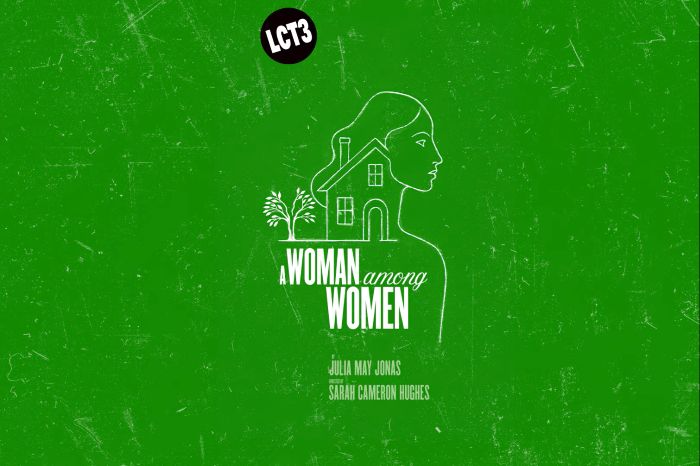
A Woman Among Women plays through Sunday, June 28, 2026, at Lincoln Center Theater, Claire Tow Theater, 150 West 65th Street, NYC. For tickets (priced at $38.50, including fees), go online, or find discount tickets at TodayTix.