“Go on,” founding father Thomas Jefferson tells us. “Hate me.”
We’ve reason enough: By the time of this direct-address monologue, arriving just prior to intermission at Round House Theatre’s new production of Suzan-Lori Parks’ Sally & Tom, we’ve learned or been reminded that the enslaved woman Sally Hemmings was only 14 years old when the author of the Declaration of Independence invited himself into her bed. That he was a widower nearly 30 years her senior is of less import than that he owned her. Their relationship continued for decades and produced at least six children. Is it possible that something 21st-century audiences would recognize as love could have existed between them?
Parks, surprisingly, has a definitive answer to this: Yes. But also, no.
That’s the contradiction Parks is circling in Sally & Tom, which premiered at the Guthrie in Minneapolis in 2022 and got a mixed reception off-Broadway two years ago. Because Parks, the self-identified “myth head,” needs a way to dramatize questions of how to recount the history of a young nation built on slavery and genocide, her drama is bifurcated — but not in the way that Tom Stoppard’s Arcadia is, unfolding across two timelines in the same spot.
Sally & Tom takes place in the 21st century, wherein a proudly confrontational, not-so-proudly broke troupe called The Good Company is rehearsing its own account of the Hemings–Jefferson coupling. Their play-within-the-play — set in Monticello circa 1790, as Jefferson and Hemings have just returned to Virginia after several years in Paris — is called The Pursuit of Happiness. France had ended the practice of slavery some 40 years earlier and allowed enslaved persons imported to the country to petition for their own freedom. So in theory, at least, Sally could have left her master during their years abroad were she so inclined. Instead, she negotiated then-extraordinary privileges for herself and her extant and yet-to-be-born children, including a pledge from Jefferson that all her children would be freed upon reaching the age of 21.
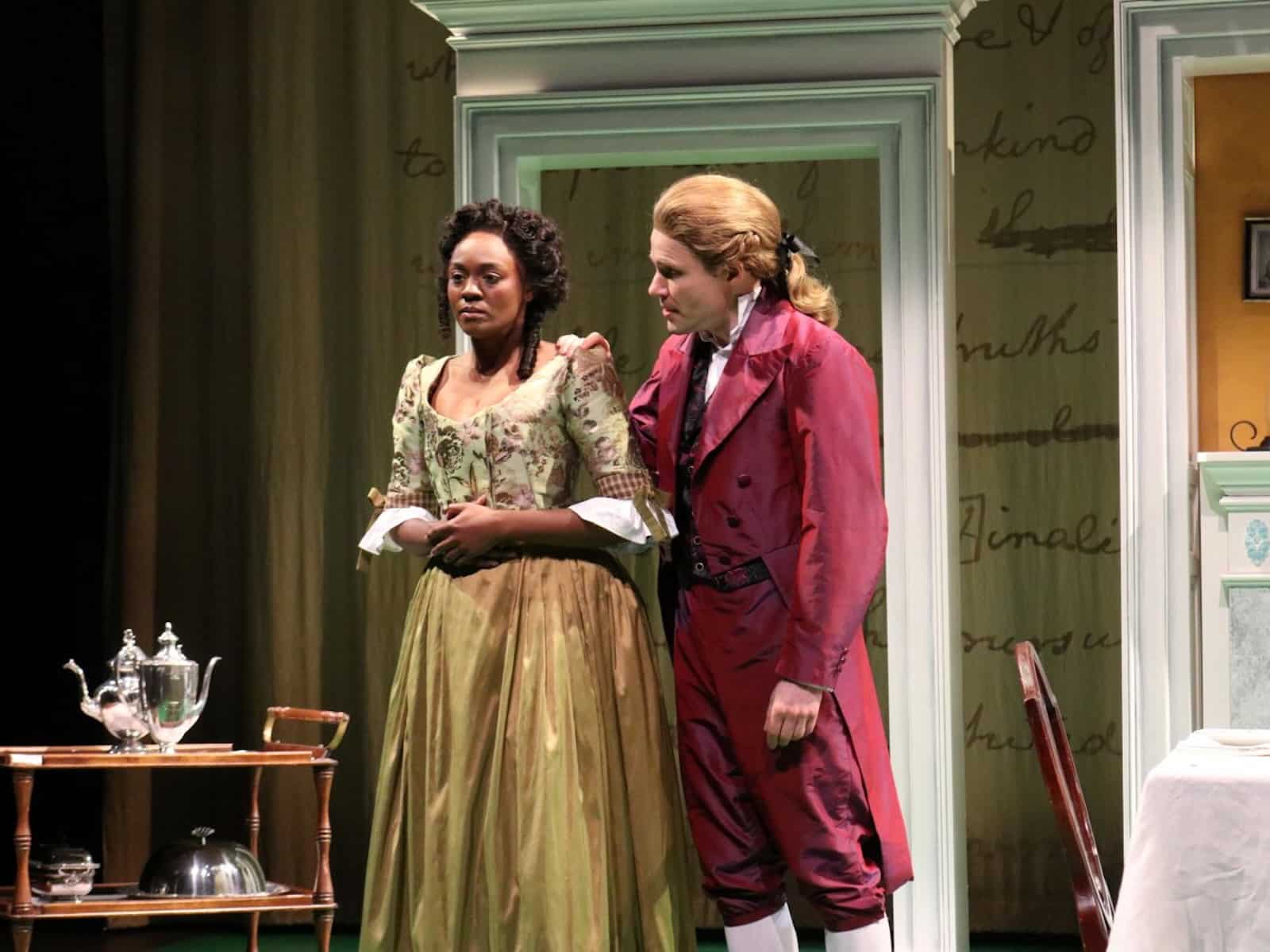
Parks piles on the dualities: Luce (Renea S. Brown, here), playwright of The Pursuit, plays Sally; Mike (Josiah Bania), the director, plays Thomas. The two collaborators are also a cohabitating romantic couple, and after years of uncompromising, uncommercial punk-rock theater, they and their castmates are weary of surviving on righteousness alone. Mike has found a wealthy investor for their ambitious new show, but the moneyman has notes. Specifically, he wants to cut the big speech by James Hemings — Sally’s brother, and Jefferson’s (enslaved) valet — that’s the one thing keeping Kwame, whose growing popularity as a screen actor has made him a big fish in this little brook, from walking away.
Ro Boddie, whose credits include a heartbreaking performance in Parks’ similarly American history–interrogating Topdog / Underdog at Round House two summers ago, delivers another magnetic turn here as James / Kwame. Kwame maintains it’s dramatically imperative that James unburden himself to Jefferson, who has repeatedly promised to free James from bondage but seems likely to renege. Director Mike, meanwhile, is sympathetic to his backer’s argument that it’s unlikely even a trusted, (relatively) privileged enslaved man like James would dare speak to his master so bluntly — and certainly not within earshot of another white man, as he does in the Pursuit of Happiness scene they’re debating. Colin Sphar is the most chameleonic member of the cast, playing the Good Company costume designer Geoff, negotiating a burgeoning romance with set designer Devon (Jamar Jones) while also playing the role of Cooper, a Jefferson contemporary who tries to persuade the founding father to sell one or both of the Hemings siblings to him. Jefferson is tempted. Like the Good Company, he’s got cash-flow problems.
There are more parallels to come — one too many, perhaps. It’s all more than a bit unwieldy, and director Timothy Douglas hasn’t cracked how to streamline it any more successfully than prior interpreters have. In the Monticello scenes, a projected blow-up of the Declaration of Independence appears behind the cast, with crossed-out words and other signs of revision to remind us that this indelible document was itself subject to an imperfect creative process. Later, the document will be displaced by a ledger of enslaved persons in Jefferson’s inventory. (The projections are by Delaney Bray.)

But peering through the wheeled, detached Colonial-style doorframes that form the bulk of designer Tony Cisek’s set, the more familiar dramas unfolding backstage are less compelling.
Kimberly Gilbert brings her usual spunk to the relatively small parts of Jefferson’s daughter Patsy and actor Ginger, who’s up for a role in an indie film. Charlotte Kim plays the other Jefferson sister, Patsy, and also Scout, an actor who wonders aloud whether Korean-Americans like her were a significant presence in 18th-century America. She’s the one who asks whether colorblind casting is a panacea for theater’s longstanding representation problem.
Anyone who finds these kinds of reflexive questions at best dull and at worst infuriating — see Jackie Sibbles-Drury’s We Are Proud to Present… for evidence of how disastrously wrong this vein of navel-gazing can go — would do well to give Sally & Tom a wide berth. Nothing here is as perceptive as the portrait of American schizophrenia that Parks created in Topdog / Underdog, or in her later Father Comes Home From the Wars trilogy, which Douglas staged at Round House a decade ago. Still, for all its visible seams, I found Sally & Tom entrancing in its paradoxes. Again and again, Douglas and his cast beguile us with a stirring scene from 1790 Monticello, only to deflate the effect by snapping us back to the mundane present. Here, we’re watching a group of talented but insecure artists — by which I mean the ones Parks has written — fumble their way toward something that feels truthful. In an attempt to reconstruct the interior lives of historical figures, the feeling of truth is the best we’re going to get.
Running Time: Approximately three hours including one intermission.
Sally & Tom plays through June 28, 2026, at Round House Theatre, 4545 East-West Highway, Bethesda, MD. For tickets (from $50, with ticket discounts available), go online, call the box office at 240.644.1100, email boxoffice@roundhousetheatre.org, or visit TodayTix.
The program for Sally & Tom is online here.
SEE ALSO:
Round House Theatre announces cast of ‘Sally & Tom’ (news story, May 4, 2026)
This Play Within a Play Confronts the Power Dynamic between Sally Hemings and Thomas Jefferson (by Chris Klimek for Smithsonian magazine, April 15, 2024)