
There are a lot of famous Shakespeare plays. The Tale of Cymbeline is not one of them, but the latest production of it by the Chesapeake Shakespeare Company (CSC) makes a strong case for why it should be.
To be fair, The Tale of Cymbeline is one of Shakespeare’s most rarely staged plays, in part because of how tricky it is to summarize with its many moving parts and interconnected plotlines. “It’s really a fairytale: an evil stepmother, a call to adventure, a death, a rebirth, and a return home,” notes director Ben Lambert, in describing the show. “Cymbeline is a roller-coaster; it’s messy, it’s funny, it’s romantic, it’s full of music and fights and magic.”
Indeed, Cymbeline is a bit of a roller-coaster, with moments of great comedy, stirring romance, and deep heartbreak. There are also quite a few sharp turns as new characters are introduced and connections established. A tragicomedy thought to be one of Shakespeare’s later plays, Cymbeline contains plot points that will be familiar to those with even the most basic familiarity with Shakespeare’s more famous plays: mistaken identities, a poison that makes it appear that someone is dead when they’re only sleeping, an invading army, an evil and conniving queen, some comically doltish characters, and an outright villainous trickster. But as the chorus in the opening scene helpfully tells us in modern English (CSC has modernized the script in places), “Spoiler alert: everyone lives happily ever after.”
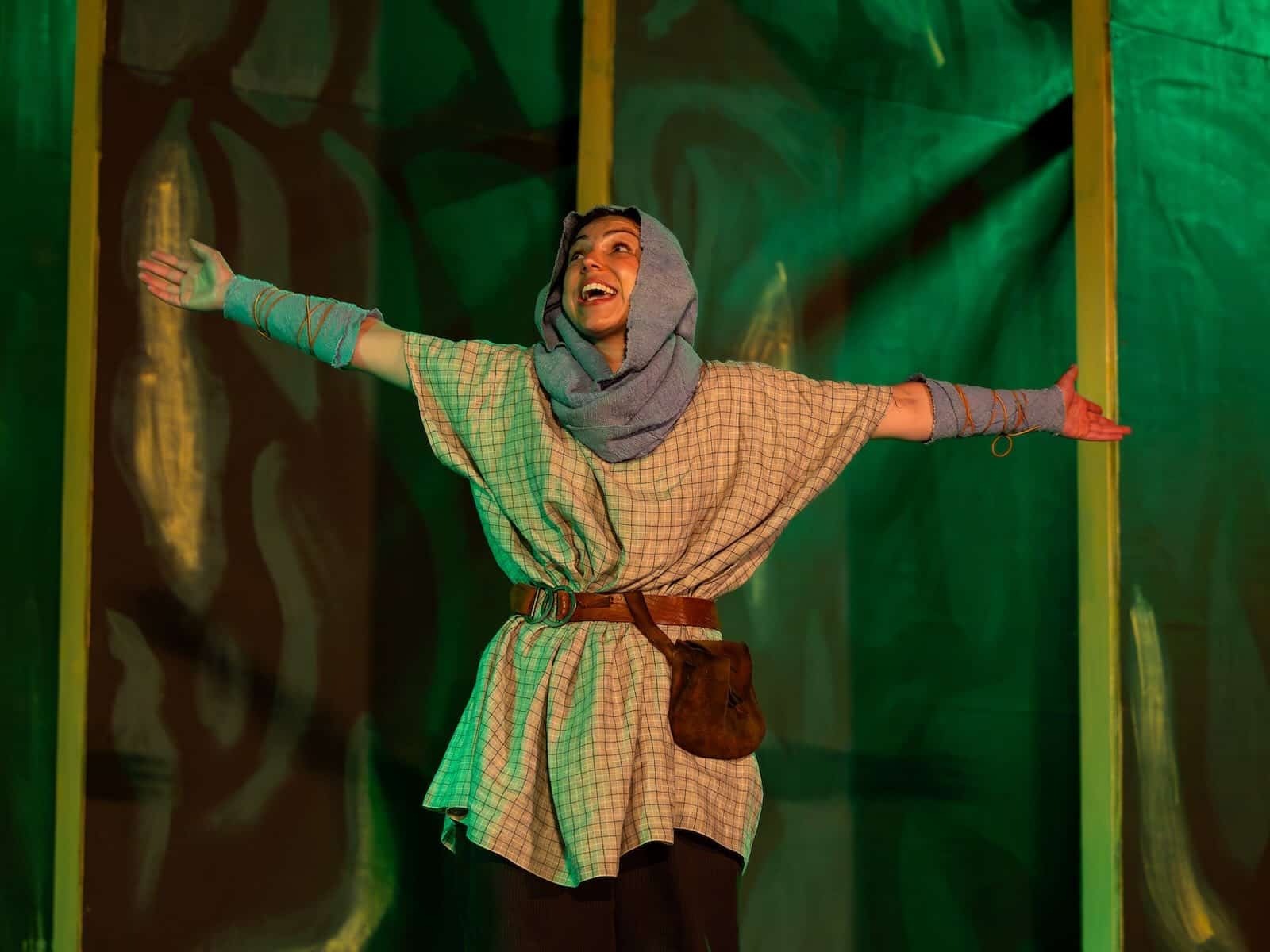
The show may be named after King Cymbeline (Samuel Richie), but its heart and true protagonist is his daughter, Imogen (Fabiolla da Silva). Princess Imogen is presumed to be Cymbeline’s only surviving biological child after her two older brothers were kidnapped as toddlers and never seen again; thus, there is great pressure regarding the person she will marry. Joshua Williams deftly doubles as both the commoner Posthumous, Imogen’s true love, and as Prince Cloten, Imogen’s nasty step-brother who seeks to marry her, by force if he must. From tone of voice to the physicality of each role, Williams clearly contrasts Posthumous’ earnestness and honor with Cloten’s vile ego and ineptitude. The dual role adds extra levels of humor to moments like Cloten’s jealous rant about Posthumus’ appearance (“the lines of my body are as well drawn as his”) or Imogen’s jibes at Cloten (“I chose an eagle and avoided an ostrich”).
The story’s main plot is set in motion by Imogen’s secret marriage to Posthumus. This enrages Cymbeline and his second wife, the current queen (Ali Haas), who is leading the charge to set up Cloten with Imogen and conspiring to ultimately eliminate Imogen and Cymbeline. Posthumus is banished and sails for Rome, where he ends up making a wager on Imogen’s chastity with the Roman soldier Iachimo (Lizzi Albert, though the performance I witnessed featured the show’s understudy, Brooke Donald, in the role). Iachimo’s deception convinces Posthumus of Imogen’s supposed infidelity and drives him to arrange for his servant, Pisanio (Abel Haddish), to kill Imogen. Instead, Pisanio helps her disguise herself as the male page Fidelus. While disguised, she encounters two men who turn out to be her long-lost brothers. From there, the plot continues to unfold, culminating in a battle between Britain and Rome that eventually brings the promised “happily ever after.”
The key to an excellent Shakespearean production — especially one as complex as Cymbeline — is how well the cast can communicate the emotion and stakes of a scene, even if the words themselves aren’t always the easiest to understand to the modern ear. The entirety of the cast succeeds in this, but they are truly anchored by the leads da Silva and Williams. Da Silva in particular embodies Imogen’s youthful love and strong will, even in the face of suffering, unwanted advances, and unwarranted rejection. Her face and body language clearly communicate the underlying emotion of every line with an earnestness that serves as the cornerstone to the entire play.
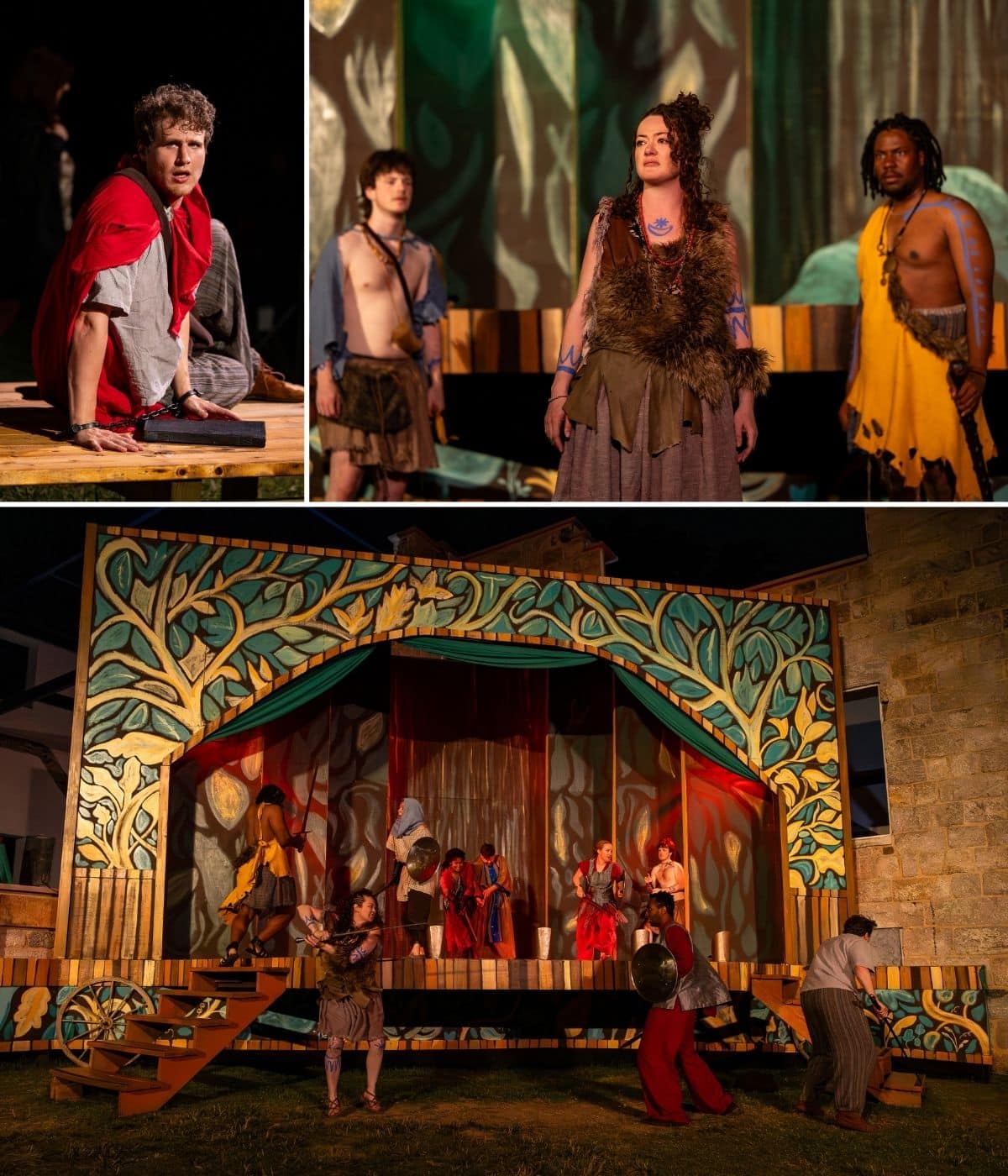
There are also moments where lines have been updated or added to help the audience understand just what is happening. For example, when the action first shifts from Britain to Rome, the cast offers helpful commentary (based on the original stage notes) while they reset the stage: “This is Rome! They are Italians! I am French!” Costume designer/wardrobe Hannah Brill’s use of color in costumes also helps greatly with these transitions: Britons are dressed in shades of green, Romans in red, and Imogen and her brothers are in blue.
The production takes place in a stage nestled among the ruins of the Patapsco Female Institute. The outdoor setting adds an enjoyable ambiance to the show (though also humidity and bugs; thankfully, CSC had bug spray available for those, like me, who forgot). The production makes full use of the venue. While most of the action takes place at center stage (a wooden construction painted with greenery, decorated at various times with tables, trunks, and curtains), a wooden wagon planted in the center aisle serves as a secondary stage, and battles and chase scenes occasionally happen through the side aisles as well. The main stage also features a trap door, used to great effect and adding another dimension to the stage design.
Any outdoor production is going to be at the mercy of the weather and the surroundings. CSC encourages guests to feel free to bring a picnic, and the seating includes a section on the outer edge reserved for those who want to watch while on a picnic blanket. This is what I did; I sometimes had a hard time seeing the action on the secondary stage as a result, which was to be expected, but for the most part, I had a good sight line. (I am nearly six feet tall, though, so that may be a factor.) Additionally, since none of the actors are mic’d, their vocal projection, while generally up to the task, was occasionally hampered by being in a dead spot on the stage or by other nearby sounds, such as planes and trains. Occasionally, background music (sound design by Chris Lane) on a speaker (used primarily for scene transitions but also during a few key moments in the action) also threatened to drown out the dialogue, especially for those sitting closer to the speakers. Those who are hard of hearing may want to sit as close as possible to the stage for the best experience.
However, the unpredictable reality of an outdoor stage can also add to the story. During our performance, a scene where Clotus attempted to use (bad) music to woo Imogen was comically punctuated by a train horn, and an incoming storm at the end of the show made the crowd’s applause literally thunderous. Lighting designer Dan O’Brien also did an excellent job ensuring the lighting adjusted as the natural daylight faded; it wasn’t until the lighting color changed for a scene involving a dream about spirits and gods that I consciously realized artificial light was even being used.
The combination of an excellent cast with a unique outdoor setting is perhaps one of the best ways to enjoy a work of Shakespeare, even (or especially) one as complex as Cymbeline. This production makes it easy to understand why the CSC has hosted Maryland’s longest-running outdoor Shakespeare event here for more than 20 years.
One content note: CSC encourages families to come — all kids under 18 get in free with a paying adult, and each Sunday performance features a Family Fun Day before the show that includes crafts, songs, and story time. However, in a pre-performance email to ticket holders, CSC noted a content advisory for kids under 13. There is a scene at the start of the second act involving beheading and associated props, as well as other battle scenes near the end of the production. There are also some sex jokes typical of Shakespeare that may not be suitable for younger kids.
Running Time: Approximately two hours and 30 minutes, with one 15-minute intermission.
The Tale of Cymbeline plays through July 19, 2026, presented by Chesapeake Shakespeare Company performing at the Patapsco Female Institute Historic Park, located at 3691 Sarah’s Lane, Ellicott City, MD. Adult tickets start at $55; tickets for youth ages 18–25 start at $29; and kids under 18 get in free (limit of two per paid adult ticket, max of four free kids). To purchase tickets, visit ChesapeakeShakespeare.com or contact the box office directly by calling 410-244-8570 or visiting in person at 7 South Calvert Street, Baltimore, MD. Discounts are available for groups of ten or more and for active-duty military.
The Tale of Cymbeline
By William Shakespeare|
Directed by Ben Lambert
CAST
Imogen: Fabiolla da Silva
Posthumus/Cloten: Joshua Williams
Cymbeline/Storyteller: Samuel Richie
Iachimo/Storyteller: Lizzi Albert
Belaria/Queen: Ali Haas
Pisanio/Storyteller: Abel Haddish
Guiderius/William: Lloyd Marcus
Arviragus/Adrian: Luke Douglas
Caius Lucius/Others: Elana Michelle
Understudy: Brook Donald
CREATIVE TEAM
Producer: Chesapeake Shakespeare Company
Director: Ben Lambert
Production Manager: Lauren Engler
Stage Manager: Colin Maher
Swing Stage Manager: Lauren Engler
Technical Director, Set/Lighting Designer: Dan O’Brien
Costume Designer/Wardrobe: Hannah Brill
Music Director: Grace Srinivasan
Sound Designer: Chris Lane
Props Artisan: Mason Dennis
Production Associate: Dawn Thomas Reidy
Fight Director: Jenny Male
Intimacy Consultant: Mel Gabel
Dialect/Text/Vocal Coach: Emily Erikson
Dramaturg: Abraham Stoll
Assistant Stage Manager: Ilana Mongilio
Assistant Technical Director: Chester Stacy
Technical Manager: Cameron Luther
Production Assistant: Audrey Russell
Production Intern: Ryan Macdonald
Senior House Manager: Pamela Forton