
If William Shakespeare lived in the 21st century, his sonnets would be raps, and his plays a remix of spoken word, beatboxing, DJ-ing, and hip-hop dance moves — everything from b-boying to popping and locking, freestyling to crumping. So says playwright Jacob Ming-Trent in his new hip-hop-infused recounting of the ways the Bard changed his life.
Shakespeare’s dramas and comedies remain timeless with compelling themes, characters, and plotlines. Filled with warring family factions, jealous lovers, overbearing parents and ungrateful children, invading armies and deposed royals, mistaken identities and star-crossed lovers, these plays remain a jewel of theater aficionados across the centuries.
And Shakespearean works have unexpectedly played a role in saving lives, too. At least one in particular: playwright and performer Jacob Ming-Trent. You may recognize him from Only Murders in the Building, Watchmen, or White Famous, but this actor, now turned playwright, is most at home performing classic Shakespeare. It’s what drew him to the stage, in fact.
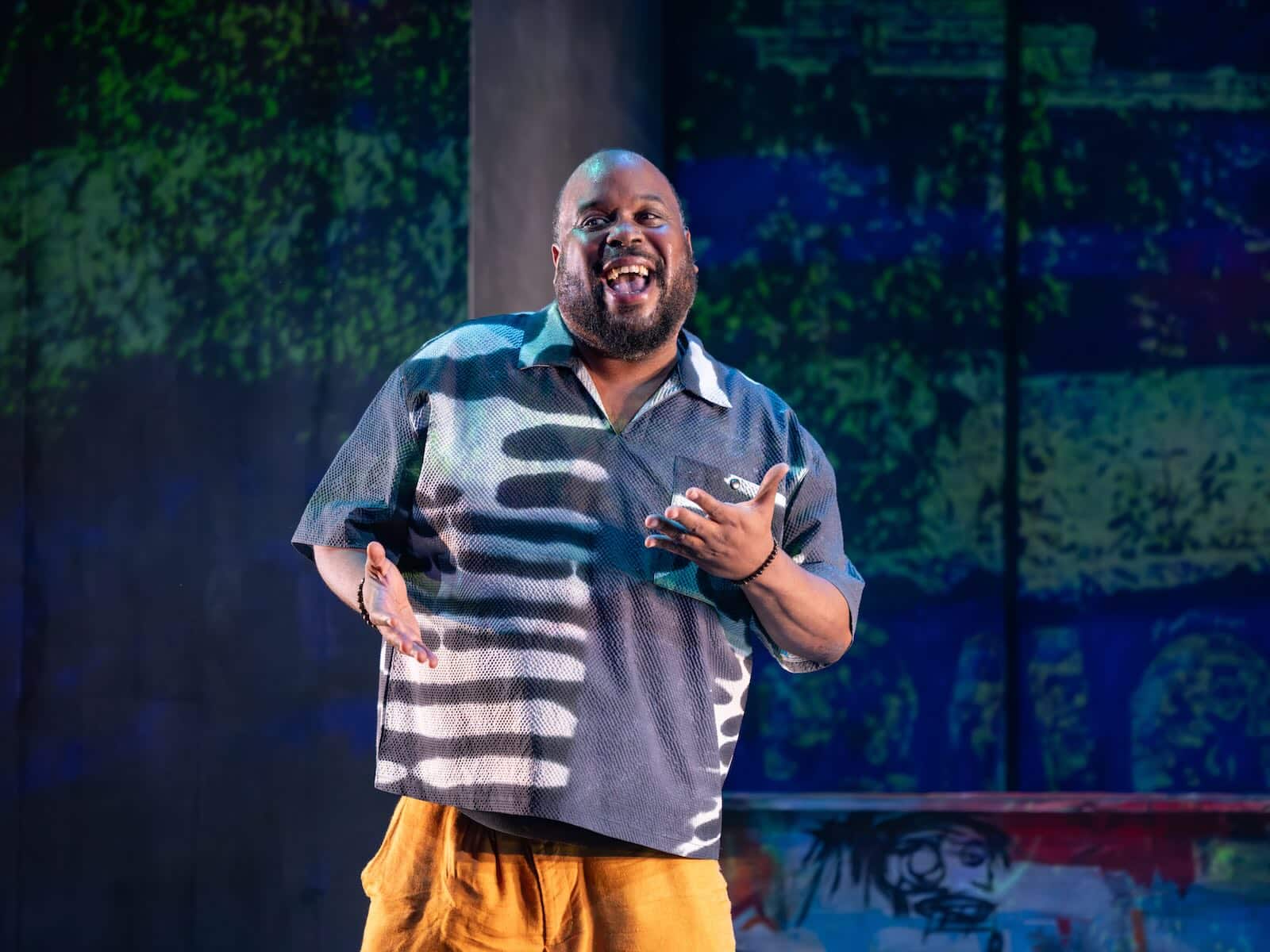
Therefore, what better place to bring his new work, How Shakespeare Saved My Life, than the hallowed and vaunted Folger Theatre, where, steps away, the Folger Shakespeare Library collection holds the largest collection of First Folios in the world, 82 out of 235. The Folger is, indeed, the house built for Shakespeare. And the rap- and pop-culture–infused How Shakespeare Saved My Life is the perfect work to shake up what some may consider the staid, arcane, and, OMG, even boring reputation the works hold, particularly among younger generations.
Ming-Trent is no stranger to the Folger, having appeared as the bombastic Bottom in its 2022 production of A Midsummer Night’s Dream. His latest turn in the DMV is co-commissioned and co-produced by the Folger and Red Bull Theater, with additional co-production credits from Berkeley Repertory Theatre. It, indeed, takes a village to launch new works these days.
This solo multi-character show draws back the curtain on the younger Ming-Trent’s serendipitous discovery of Shakespeare and follows the rocky road he traveled early in life, revealing how that discovery saved him from wallowing in the abusive experiences of his childhood. He is the man and actor he is today solely because his middle school English teacher challenged him to read a monologue from Henry V out loud.
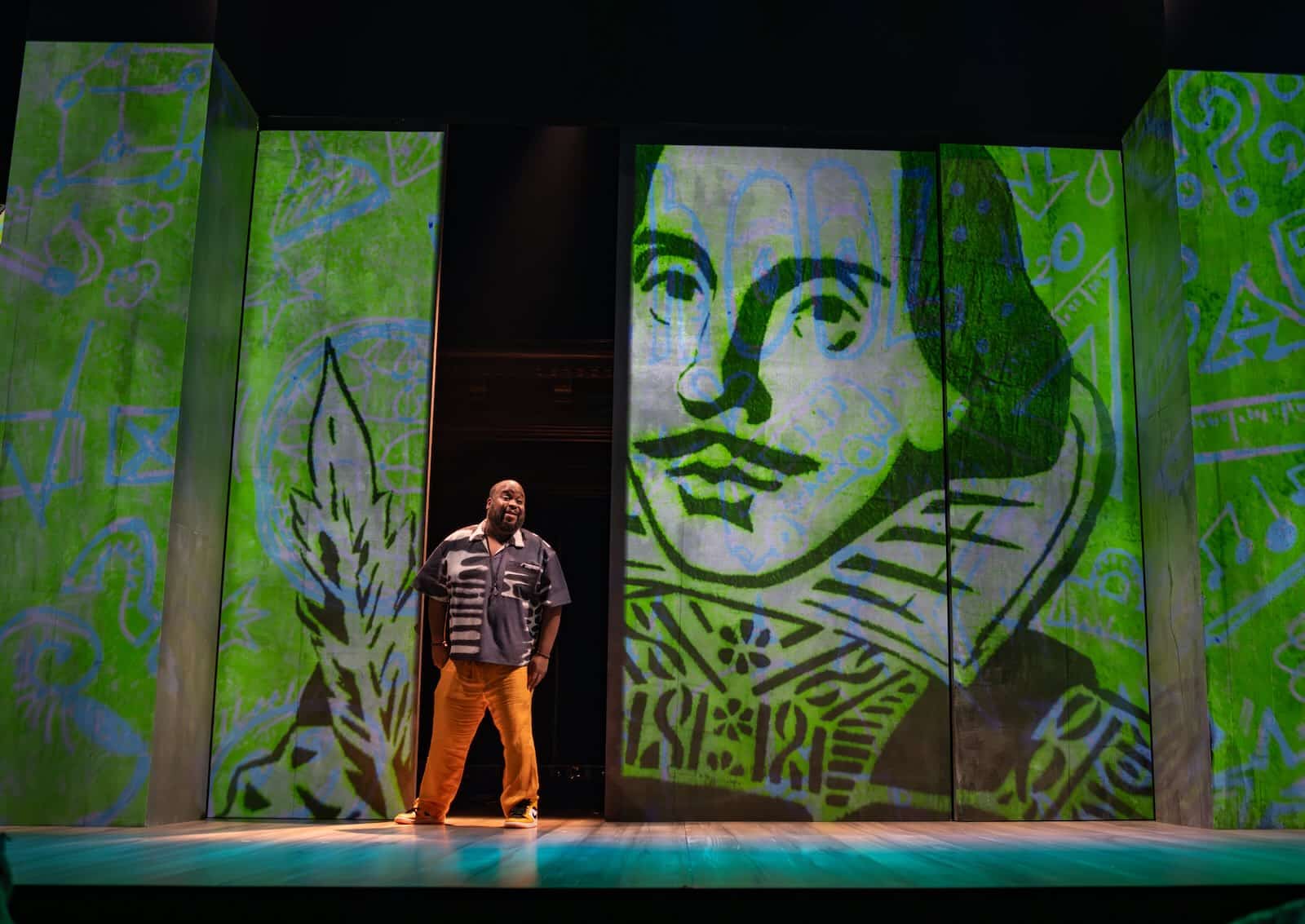
On Takeshi Kata’s mostly bare stage, a bench is framed by panels that become shifting landscapes via projections from Alexander V. Nichols featuring street- and pop-culture–inspired graphic and graffiti art. Original hip-hop beats and lyrics, plus ambient street sounds, composed and collected by Jake Rodriguez, complete the urban landscape in which Ming-Trent’s compelling personal tale unfurls. Director Tony Taccone, with choreographer Tiffany Rachelle Stewart, keeps Ming-Trent moving nimbly throughout the space, as he flips — Anna Deveare Smith–style — from portraying his proper but icy mother, to his smooth-talking, drug-taking dad, to his three gang buddies, each with unique quirks and vocal tics.
We meet Ming-Trent as he invites the audience into his world and acknowledges his ancestral and spiritual protectors. He calls on the audience as a congregation to play their part in channeling the past, asking viewers to shout out “Play on!” to keep them attentive to the twists and turns of his tale of woe and hope. Growing up in Pittsburgh with a demanding mother and an absent father who calls his son “Fat Man” — and, yes, Ming-Trent is wholesomely built, Falstaffian in size — we learn quickly that love and care are rarely doled out to this lonely son. His mom’s harsh advice: “You have to live life like you’re in danger.” On stage, Ming-Trent transforms into his 12-year-old past self, a fan of words and beats of Tupac and Biggie, but middle school English class, not so much his cup of tea. Until that English teacher/football coach thrusts a book in his hand and exhorts him to read.
“We few, we happy few, we band of brothers;
For he today that sheds his blood with me
Shall be my brother; be he ne’er so vile,
This day shall gentle his condition …”
This passage from Henry V is the king’s pep talk to his soldiers; no surprise the football coach liked it. More important, it struck a nerve in Ming-Trent. He understood in that moment the power that words penned 500 years ago can hold across cultural, historical, and practical divides. The actor remarked: “I woke up that morning a super-predator … but after that class, I was a Shakespeare prodigy.”
As he immersed himself in Shakespeare, he took on the mantle, introducing himself to all who would listen as a “Shakespearean actor,” alas, with no credits. Even as he ended up living alone, on the streets, the Bard’s words still fed him. At 17, he ended up in New York on his own, studying theater and facing rejection, not for his talent, but for his race and class: Shakespearean actors don’t sound like you, he heard from casting directors.
Ming-Trent is a nimble storyteller, weaving in high-end quotes from Shakespeare’s Ur texts with the ease that most high schoolers can finesse the latest TikTok trend. And he also astutely stitches in a shocking reveal that caused at least one audience member to audibly gasp the night I attended.
Shakespeare’s tragedies, in particular, in the best productions, allow attentive audiences to connect, empathize, and see themselves and others in a new light. Ming-Trent’s deep dive into Shakespeare leans into radical truth-telling as he learns to move on with a measure of forgiveness and a will to “play on.” In the Folger’s historic theater, Ming-Trent’s struggles and triumphs earn the same gravitas as those of Lear, Macbeth, and Hamlet, while making Shakespeare relevant to new and next generation audiences, uninitiated to the Elizabethan playwright’s work. How Shakespeare Saved My Life is his salvo to the next generation of theatergoers to find the same vigor, rigor, and connection to Shakespeare as they do in Kendrick Lamar, Future, and Drake.
Running Time: Approximately 90 minutes with no intermission.
How Shakespeare Saved My Life plays through July 5, 2026, presented by Folger Theatre at the Folger Shakespeare Library, 201 East Capitol St SE, Washington, DC. Tickets ($20–$79) and are available online, by calling the Folger Box Office at (202) 544-7077, or at TodayTix.
Credits for the cast and creative team are online here. The playbill is online here.
Accessible performances will be offered throughout the production’s run and are listed on the show page. Production includes the use of airborne haze, strobing lights, and recorded gunshots and is recommended for ages 13 and up due to adult language, situations, and conversations.
SEE ALSO:
Jacob Ming-Trent on his ‘bold and raucous ride through the past’ at Folger (interview by Marc Fjor, June 4, 2026)
Folger Theatre to premiere ‘How Shakespeare Saved My Life’ (news story, May 19, 2025)