There is no shortage of interpretive analysis about the deeper meanings in No Exit, Jean-Paul Sartre’s darkly existential 1944 drama, with its famously bleak line “Hell is other people” But reading up on the play recently, I was tickled to learn that the renowned French philosopher was prompted to write it not particularly because of its mordant message but because of quite theater-nerd practical circumstances: As he explained,
I had three friends for whom I wanted to write a play, without giving any one of them a larger part than the others. In other words, I wanted them to be together on the stage all the time, because I said to myself: “If one of them leaves the stage, he’ll think that the other two have better parts in his absence.” So I wanted to keep them together, and I said to myself: “How can one put three characters together without an exit, and keep them there on stage to the end of the play, as though eternally?” That’s when the idea came to me to put them in hell and make each one of them the torturer of the other two.
So like: Hey, actor chums, let’s put on a show — and have I got just the script for you!
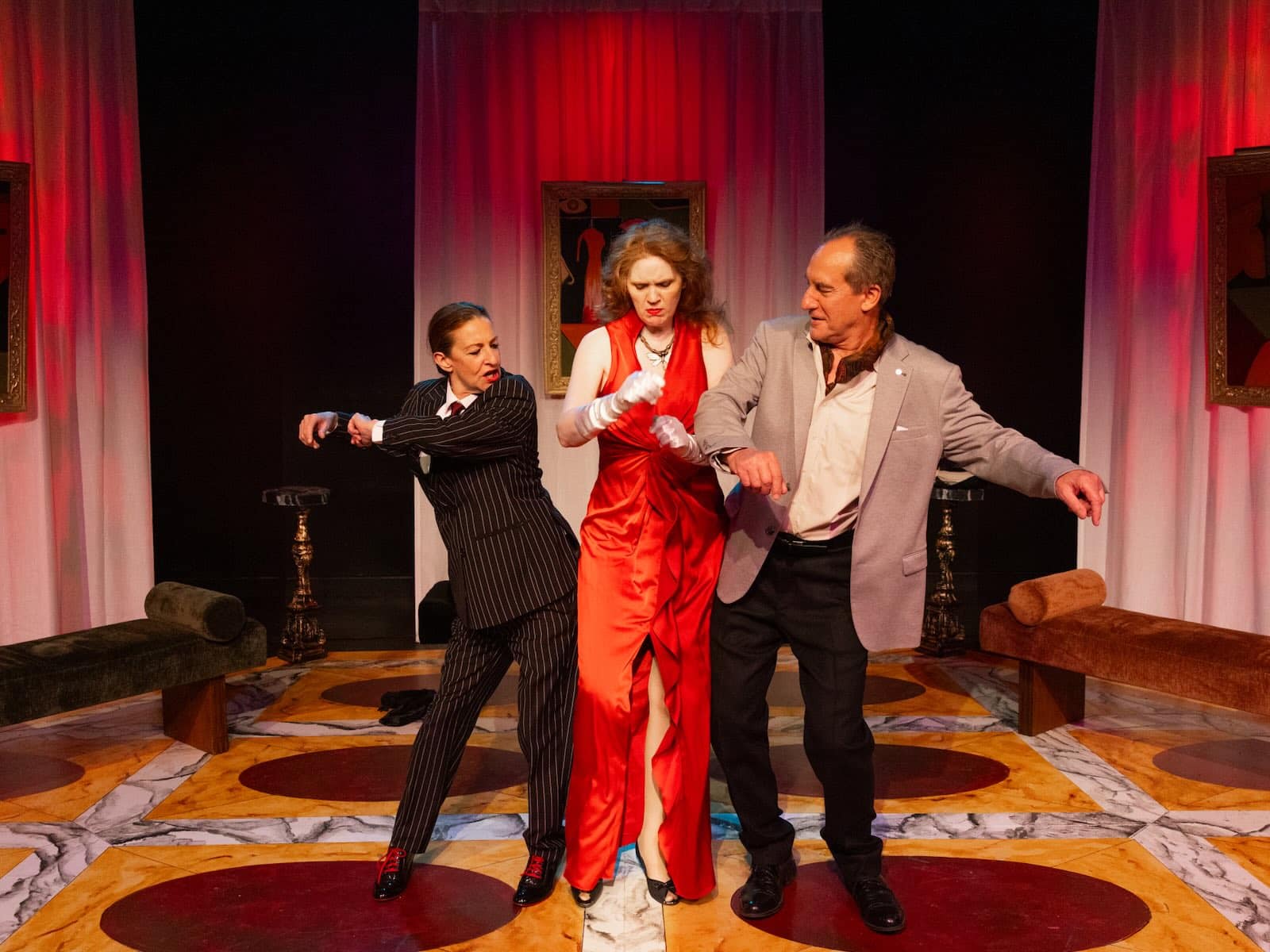
As I imagine Sartre’s friends’ impromptu delight in such play-acting, I sense it as the raison d’être of Scena Theatre’s droll approach to this classic of modern European theater: Yes, let’s say we’re stuck together in hell, but let’s see how much waggish fun we can have while we’re at it.
The colorful set that greets us in Lab Theatre II at Atlas Performing Arts Center certainly augurs whimsy. Beneath three vibrantly lit Miró-like abstract paintings, three sleek divans are arranged on an elegantly patterned marble floor, suggesting a flamboyant interior decorator’s touch (the inspired scenic design is by Carl Gudenius and Michael Stepowany). The story starts up when a bellhop-like Valet (Kim Curtis) shows a serious, sports-jacketed Garcin (Stas Wronka) into what Garcin fully expected to be a literal torture chamber from hell. While Wronka stays in straight-man character, Curtis adopts a sarcastic, supercilious tone: “Why would it be torture?” he asks, with an ironic amusement that points to the whole production’s bemused take on the play.
The next character to be shown into these well-appointed, forever quarters is Inez (a hilariously over-the-top Luz Nicolás). In her necktie, mannish pinstriped suit, and red-laced thick heels, she delivers a cartoonishly serpentine butch whose every glower or glance at the audience is a priceless comic turn.
Then who should enter next? one can imagine Sartre wondering, in his male-fantasy-fueled plotting. And who should he think of but a socialite with sexpot aspirations? She’d be the perfect complicator/complement to the het man and predatory lesbian already on the premises!
Alluringly begowned in burgundy and tossing her long locks, Danielle Davy as the dim and vain Estelle serves as the perfect enticement for the two others’ aroused attentions — even as she bemoans the fact that she lacks a looking glass in which to admire herself (the cleverly characterizing costumes are by Alisa Mandel).
They tease and taunt one another, including in some marvelous threesome dancing and twosome canoodling (choreography by Kim Curtis, intimacy coordination by Paul Gallagher). The light physical comedy is in fascinating tension with the play’s dark subtext.

Briskly directed by Robert McNamara as borderline erotica and parlor-game farce, No Exit as written is actually a deep dive into the dead-serious matter of moral culpability and humans’ tendency to worry shallowly about how they are perceived. Each of the three principals is well aware that they committed heinous crimes on earth that easily qualify them for eternal damnation — and that they now take turns disclosing. The play has been around long enough to make it not a spoiler to note, for instance, that Garcin was executed for desertion, Inez seduced her cousin’s wife, and Estelle killed her illegitimate baby, which led her lover to off himself.
They get why they’re in hell, in other words, but they do not like to say they are dead. They prefer to think of themselves as simply absent.
There are hardly any redeeming qualities among the lot of them. They really are stuck together forever. A low liquid drone underscores their plight; we hear a massive unseen door slam shut on them (the apt sound design is Brandon Cook’s). And each has plaintive, self-righteous monologues played to the house through the fourth wall (spotlit wittily in Carl Gudenius’s lighting design).
Decidedly dour as Sartre’s No Exit is, it still has an arguably secure niche in the dramatic canon. But why not just stay home and read it? Why leave one’s home sofa to spend time with three of the damned on their divans? Wisely, I think, Scena Theatre has very appealingly treated No Exit with a satirical smirk and raised eyebrow — and with the actors playing their characters as if in air quotes. The concept makes the theatrical experience the kind of pleasure through which audiences themselves come to life.
Running Time: One hour and 50 minutes, no intermission.
No Exit plays through July 19, 2026, presented by Scena Theatre, performing in Lab Theatre II at Atlas Performing Arts Center, 1333 H Street NE, Washington, DC. Purchase tickets (adult $50, senior $45, student $25, plus fees) online.
Content Warnings: This production contains mild use of swearing, references to self-harm, suicide, sexual assault, grief, and infant loss, as well as frequent sexual content and violence.
No Exit
By Jean-Paul Sartre
Translated by Paul Bowles
CAST
Garcin: Stas Wronka
Inez: Luz Nicolás
Estelle: Danielle Davy
Valet: Kim Curtis
PRODUCTION
Director: Robert McNamara
Assistant Director: Anne Nottage
Scenic Design: Carl Gudenius, Michael Stepowany
Lighting Design: Carl Gudenius
Sound Design: Brandon Cook
Costume Design: Alisa Mandel
Stage Manager: Danaeya Witherspoon
Fight Director: Paul Gallagher
Choreographer: Kim Curtis
Technical Director: John Traub
Intimacy Coordinator: Paul Gallagher
Original Art by Michael Stepowany