“Beetlejuice, Beetlejuice, Beetlejuice!” After debuting at the National Theatre in a 2018 pre-Broadway run, the “ghost with the most” returns to DC this month for a national tour stop at the same venue. Featuring a book by Scott Brown and Anthony King with music and lyrics by Eddie Perfect, the musical brings the iconic 1988 film to life in a unique theatrical adaptation. DC Theater Arts’ Julia Tucker spoke with the tour’s director, Catie Davis, about the creative process of bringing the legendary movie to the stage and the logistics of directing a musical across a variety of venues. This interview has been edited for clarity, length, and flow.
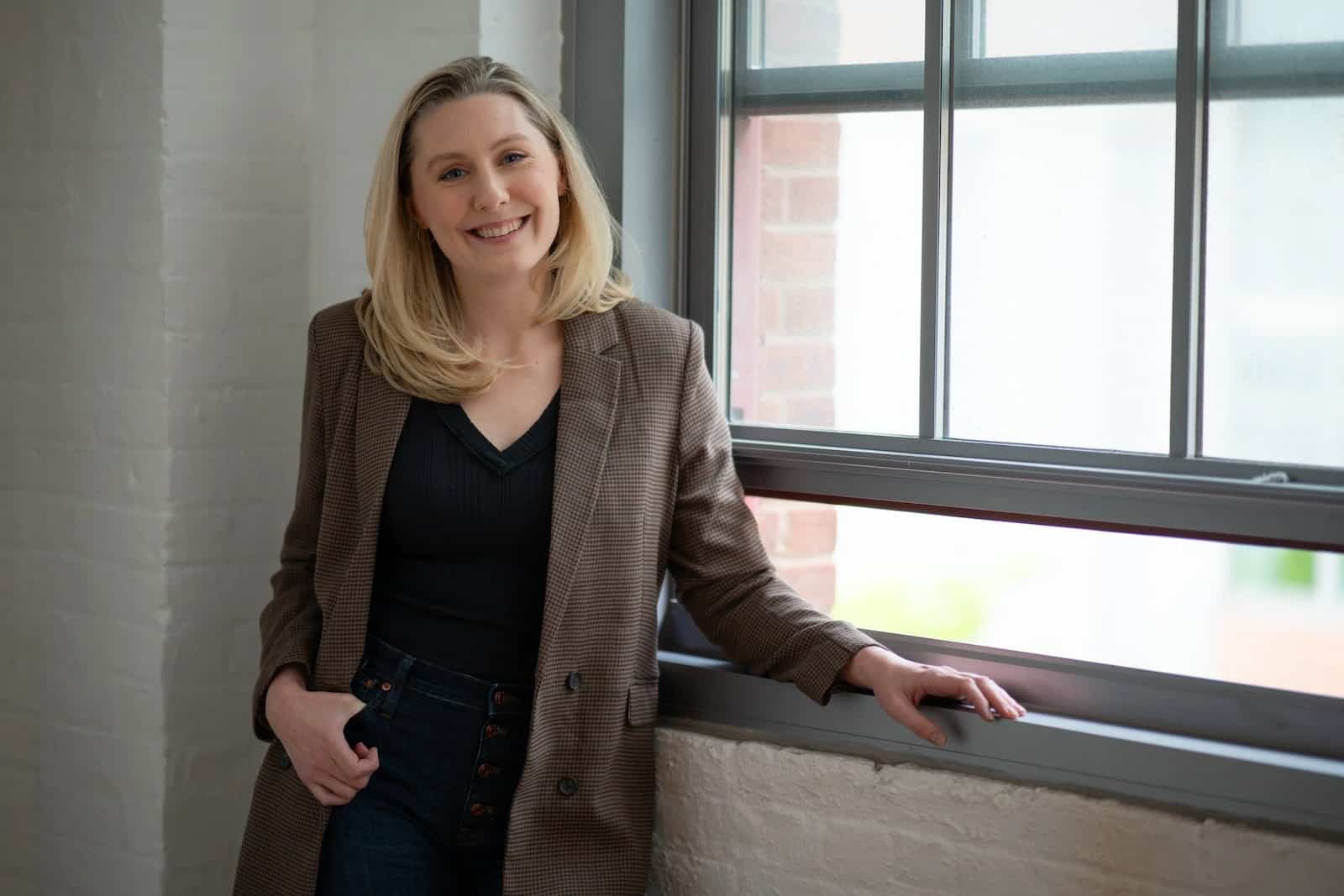
Julia Tucker: Beetlejuice has been a pop culture phenomenon for nearly 40 years. What have been the greatest challenges and rewards of bringing such a beloved property to the stage?
Catie Davis: I think with any phenomenon that has a built-in audience of people who already love these characters and the style and world of the show, there’s a certain expectation to meet the nostalgia — the expectations that audience members are coming in with — and I think that is both a challenge and a blessing. There’s sort of built-in excitement and fandom around something like Beetlejuice, and then it’s up to the creative team to deliver and give folks what they want. With Beetlejuice in particular, something that we focused on was trying to show the audience and fans that we also love it and make that really clear from the jump — that we love the same things you love about the show — whether that’s little Easter eggs of other hidden Tim Burton characters or some of the iconic lines from the film — so there’s a sense of trust and celebration of the original content while also riffing on it and making it original and new for the stage.
One of the rewards is seeing how the show continues to be received. I’ve worked on it since 2016 in early development, and the superfans that have supported it over the course of its run — which is now spanning eight years since we were originally at the National Theatre — celebrate every cast and every actor who has a different take on the role, and they’re really excited about seeing what everyone’s going to do with it. I think that sense of expecting something unique and different stems from that sense of what the original creative team built: that we love this, but it’s also going to be something new and exciting. That has rippled out, and I think that has contributed to the success of the show.
Beetlejuice has been on Broadway at the Winter Garden Theatre (2019–2020), the Marquis Theatre (2022–2023), and the Palace Theatre (2025–2026) — three very different venues with unique configurations. What was involved in adapting the production for each space, and how did those experiences prepare you for the flexibility required on a national tour?
The first two Broadway theaters (the Winter Garden and the Marquis) were effectively the same physical production. We were closed at the Winter Garden due to COVID shutting Broadway down, and the entire set, props, costumes — all of that went into storage. There was a significant amount of work required to move that production into the Marquis, but effectively onstage, we were looking at the exact same original production. We then had a number of productions before we returned to Broadway at the Palace. We had our first national tour, we went to Australia, we had a production on Norwegian Cruise Lines and in Korea. Those productions provided lessons about how to move the show and improve it over its original iteration.
What audiences saw at the Palace was effectively the first national tour. It was the cast of the first national tour, with just a few changes. It was most of the same physical production, but then we sort of plussed it up, and we added back some of the original puppets from Broadway — things that had been difficult elements to tour and to load in and out of a theater weekly got added back into the show. Every production has been a hybrid of things that we’ve learned and ways that we’ve had to adapt to meet the demands. Particularly, touring is the most arduous of any of these ways of setting up a production and has required us to be really flexible and creative with how the physical production, which is really large on this show — it’s a great visual spectacle — and yet it needs to be able to fit onto five-six trucks and get packed up over the course of 12 hours and move on out to the next city. I give a lot of credit to the folks who designed that and the crew that moves it week to week. I think that for audience members, the national tour delivers visually in a huge way, and it feels like a big Broadway show onstage despite the fact that it is able to jigsaw its way into these trucks.
You’ve directed many contemporary musicals, including numerous new works. How did directing Beetlejuice, a story that audiences already knew and loved, differ from developing a brand-new musical from the ground up?
I’ve worked on Beetlejuice since 2016. I was the associate director (to our incredible original director, Alex Timbers) through its development and all of its past productions. I learned so much from him in the way that he adapted the show. As I mentioned earlier, the challenges of adapting something where there’s already an audience expectation — a way that we often thought about it was imagining we were creating fan fiction. There’s characters and events that happen that we already know about; some of those are included in our show; some we might imagine happened before or after the musical that are part of the world of what we’re doing. Then, we’re adding to it and getting to show audiences even more of the lives — the happenings to these characters that we all know and love.
When I compare that to developing a brand-new musical, there’s a lot of overlap. It felt like we were doing something new in many ways, even though we were working with existing IP. We had those audience expectations we had to meet. That is sort of a shared language — people coming to see Beetlejuice who have any sense of what the original film was, they have a sense of its whimsy and its dark humor. There is an understanding of what we think the show is going to be tonally and a shared touchpoint reference to the original film. That is helpful in many ways, especially when you’re marketing something, to say, “We already all know what this is.” I think more often than not, it played into our favor. I think developing and marketing a brand-new musical that no one’s heard of is much harder, but it also comes with the challenge of having to deliver and meet those expectations.
Beetlejuice had its out-of-town tryout at the National Theatre in Washington, DC, in 2018 before making its Broadway debut the following year, and the creative team made significant changes during that process. For those who saw the original DC production, what makes this version worth seeing again? What kind of theatrical experience can first-time audiences expect?
We learned so much doing the show out of town in Washington, DC. We had developed it sort of in a bubble — you develop a musical with just the same team and small group of people working on it. An out-of-town tryout is the first time that we get to experience an audience (who may or may not know anything about what they’re about to see) coming in and giving us feedback. Sometimes, you do out-of-town tryouts and the team only makes minor changes, but what was so remarkable about this team of writers and creatives was that we did the out-of-town, we learned a lot, and everyone was willing to roll their sleeves up and try to make the show even better.
A big shift from what we originally presented at the National Theatre to what folks will see there now is that we’ve centered the story on Lydia, a curious, dark, and mischievous teenager reeling in the aftermath of her mother’s sudden death. We center her story and her reconnection with her father. I think that made the show even more accessible — it not only delivers on all the comedy and mischief, with Beetlejuice still front and center for much of the show, but it also has a real emotional impact that I don’t think people expect when they come to see the musical. Not only to get the spectacle and the comedy, but also to be deeply moved by the profound reconnection between a father and daughter as they work through their grief is really touching. I think that’s why people have recommended the show and why it’s run for as long as it has. For folks who saw it before, it has everything that they loved about Beetlejuice — the spectacle, puppets, and mischief. It has even more of Lydia — it has new songs, revised characters; it’s really not the same show they would have seen before. For folks who are coming to see it for the first time, the show is highly theatrical. It has incredible production value, so you’re going to see a big, splashy Broadway show with puppets, special effects, video content, and all the bells and whistles. It’s mischievous and darkly funny. Our writers (Scott Brown and Anthony King) write a lot for television and have a dark sense of humor that we don’t often see in musical-theater comedy, so it really delivers in that way as well. It’s a show the whole family can enjoy — it’s not so violently inappropriate that you can’t take them. There’s a lot for adults that will also just go right over young audience members’ heads, so it’s a great time for all.
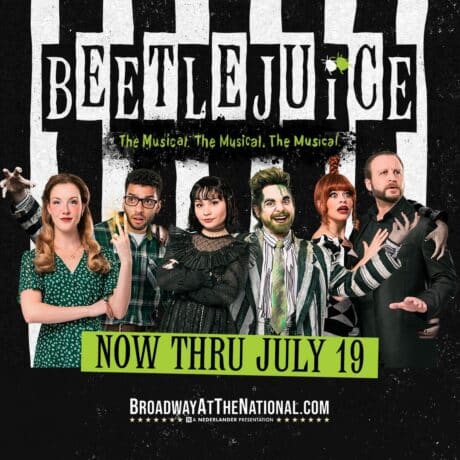
Beetlejuice plays through July 19, 2026, at the National Theatre, 1321 Pennsylvania Ave NW, Washington, DC. Tickets are available online or by calling Broadway at The National at (202) 628-6161. An audio-described performance is offered July 12 at 7:30 pm, and an ASL-interpreted performance is offered July 16 at 7:30 pm.
Running Time: Approximately two hours and 30 minutes, including intermission.
Note: Recommended for ages 13 and up. Parental discretion advised. Contains strong language, mature references, and a lot of the crazy, inappropriate stuff you would expect from a deranged demon.
Cast and creative credits for the North American tour can be found here.
Beetlejuice
Music and lyrics by Eddie Perfect. Book by Scott Brown and Anthony King. Music supervision, orchestrations, and incidental music by Kris Kukul. Tour direction by Catie Davis; original direction by Alex Timbers. Tour choreography by Michael Fatica; original choreography by Connor Gallagher.