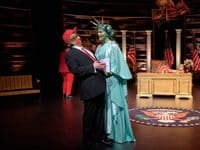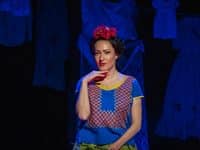
I return to the glasslike Lake Otsego and Glimmerglass, a summer festival of opera and other musical theater offerings, and each year I can’t help but feel I’m coming home. The green rolling lawn gently slopes up on one side to rustic barns that serve as scene shops and dorms to many of the top young artists and interns culled from around the country. The central airy Alice Busch Opera Theater, with its iconic walls that slide shut moments before a performance, brings locals together with Manhattanites, New Englanders, and those from farther-flung places — some who have made this cultural pilgrimage for years. And why? Many will tell you it’s because this is where magic happens, and the audience is very much part of what makes it so.
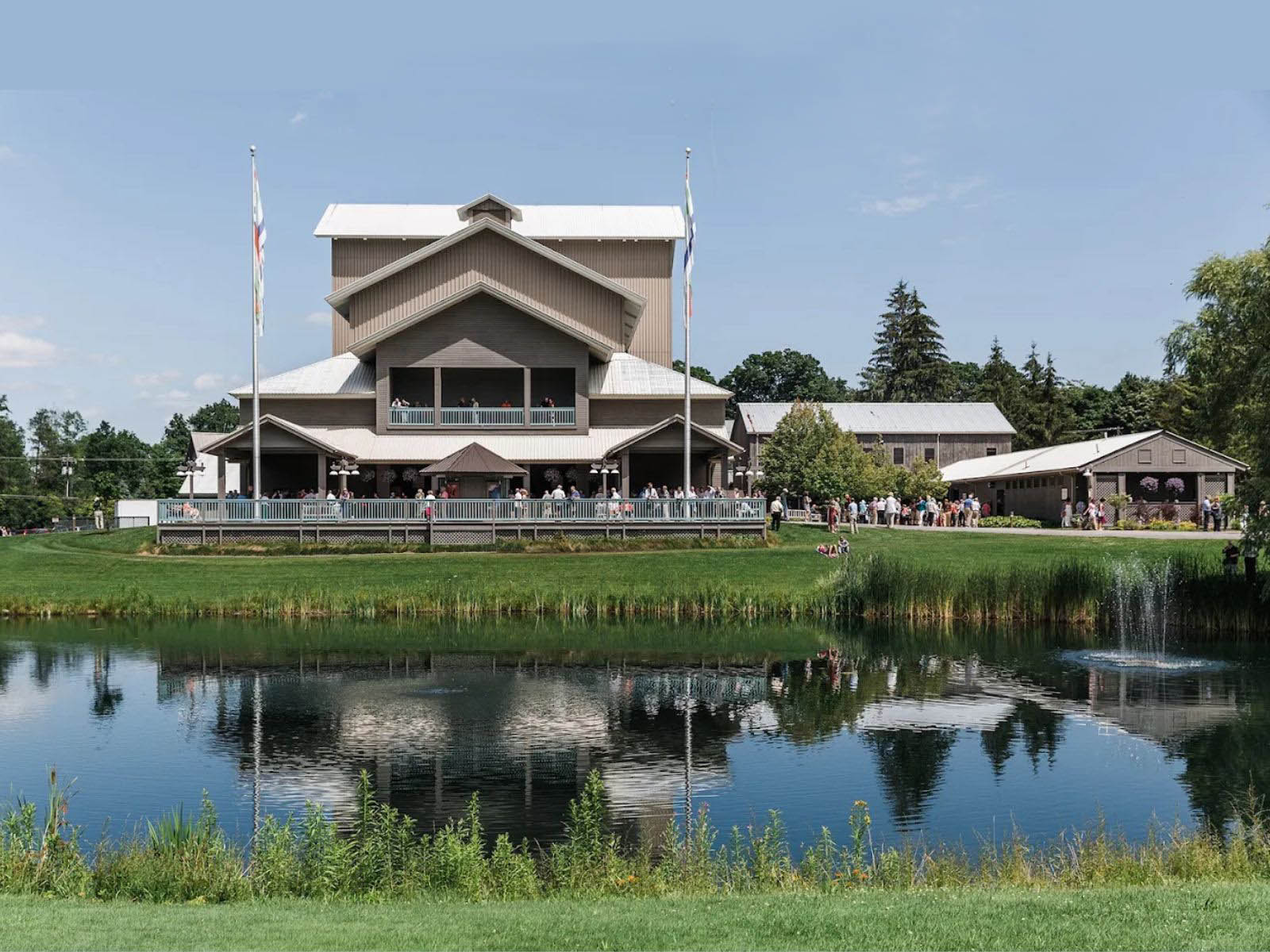
This year, however, the magic received a big threat due to wildfires in Canada and winds that blew harmful particles through this valley, particularly nasty for sensitive operatic vocal cords and other wind instruments. Saturday afternoon’s opening of the contemporary opera Fellow Travelers was postponed and Saturday evening’s performance of Oklahoma!, looking dubious, was put on hold. An announcement was made that a final decision would be made late afternoon, and confabs would take place to see if “some songs” might be offered “somewhere safely indoors.” (I should have known, however, that this intrepid company would find a creative solution, as it had done so admirably during COVID. The show did go on at the local high school where the company had started years ago, and, on three hours’ notice, complete with restaged choreography, audience members who had kept the faith were treated to some theater magic in what was described as “a brilliant Oklahoma!”)
Mozart’s Così
Nevertheless, lucky for me, I did catch two of the season’s mainstage offerings. Friday night, we took in a new production of Wolfgang Amadeus Mozart’s Così, with the original libretto by Lorenzo Da Ponte given an update in English by the inventive wordsmith and awesomely talented artist Kelley Rourke. She has proven an able and longtime collaborator with both Glimmerglass and Washington National Opera, and for this reinvention, she has captured lightning in a bottle.
I’m not one to suggest that all works from “received repertoire” (the classical Western-European operatic canon) always need updating, but some might agree with me that the original plot of Così fan tutte is unnecessarily complicated, full of implausible disguises and other silliness, especially in the second half. Indeed, by setting the story on a small college campus where football is king and two jocks are the heartthrob heroes, Rourke has, I believe, solved several problems. Not only are over-the-top coed love relationships plausible and amorous campus crushes — complete with a little early wandering “experimentation” — understandable and forgivable, but the two female leads, in the characters of Fiordiligi and Dorabella, seem less like capricious socialites, and more like new “roomies,” hungry for adventure in their first time away from home. Despina, instead of being the maid, brings the theme of inequitable social classes to the role and comes across as being something of a campus social director or perhaps graduate student dorm mom. Her worldly advice seems sensibly justified, coming from a place of seeing college as a rites-of-passage stage, encouraging the young ladies not to get tied down too soon but to spread their wings a little and enjoy their new adult freedom.
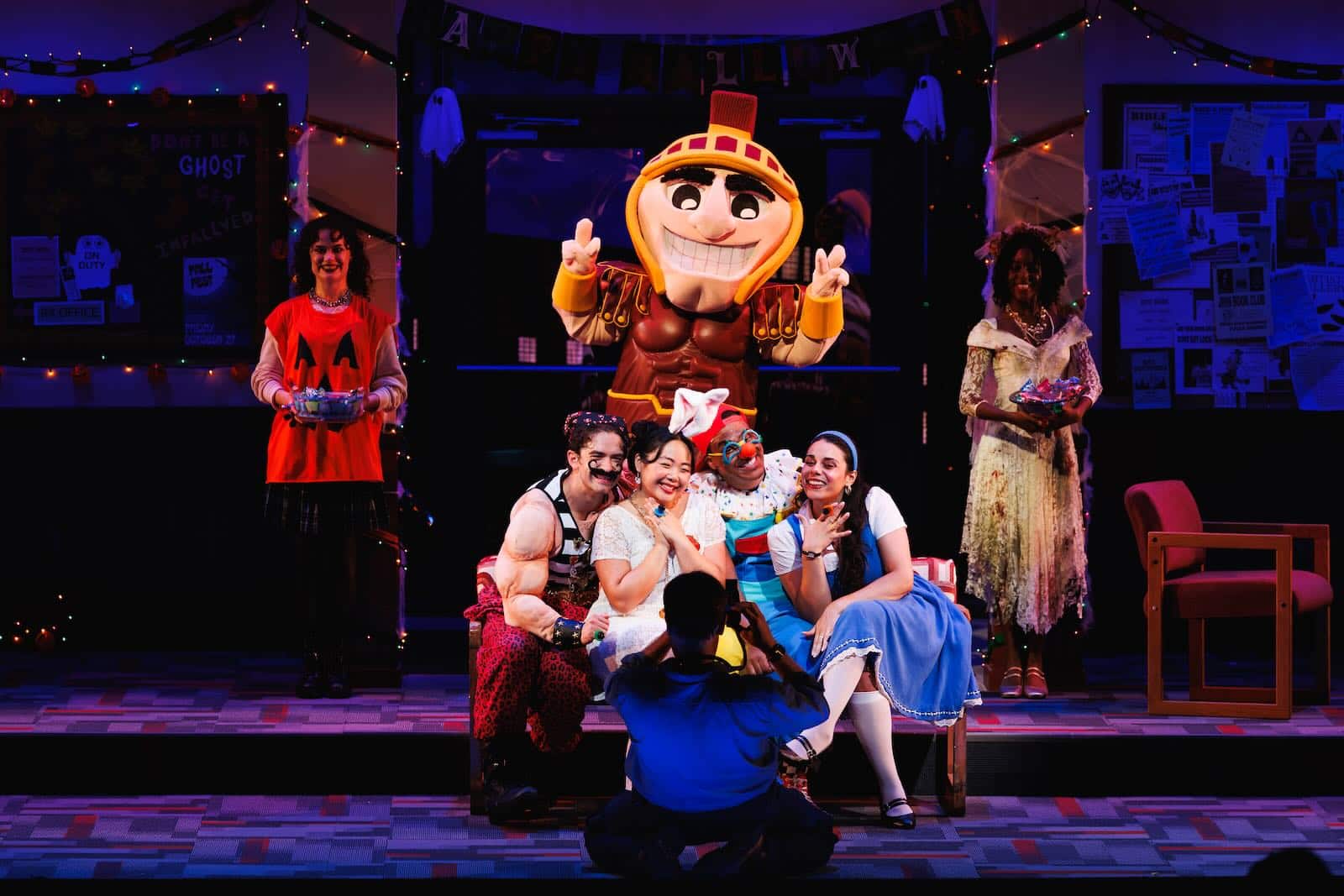
Set designer James Rotondo has given us a perfect dollhouse cut-out of a dorm building, with two rooms below representing the shared social spaces, which director Eric Einhorn and choreographer Madison Manning keep filled with ensemble business, reminding us that actually going to classes is a highly overrated myth to many embarking on undergraduate life. I especially enjoyed the staging in the second-floor bathroom, both in front of the mirror in Narcissus-like self-idolizing and the heartbreak scene featuring a weepy and mortified Fiordigili sitting alone in a bathroom stall. Surely these sensitively staged and beautifully acted scenes touched others in shared cultural memories!
The singing from this youngish cast posing as coeds — Amanda Batista, Michelle Mariposa, Travon Walker, and Gregory Feldmann — is fresh and delightful. Keely Futterer makes a keen and entertaining Despina, while keeping her warm and forgiving of her young wards. And, of course, Mozart’s music is glorious, conducted with sparkling vivace by Maestro Joseph Colaneri.
The casting of Kevin Burdette, who serves as artist-in-residence this season, perfectly anchors the production. His Alfonso, who masterminds the whole wager by testing the fidelity of women, is here a campus janitor, commanding not by station but by trusted experience, and not as creepy and cynical as sometimes played, with touches of a tongue-in-cheek comic clown. He operates with a light touch as if he has seen it all before. Burdette’s approach balances the tone and themes of the production, including pointing out the prone-to-infidelity of young males as well as females. Così fan tutti — such as it is. Very così indeed.
Puccini’s Madame Butterfly
This year’s new production of Puccini’s Madame Butterfly is a whole other matter of consequential gravitas. Directed by WNO Artistic Director and former Glimmerglass Artistic Director Francesca Zambello, this Butterfly floats: that is to say, the production achieves a timeless and exquisite state of being.
Madame Butterfly is an opera not without its own producing challenges, especially in our era. Now one must ask, Is it a story about the white male fantasy for “exotic” (and acquiescent) Asian women? Is it an ongoing indictment of Western imperialism? Cultural appropriation? I’ve not seen many updates that work. One relatively recent production used contemporary Japanese American artist Jun Kaneko’s vast geometric backdrops, which, to my mind, only served to garishly dwarf the singers and distract from the story.
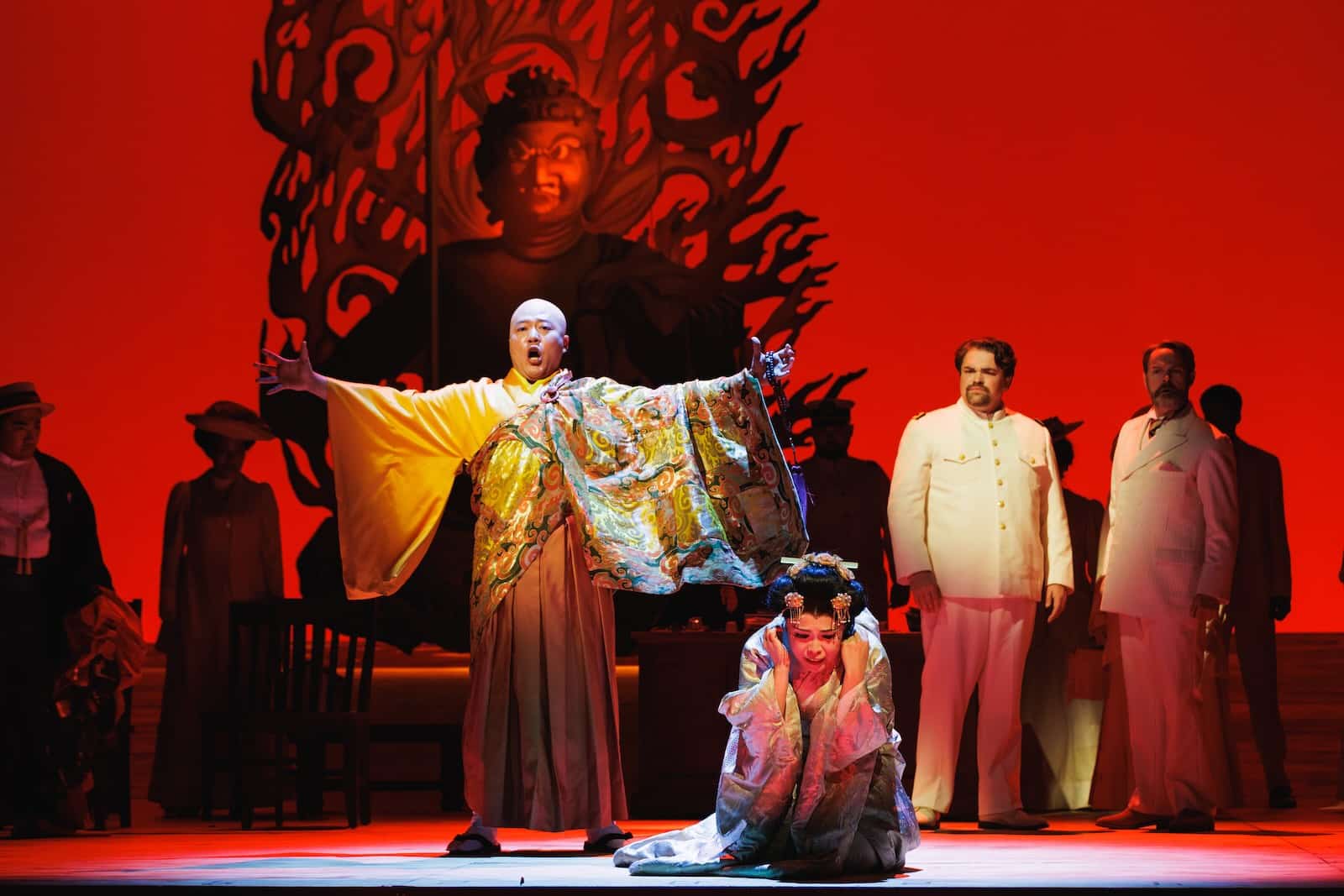
This production’s minimalist approach — by design team Michael Yeargan (sets), Robert Wierzel (lighting), and Anita Yavich (costumes) — has wrought a collaboration of pure ethereal beauty. These artists kept the aesthetic of traditional Japanese screens but invented multi-storied panels of lighting that suggest something modern and airy. They also included historical touches such as 1904 Western-period fashion in shades of ecru and white and roll-on desks and waiting room chairs to represent the newly opened American consulate. But for the entire second half, the stage is bare, becoming an abstract plane of memories, with only a projection of a round, hazy disc of yellow struggling to break through (as our own surrounding air struggled through atmospheric toxicity). So, when the final tragic scene unfolds, and the stage floor turns blood red while a red silk curtain descends and fills the proscenium, only to be ripped down by a stricken, guilt-ridden Pinkerton — a man who had thought he could rent a wife and dispose of her as easily as he had broken the long overseas lease of his love nest without repercussions — it is electrifying.
Without gimmicks and/or contemporary political or social commentary, Zambello directs Madame Butterfly with loving respect for Puccini and some of the most beautiful music ever written for opera, letting the music shine.
Eri Nakamura is the geisha Cio-Cio-San who marries American Lieutenant Pinkerton and, renounced by her family, falls deeply in love with a dream of love and hope for finding a new identity as an American wife. Nakamura’s pure and sure soprano voice starts out tender and expressive, full of all the hopes and pathos of a young girl bride, then builds in power until it rends the air with tragic emotion. What a gift!
Michelle Mariposa is Suzuki, companion and lady-in-waiting, rendering a heartfelt character who worries and prays, watching what she knows in her heart to be a tragedy unfolding. The famous Flower Duet is especially moving.
Tenor Eric Taylor plays Pinkerton, and, in naval whites, proves impressive in figure and voice, a commanding presence. It is a tricky challenge not to make the man extremely unlikeable and untrustworthy from the start, which I think upsets the hopes in the story. Taylor manages to convey an ardent infatuation, convincing himself this could be love and that he is a decent man, which changes to remorse when he confronts the tragic outcome he has wrought.
Troy Cook as Sharpless, Randy Ho as the wily Goro, Joseph Park as Prince Yamadori, and Erin Alford as Kate Pinkerton, plus others in the cast, do their parts admirably. The Festival Chorus comes into focus in what is known as the Humming Chorus. It’s all quite lovely. But the story is Cio-Cio-San’s ultimately and her decision if she cannot live without love or honor…
While my experience at this festival season was somewhat truncated, I would not have missed these two operas and am glad to report that Fellow Travelers and Madame Butterfly will be part of the upcoming WNO season in Washington. Meanwhile, there is still time to catch the remaining season at Glimmerglass now through August 17.
For more information on the Glimmerglass Festival and for tickets, go to Glimmerglass.org.
Così
Music by Wolfgang Amadeus Mozart, Original Libretto by Lorenzo Da Ponte, English adaptation by Kelley Rourke
Conductor: Joseph Colaneri, Director: Eric Einhorn, Set Designer: James Rotondo, Costume Designer: Beth Goldenberg, Lighting Designer: Kate Ashton
CAST: Amanda Batista (Fiordiligi), Michelle Mariposa (Dorabella), Travon Walker (Ferrando), Gregory Feldmann (Guglielmo), Kevin Burdette (Alfonso), Keely Futterer (Despina)
Presented in English with English projected titles
Running Time: Approximately three hours, including a 25-minute intermission.
Madame Butterfly
Music by Giacomo Puccini, Libretto by Luigi Illica & Giuseppe Giacosa
Conductor: Joseph Colaner, Original Production Director: Francesca Zambello, Revival Director: Joshua Horowitz, Set Designer: Michael Yeargan, Costume Designer: Anita Yavich, Lighting Designer: Robert Wierzel
CAST: Eri Nakamura (Cio-Cio-San), Eric Taylor (Lt. Pinkerton), Michelle Mariposa (Suzuki), Troy Cook (Sharpless), Randy Ho (Goro), Joseph Park (Yamadori)
Presented in Italian with English projected titles
Running Time: Approximately two hours and 40 minutes, including a 25-minute intermission.