
By Kerry Epstein
Stage management is the art behind the scenes. It is magic happening when you say “go.” As a stage manager, I facilitate all aspects of the creative process for a production, from rehearsals to closing. I manage effective daily communication by sending schedules, notes, and reports. I ensure safe and artistically accurate executions of each performance by cueing all the light changes, sound effects, and moving scenery. And I solve problems in a proactive and creative manner.
But what does that all mean? Let me walk you through a production timeline from a stage management perspective. The process is the same for each show, but the internal components vary wildly.
Prep Week
The week before rehearsals start is stage management prep week. I meet with the other members of the stage management team. Typically I work with two additional people, either two assistant stage managers or an assistant stage manager and a production assistant. Assistant stage managers, like myself, are members of Actors’ Equity Association, the union of professional actors and stage managers in the United States. A production assistant is typically in their stage management journey and not yet a union member.
The three of us will figure out our working rhythms so that we can each support the show in our own unique ways. We read the script like detectives hunting for clues. Then we generate prop lists, scene-by-scene breakdowns to note which characters are in which scenes and songs, figure out what costume pieces would be helpful to have in the rehearsal room (spoiler: it’s always shoes), contact actors and designers, and make calendars. Lots of lists, lots of spreadsheets. Attention to detail is key! Not to mention a slightly unhealthy fascination with office supplies.
Rehearsals
A typical rehearsal process is three weeks, Tuesdays through Sundays from 10 am to 6 pm. Those times are actor start times. The stage management start time is “a little” before and “a little more” after. We arrive early to prepare the space for whatever we are rehearsing that day. My team and I have eyes all over the room, noting entrances and exits, writing down where each performer stands or how they move in each scene (this is called “blocking”), tracking where props start and where they end up, estimating how long actors need for costume changes between scenes, and observing actor/director conversations about character intentions. I keep an eye on the clock to make sure the room is adhering to breaks as set forth by Actors’ Equity Association. If it’s a new play or musical, I’m also keeping an extra ear out for added lines from the playwright. Sometimes these are sneaky conversations that happen in the corner of the room; sometimes it’s a discussion with everyone. It’s important to track the new lines not only to make sure everyone has the updated lines (maybe we are individually writing the new words or phrases in our scripts, maybe it’s a large enough change that we need to print new script pages for all). One new line or lyric can mean a new prop, a new costume, or a change of mood for the lighting design.
At the end of each day, I’ll meet with the director, choreographer, and music director to figure out the next day’s schedule. In addition to rehearsal, there are often costume or wig fittings that need to be incorporated or previously approved conflicts. It’s a big, challenging scheduling Tetris, and it’s hugely satisfying to crack that puzzle. This schedule (aka the Daily Call) gets emailed to everyone on the production. Then the stage management team debriefs and shares information gathered throughout the day. I’ll email out a report to the designers and production staff summarizing everything that happened during that rehearsal day, what discoveries we made, any new line changes, and what new items we have added, like props or costume pieces.
Tech
After the rehearsal period ends, we bid farewell to the rehearsal room and move into the theater for tech. This is a week-long adventure when all the artists come together to work out all the technical elements of the production — scenery, props, costumes, lights, and sound. The designers and production staff spread out throughout the theater, each with their own tables packed with monitors, computers, gadgets, and snacks as we spend long hours making the world of the play come alive. Whereas in the rehearsal room we had tape on the floor to indicate the outline of the set, now we have actual walls and stairs. Before, I would say “ring!” to indicate a cell phone ringing; now I flip a switch and a phone rings. My job becomes about executing the vision of the show as I call the cues. Cues happen every time a light changes or a sound effect plays or a piece of scenery moves. These are all numbered and given to me by the lighting designer, sound designer, and director. I’ll write these notes in my script so that the cues become my lines during the show. For example, the lighting designer will tell me light cue 256 happens when the actor is at center stage. I figure out my timing for when I need to start talking so that I say “Lights 256…” as the actor starts to make her cross and then “…go” as she gets to center. On my “go,” the head electrician pushes the Go button on the lighting console and the spotlight comes up on the actor. Magic!
During tech, I can feel a bit like air traffic control, as I am on a headset simultaneously with the assistant stage managers and crew backstage, the lighting designer and head electrician, the follow spot operators, and the sound designer. You get very good at listening to all the voices in your head.
While we are in tech rehearsals, the orchestra is having their own rehearsals in a separate room. The first day that the cast and orchestra work together is called wandelprobe. On this day, I start watching the conductor closely to make sure that the rhythms of the show are all in sync. Before, we were rehearsing with just a piano. Now it’s very clear that a hip circle lines up with the wah-wah-wah of the brass or that we should add a light cue with the drumroll … crash! The conductor is on video monitors placed strategically in the theater so the actors can see, and I also have a “conductor cam” monitor at my workstation.
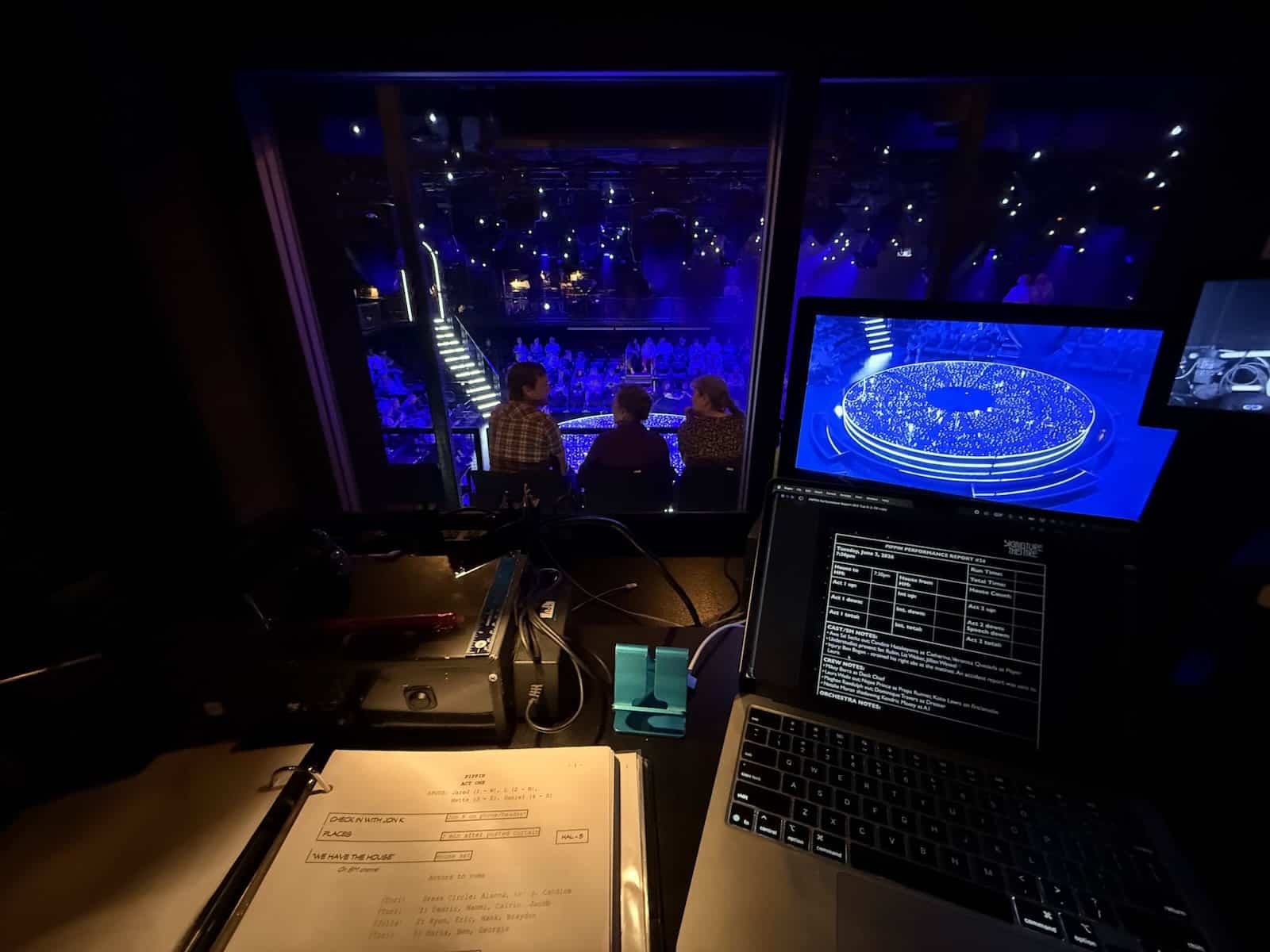
At the end of tech week, I move my script, computer, gadgets, and monitors from the middle of the theater to the booth at the back of the house. Ideally, I can see the stage from the booth, but sometimes my sightline is partially blocked by audience seating or scenery. I therefore rely on an infrared camera to augment my view. There is a video game-esque control knob that allows me to zoom into corners or make sure actors have exited safely during blackouts. The camera is hung in the back of the house, and I have a monitor in the booth, right next to my conductor cam.
I have moved up to the booth for the invited dress rehearsal. We will run the show, hopefully without stopping, for an audience of theater staff and guests. Sometimes it’s a full house, sometimes it’s just a handful of folks. Either way, it’s a great way to sneak in a first audience.
Previews
We now have a week of afternoon rehearsals and evening performances. Each afternoon, we will make adjustments based on how the audience reacted to the show the night before. Sometimes, especially in new works, entire songs are cut or moved to a different part of the act. Preview week is just as intense, if not more, than tech week because you are constantly changing and refining the show, but there’s a live performance in the second half of the day. At the end of the week, the show is frozen, meaning no more (major) changes are made.
The Run
We open the show, celebrate with a fancy frock and photos, and toast our success. We can now settle into the run, right? Sort of! Immediately after opening, I start having afternoon rehearsals with the understudies. We will work through the show to prepare the understudies to perform their various roles and to make sure the show is covered in case of illness, injury, or emergency. The understudy company consists of internal actors covering other roles and external understudies/swings. Sometimes understudies know well in advance they have scheduled performances. Sometimes they find out at intermission that they are going on for Act Two. Having a rock-solid understudy company is such a relief for any stage manager, and I have been extremely lucky to work with very talented understudies. You know your show will be in good hands, no matter what the theater gods throw at you. But part of the art of stage management is anticipating what might go awry and having contingency plans at the ready.
Meanwhile, the show is running eight performances a week. Actors are called a half hour before curtain, and I will usually arrive a bit before that to make sure that the stage is set and ready for the performance. The assistant stage managers will double-check that all props and costume pieces are in their preshow starting positions. If there are any actors who have called out sick, I’ll make sure house management is informed so they can prepare understudy signs and program stuffers for that performance. If a show has extensive fight choreography or complicated dance lifts, we’ll have a 10- to 15-minute fight and lift call with those specific actors to run through those moments. Once that is complete, I’ll do a blackout check where we turn off all the lights in the theater to make sure there aren’t any errant work lights left on and then go into the preshow light and sound cues. At that point it’s just about 30 minutes before curtain and we are ready to hand over the house to the house managers to seat the audience. This is now the sacred time of “half hour” when everyone prepares for the show. During half hour, I give time calls to the dressing rooms and backstage to keep the company on schedule and ready for an on-time start.
For the actual performance, I’m still calling the cues, sometimes at a rapid pace, but I’m also watching the show with a directorial eye to ensure that the actors are continuing to flesh out their characters as the director intended. Certainly, things grow and change during a performance — that’s the beauty of live theater — but now my artistry expands to include maintaining the artistic integrity of the show. This involves giving actors notes. Sometimes it’s an easy verbal note given in passing after the show (“Hey, tonight you were out of your light during the chorus. If you take one step to your right, you’ll hit it”). Sometimes it’s a general note about line or scene pacing that can be emailed to all actors. Sometimes it’s a one-on-one conversation to figure out why a moment has changed from what was created in the rehearsal room. This fine-tuning ensures that all of the work the creative team has done is still there for every audience member to experience during the entire run.
After every performance, I send a written report to the creative team and production staff. This includes data points like curtain times, running times for each act, and the audience house count. I also add narrative bits about what happened during the show: strong audience reactions, anything out of the ordinary, and how it was handled. It’s a little snapshot of what you might have experienced if you were at the show. My goal is to make it an enjoyable read, but it is also used to pass on production notes or requests, like if a table is wobbly and needs a repair or if we need more apples for next week or a costume piece ripped and needs to be replaced.
Closing
We reach the end of the run. Most, if not all, understudies have gone on. There have been trials and tribulations, secret triumphs, and amazing moments on and off stage. Hopefully the audience has been thrilled and delighted or at least rejoiced in a shared communal experience. We take down all the backstage paperwork — the prop cards, the scene orders, all the documents we made during prep week — and scan them to a digital archive. We take our metaphoric final bow. And then the next week the process starts all over again with a new show.

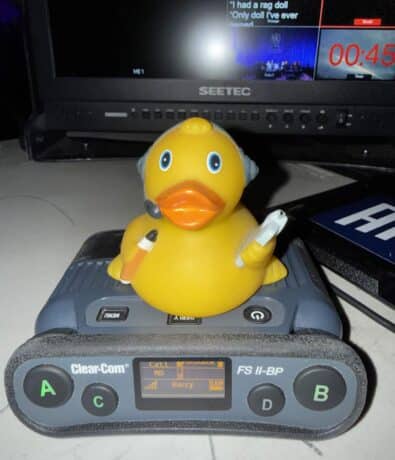
Kerry Epstein is the resident stage manager for Signature Theatre, a position she has held for over 20 years. Recent and selected credits include Pippin, Safety Not Guaranteed, Fiddler on the Roof, Play On!, The Untitled Unauthorized Hunter S. Thompson Musical, In the Heights, A Funny Thing Happened on the Way to the Forum, Soft Power, HAIR, Private Jones, Ragtime, Pacific Overtures, Into the Woods, She Loves Me, Assassins, A Little Night Music, Titanic, West Side Story, Cabaret, Sunday in the Park with George, Threepenny Opera, Shakespeare’s R&J, Sunset Boulevard, First You Dream, Les Miserables, The Visit, The Studio, and Nevermore. She serves as the stage management mentor for Signature in the Schools and has an extensive show-specific rubber duck collection.
About the series
How Theater Works is a new DC Theater Arts series designed to give readers a deeper understanding of the essential, often-overlooked disciplines that shape a theatrical production. Beyond performances and scripts, theater is built by a network of artists whose work isn’t always visible to audiences: designers who create the world you see and hear, directors who shape storytelling, and stage managers who keep it all running. By breaking down these components of theater, this series offers audiences the tools to better understand, appreciate, and evaluate the full scope of what goes into bringing a play to life.