
Three years ago, I realized Kelsey Mesa was a writer to watch when I reviewed Taffety Punk’s production of her first play, La Salpêtrière, a satiric dark comedy about women branded as hysterics and consigned to a notorious asylum in Paris. As I wrote then, “the show’s originality and subversive substance make it a must-see.” Now, in a first-rate Taffety Punk production of her second play, Freddie: A Girl, Mesa has again dug into a potent political aspect of women’s history and brought forth a stunning, must-see stage event that is as surprisingly and delightfully funny as it is psychologically and ethically profound.
Freddie: A Girl takes place in the Netherlands during World War II when the nation was invaded by Nazis and a Dutch underground resistance rose up. We meet two young sisters who — true story — will play a major role in that resistance: Freddie Oversteegen, 15, and Truus Oversteegen, 17, both raised in poverty by a single mother who taught them anti-fascist, pro-justice values. Freddie and Truus were recruited into an underground army to help sabotage and assassinate Nazi forces and rescue Jewish children. They did so because it needed to be done. And their recollection of their mother’s guidance — to “stay human” — introduces a moral tension in the storytelling that points to the greatness in Mesa’s play.
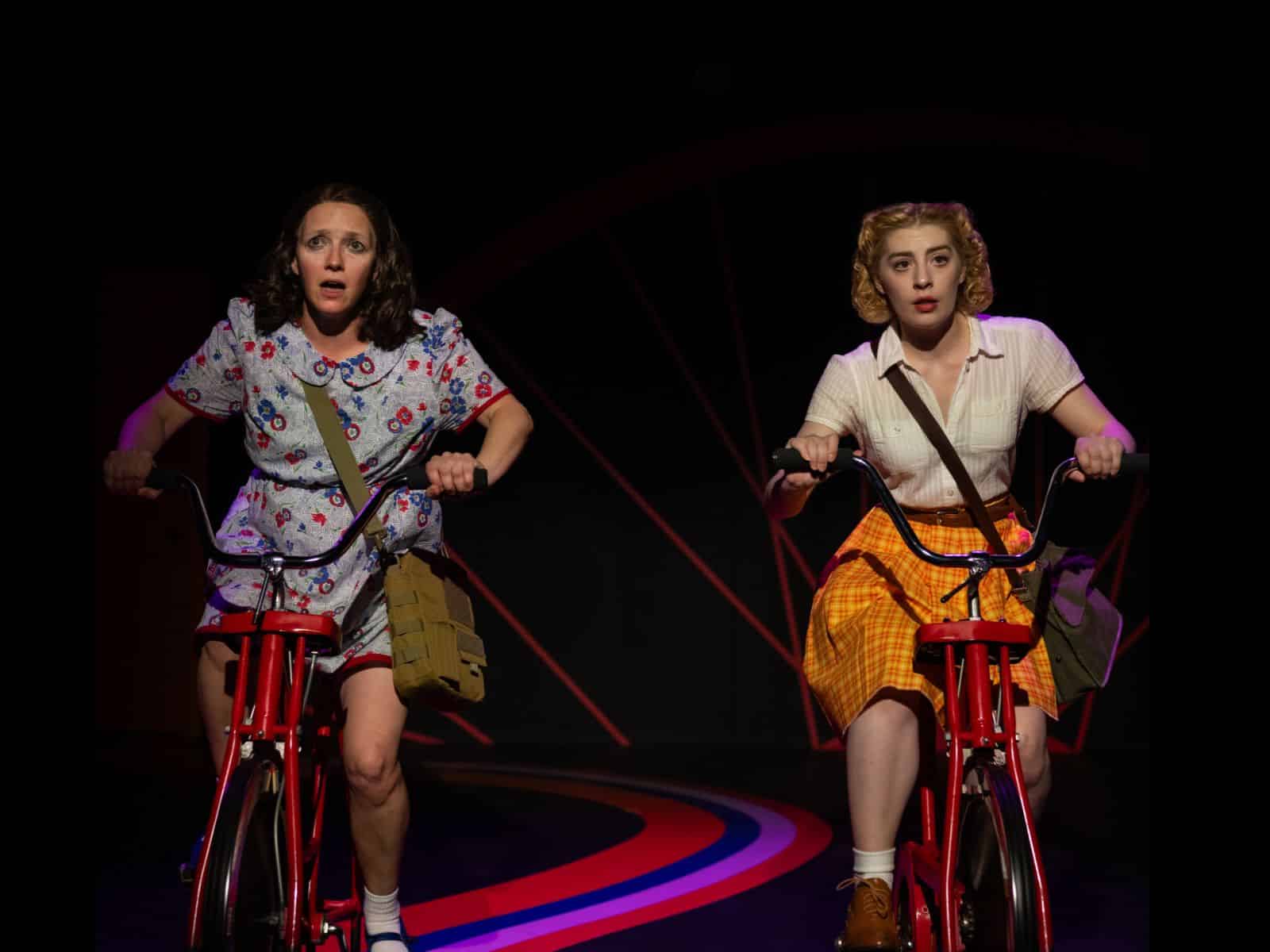
The first scene — when the sisters connect with the recruiter — sets a tone of playful wit and deadly earnestness. Tia Shearer Bassett, giving an enjoyably expressive performance, plays the titular Freddie as a gamine-like rascal. As Truus, slightly more serious, Sadie O’Conor stands out as the stalwart big sis you’d trust with your life. Immediately, their affectionate play and giggly, girly banter pull us into their story with a wide-open heart.
The recruiter, Frans van der Wiel, meets them at an appointed place, checks them out for confidentiality, and tests their mettle … with an alarming firearm, which the girls wrestle from him by surprise in a comedic brawl. Dan Crane as Frans — in the first of several male roles he plays with distinction (later waiter, SS officer, journalist) — explains to the sisters (and to us) why the underground needs them in particular:
FRANS: Think of it — they [the Nazis] will never see it coming. Two sweet-looking teenage girls, working for the resistance? Those bastards don’t respect women. They don’t think women can do anything but cook for their husbands and iron their uniforms.
So it is Nazi misogyny that gives the girls cover. And their assignments, several of which we see enacted, include lying to unsuspecting Nazis and luring them into the woods where coconspirators in the resistance will shoot them dead.
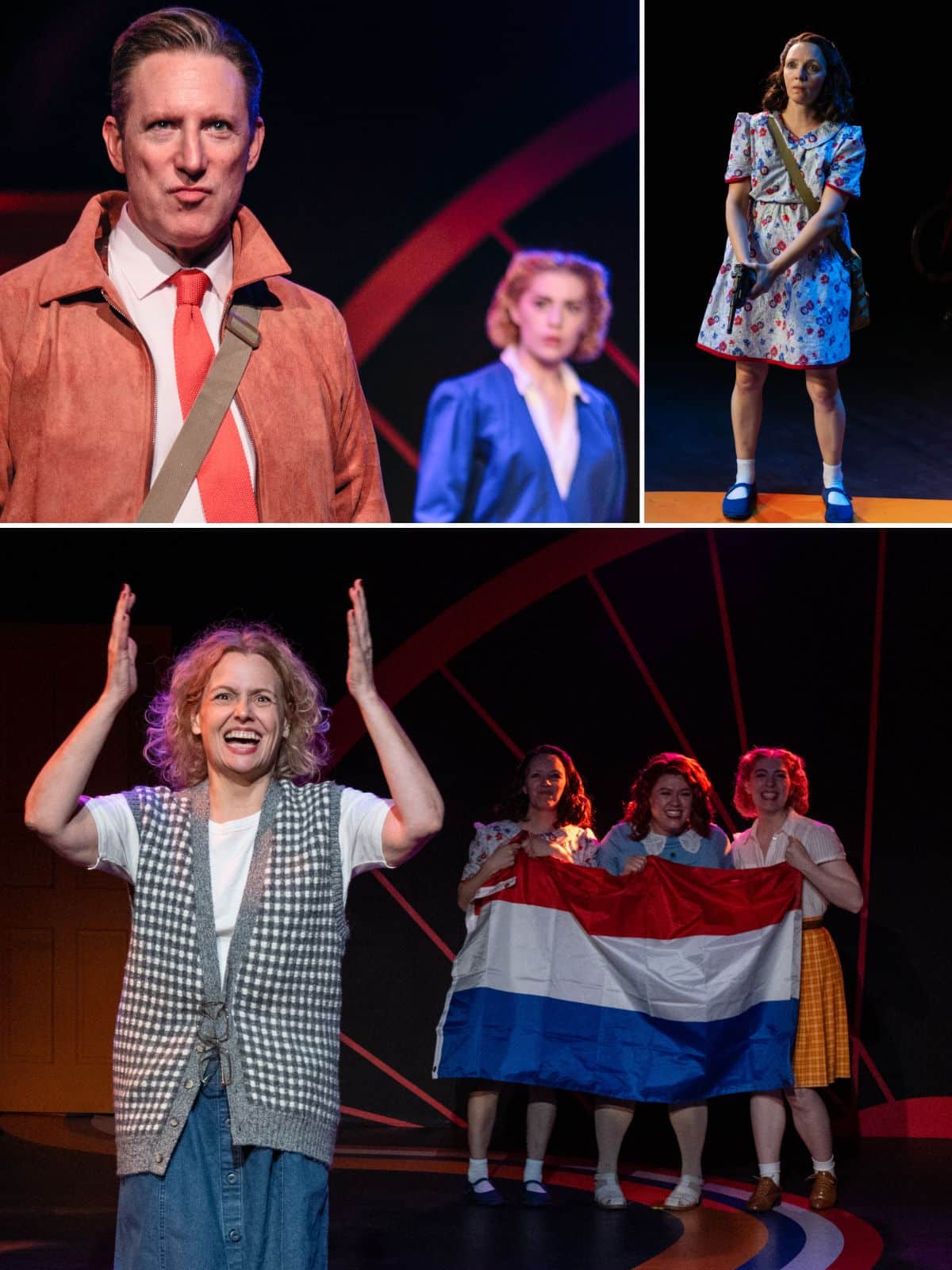
A slightly older accomplice is recruited to join the sisters on their elimination missions: Hannie Schaft, who, in Hana Clarice’s grounded performance, complements Freddie and Truus in important ways — notably later in the play when they imagine what they’ll do after the war:
HANNIE: When this is all over, we’ll become feminists and fight for the right to be heard. We’ll get dressed up and do our makeup and march right to the Hague and say, “We fought for this country even with terrible firearms, let us have a say. You need more women in higher positions of power.”
FREDDIE: I can’t wait!
The three of them bicycle about the stage on an abstract set designed by Jessica Moretti, its black walls and floor painted with colorful swoops and swirls and bicycle spokes. The sense of place, specific in the script, is evoked minimally: Freddie climbs a small stairway that serves a tree; a statue garden is represented by a single wheel-on prop; a bench, small tables, and several chairs are multipurposed. Meanwhile, Elizabeth Morton’s period costume design keeps us mindful of the treacherous timeframe.
Gunshots factor in Lee Martinez Cruz’s superb sound design along with war planes overhead and lovely piano music that, together with Katie McCreary‘s agile lighting design, seems to power the narrative from scene to scene. That effect is amplified by the tight pace and fluid physicality in Lise Bruneau’s inspired direction. The wonderful humor that pops up throughout the performance, unexpected given the story’s gravity, is a credit to what has to have been some special synergy between cast and director.
Near the end of Mesa’s play, for the last tenth or so, the setting and timeframe change dramatically. We are, says the program, “Some decades later…in the home of Freddie Dekker” — the married name of the teenager whose brave story has just been told.
Up to this point, we have seen the extraordinary actor Tonya Beckman in several minor supporting roles; now she appears centerstage as main character Freddie in late life, being reluctantly interviewed by a nosy journalist. What Mesa does in this last scene is nothing short of brilliant: In a magnificent monologue for Freddie Dekker, Mesa parses apart the ethics and empathy and urgency of everything that has gone before. For instance:
FREDDIE DECKER: When you shoot a person and you see them fall…they’re falling down. They’re falling down down down. And if you’re a human person. You fall with them. My heart. Even if they’re a bad person — even if you know in your mind, because you spent two weeks tracking them. Because you saw them spit at an old lady in the street. Because you’ve been told about the worse things they did. Even if they’re a bad person, you fall with them. You shoot them and you see them fall and you want to pick them up again. You want to say “I’m so sorry! I didn’t mean to!” but you absolutely did. You did mean to kill that bastard. It’s just in the split second, when they crumple like a little kid, like a little baby. You think, “Oh, no…shouldn’t I help them?”
When I tell you Beckman’s performance in this last scene is Meryl Streep-caliber, you may have to take my word for it until you see the play. And when you do, I promise, you will be left with an excruciating examination of conscience that is exactly the reason all great theater exists.
Running Time: Nearly one hour and 40 minutes with no intermission.
Freddie: A Girl plays through September 19, 2026, presented by Taffety Punk Theatre Company, performing at the Capitol Hill Arts Workshop, 545 7th Street SE, Washington, DC. All seats are general admission, and tickets ($20) may be purchased online.
Freddie: A Girl
By Kelly Mesa
Directed by Lise Bruneau
THE PLAYERS
Tonya Beckman: Freddie Dekker, Mrs. Elsinga, Hospital Director, and others
Hana Clarice: Hannie Schaft
Dan Crane: Frans, Kees, a Waiter, SS Officer, Journalist, and others
Tia Shearer Bassett: Freddie Oversteegen
Sadie O’Conor: Truus Oversteegen
UNDERSTUDIES
Hana Clarice: Understudy to Ms. Beckman
Michael Girts: Understudy to Mr. Crane
Sadie O’ Conor: Understudy to Ms. Clarice
Maria Wraback: Understudy to Ms. O’Conor and Ms. Shearer Bassett
DIRECTION, DESIGN, AND PRODUCTION
Set Design: Jessica Moretti
Light Design: Katie McCreary
Costume Design: Elizabeth Morton
Sound Design: Lee Martinez Cruz
Fight Director: Lorraine Ressegger-Slone
Dramaturgy: Tiffany Bryant
Stage Manager: Jenna Keefer
Assistant Director: Maria Wraback
Assistant Costume Designer: Aliza Horowitz
Assistant Stage Manager: Sophia Jeffress
Scenic Painter: Chester Stacy
Scenic Manifestation: Christian Sullivan
Wigmaker: Ava Ostroff
Lighting Assistant: Omar Cruz
Lighting Assistant: Luke Douglas
Production Assistant: Aaron Beaver
Artistic Director: Marcus Kyd
Managing Director: Erin Mitchell Nelson
House Management: Renee & Aaron Beaver
Music and melody for the story-song Freddie sings composed by Tia Shearer Bassett. Lyrics by Kelsey Mesa.
SEE ALSO:
Taffety Punk to present world premiere of ‘Freddie: A Girl’ (news story, August 8, 2026)