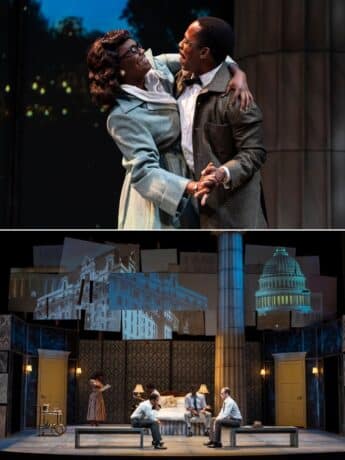
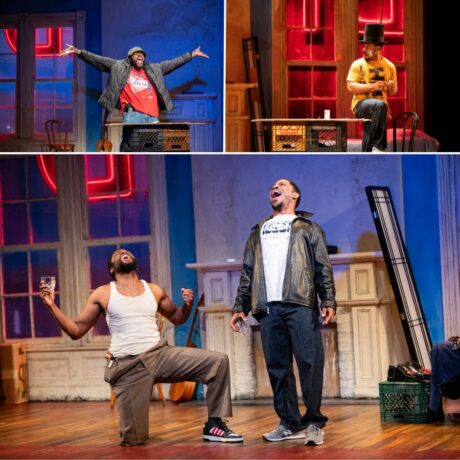
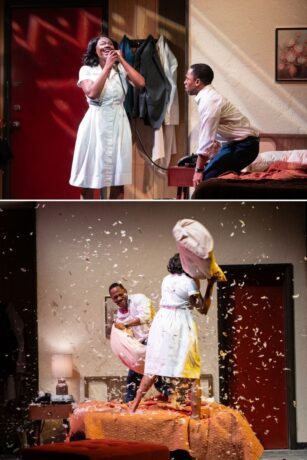
Last season, Ro Boddie, Renea S. Brown, and Yao Dogbe co-starred in Chess Jakobs’ Helen Hayes Award-winning play The American Five at Ford’s Theatre. The trio has worked together extensively (in many combinations), frequently appearing in Round House Theatre productions. Renea and Ro co-starred in The Mountaintop; Yao and Renea in Nollywood Dreams; Renea and Ro in Sally & Tom; Ro and Yao in Topdog/Underdog. In a few weeks, Yao and Ro will co-star in Ma Rainey’s Black Bottom (it opens September 14).
But something about The American Five felt different and led Yao to think, “I want this experience all the time.”
Renea elaborated: “What happened in that room was just complete openness… It was just honest, and an honest room really saves a lot of time. We didn’t have to tiptoe or beat around the bush … and there was just a complete freedom that you’re going into work with every day, and I think that’s what Yao means by ‘I want more of that.’”
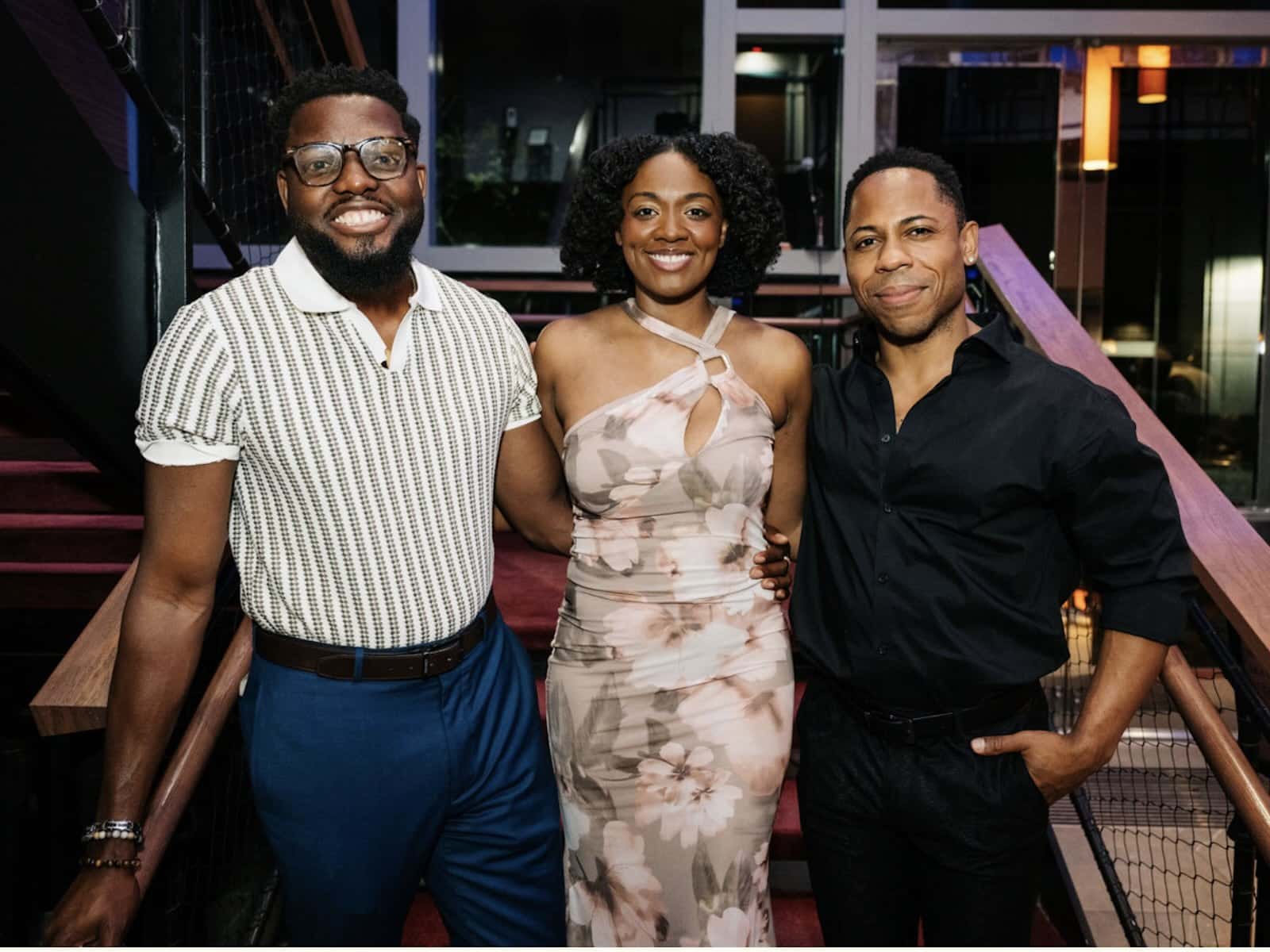
And more of that, they’re creating. Enter: Imminent Theatre Company, their new Black-led, DC-based resident ensemble, home to a group of in-house Black actors, playwrights, directors, and designers. So far, the ensemble includes Asha Basha Duniani, Yetunde Felix-Ukwu, John Floyd, Cidney Forkpah, Jeremy Keith Hunter, Raven Lorraine, Sabrina Sawyer, Justin Weaks, and Chess Jakobs. Felicia Curry and Awa Sal Secka are affiliated artists, joining productions when their schedules allow. Ryan Rilette, Ed Zakreski, and Craig Wallace serve as ITC’s board members.
Ro, Renea, and Yao have big plans. They launched Imminent at Woolly Mammoth Theatre in early August during their End of Summer party, a community-building event and artist mixer. I spoke with them at length for their first interview. We got into their mission, origin, philosophy (they clarify what Black theater means to them), fundraising needs (they’re raising $600k — yes, sustainable theater is expensive), dream partnerships, and ways to get involved with Imminent.
(This interview has been edited for length and clarity.)
“Like Acrobats of the Heart”
Marc Fjor: You all work so hard. What is it like to balance being both artists and the founders of a new theater company?
Yao Dogbe: We’re taking it one day at a time. Right now, Ro and I are in rehearsal [for Ma Rainey’s Black Bottom at Round House], and Renea has started rehearsal [for Measure for Measure at Folger], so responsibilities and obligations shift to whoever’s not in a thing at that time. A similar thing happened with Sally and Tom earlier in this year: responsibilities shifted to one of us who wasn’t in that show. It’s happened organically, the same way we work on stage together, where it’s kind of a shorthand. It’s seamless. We’re all aware of what we’re trying to accomplish here. And we are all mindful of the work that each of us is putting toward that same goal.
I wanted to ask you all about the advantages and opportunities that come with establishing an ensemble. One, how you’ve all been able to find your rhythm working with different artists. And two, the opportunity that comes with assembling this new group of artists.
Renea Brown: These are artists who we’ve worked with, who we trust, and who have that shorthand Yao was talking about. There’s a synchronicity that’s already there. But what’s super important is that all of these artists mainly work in DC. These are artists who work hard, and who are not satisfied with mediocre work, people who are excellent, who think excellent, who work excellently. And also people who are, energy-wise, just good to be around, who have decent attitudes, who ask questions, who are not afraid to make bold choices.
Ro Boddie: Yeah, we know what it feels like when you’re in a room with someone who is consistently making you better as an artist. And I can honestly say when I’ve worked with these two, at the end of every single project, I feel like we have grown, as if we’re in some kind of professional grad school. And that makes you hungry for more. Like Renea was saying, with this ensemble that we’ve put together, we all do that for each other. They’re like acrobats of the heart. They do it because they love it, and because their heart is in it.
It seems like you all are at a place in your career where you’re able to have work that aligns with your gut, which must feel amazing, because a lot of artists are just trying to survive. So, now that you’ve achieved a level of comfort and stability, what does that look like at this stage of your career?
Ro Boddie: The three of us have been blessed to have our one or two chances per season, but what would happen if we had a full season to be able to get that heart bigger and bigger in the work? And I feel we’re at a place right now where we can give others who may only get opportunities once or twice a season a full season to be able to explore. With the support behind us, we’re able to provide more of those opportunities for people.
“Onstage trust, off-stage friendship”
Can you tell me about the impetus for Imminent Theatre Company? How did it happen? Was there, like, a spark?
Yao Dogbe: Round House Theatre Company, Ryan Rilette, along with Sarah Cooney, have been like angels on our shoulders throughout this process, guiding us. Renea and I met doing Nollywood Dreams. Ro and Renea met doing The Mountaintop; that two-hander was the spark that formed their bond. And then later, I ended up being able to work with Ro in Topdog/Underdog. And it was the exact same experience: we really enjoyed working with each other. And I had already worked with Renea on Nollywood Dreams — by that point we had actually begun dating. So there was this onstage, off-stage friendship that started to brew from our shared sense of rigor — the way that we like to attack the work, the preparation that we come in the room with.
And finally, the three of us were able to work together on The American Five at Ford’s Theatre. After one show, an audience member, a government worker, came up to us in the lobby talking about what the work meant to her, and what the story meant to her. This was during the longest government shutdown in U.S. history. And we kind of just hugged it out in a little circle right there in the lobby at Ford’s. And that was one of those experiences where it’s like, we do this work, but we don’t just do it for ourselves; we do it for those empathetic experiences. After we did The American Five, it was like, I want this experience all the time. I want to be able to come to work all the time, and just be able to play in the room, and create with no barriers, no red tape, just nothing in the way. And those conversations began shortly after that. We started talking about how to do it. One thing led to another, and here we are with a 501(c)(3), our articles of incorporation, all of our paperwork, and a bank account. We’re already starting to do things for the community with the gatherings that we put together, and we hope to continue to build community here in Washington, DC.
“Expanding the family”
What are you looking for in this family that you’re building? What are the conversations looking like? How are you going about building this larger organism?
Ro Boddie: Imminent is rooted; it is a Black-led ensemble theater company, rooted in the African diaspora and the African American experience, but that does not mean we are excluding other cultures or other demographics. Everybody’s welcome; there’s a universality in theater, and we want to continue to champion that with our work. But a lot of our work will center Black and African American experiences. And so we are looking forward to building this family out. We haven’t quite started thinking about auditions yet, but with these parties that we’ve been throwing, there’s a lot of daydreaming and brainstorming about all the possibilities. We’ve been thinking recently about new works, classics, and also Black classics — plays that the Negro Ensemble Company have done, the DC Theatre Collective, African Continuum. We’re interested in doing all of it.
Renea Brown: At our community events, we’re also meeting artists who we have not met before. That’s very important. I would also like for ITC to be that place where artists who maybe we don’t know will also have a chance to work. Like, ITC is not just after people we know. Yao had said the other day, “Companies don’t really hone artists anymore.” And I 100% agree. Like, how does an artist know they are growing, if they aren’t given an opportunity to grow? That’s why I love these events, because I’m meeting people who I don’t know and they don’t know us, they’re just like, “I saw this on Instagram, and I came,” you know? So that’s also expanding the family.
Ro Boddie: Being here in DC, so close to Duke Ellington School of the Arts and Howard University, having a Black-led theater company will only pay dividends to the community and to those young artists. Because they graduate from these places, and there’s no clear trajectory. They don’t see people that look like them at the head, leading a place. And so the impact and the confidence that I feel like it will give young emerging artists to see people like us taking the reins, I think is incredibly valuable.
“How beautifully complex being Black is”
Former producing artistic director at Crossroads Theatre Marshall Jones III once said, “There’s a difference between Black theater and a theater with Black people in it.” What does Black theater mean to you all as you flesh out your company? How do you approach the topic of Blackness in Black theater, all that it means, given that it means different things to you and your collaborators?
Yao Dogbe: I am a first-generation Ghanaian American. But all I know is the experience of being a Black man in America. There are aspects of my life that broaden my understanding of Blackness, being first-gen, but for the most part, my experience has been that of what I would say a Black American is. What I mean by that is if I get pulled over, I’m not going to feel any different than a Black American man, you see what I’m saying?
As for my philosophy on theater in America, and playing certain roles, the way that we’re approaching our ensemble is: if you can do it, you can do it. No matter if that’s classical, contemporary, or new work: If you can do it, then you can. There is a complicated conversation happening in our industry right now when it comes to folks across the diaspora playing certain roles. And at Imminent, what we’d like to do is create space for all folks, with new works that are dedicated to Black people of all walks of life. They could be of Jamaican ancestry or someone from North Carolina, like Ro, or someone from the UK — all of these different kinds of Black people would be able to exist on a stage at the same time, telling a story for them and by them, that exemplifies and honors their culture and history. And that’s how I would say our approach is when it comes to that color-conscious casting. We might do a show that is colorblind — say, like, a Shakespeare, or a Chekhov, or a Tennessee Williams, and we might have our ensemble members in that cast, but then some other community folks of a different background, and we could interpret that story in a brand new way.
Ro Boddie: What is beautiful about what we do is that we can control the narrative, and we can control stories, and Black is going to mean different things to every single Black person. I was brought up a different kind of Black than you were, but we’re all Black, you know? And what is beautiful about having a resident playwright, like Chess Jakobs, or any other playwright that we decide to work with, is that the intersectionality of what it is to be Black will only enrich the stories that we’re telling. And I think it’s important to have all kinds of different walks of Blackness on that stage, and I don’t think we have to label one. What I think is important is that the audience gets to see themselves in one, or all. So we haven’t really addressed it fully, because I feel like what’s going to happen is people are going to bring their own cultural experience to the work. When we go through casting and putting people in certain roles, we’ll pick the best person who will make the story make sense and lift off the page. But I think it’s important that we show how beautifully complex being Black is. Because it is very, very complex, and everybody has their own unique struggles with it. But there is a struggle. And so I’m looking forward to being able to tackle all of those different walks of life on one stage at our theater.
Renea Brown: I would add that there is no definition for what it means to be Black. And I know that because this is something that I have struggled with a lot, both as an actor and in how I was raised. People have questioned my Blackness, especially when it comes to text and dialect work. How Black am I? Am I Black enough to do X, Y, and Z?
But there is no definition for it, culturally. And I think that’s where you see the expansion; that is why we are the culture. It’s because we can create any kind of music, fashion, story, language, and be universally understood. It just is. Even without speaking, I love being around Black people who I don’t know, and something happens, and we are already speaking to each other, and we don’t know each other, and we’re not even using words.
You brought up this concept of “Black theater versus a theater full of Black people.” A theater full of Black people sounds like there are probably concepts slapped on top of a play and we are forced to fit into it, versus a Black theater wherein the world is the world. It is how we exist. It is how we live. It’s not a particular kind of music or costume that we have to have, or any of those elements. It’s just us existing in this space.
I was in a show and an audience member once asked, like, “So did you all change the script around?” And the director said, no, we didn’t change any words. But because of the Black bodies that were on stage, that white woman had a different experience of the play, just because the words were coming out of the mouths of people who didn’t look like her. It’s the same words, but it’s just a different experience.
And I think that is our culture. We are living in the same world, we are just providing a different experience; well, maybe we are experiencing a different experience, as well.
“A space to explore imagination”
All three of you are educators. How do you see that fitting into your model? Do you have an understanding of your theater company being a training ground or an informal conservatory? What role does education outreach play in your equation and service?
Renea Brown: It’s very important for this new generation to get into the theater. How do we get ages 13 to 18 to say, you know what, “I would like to be a long-time subscriber of the theater,” so that they’re still returning to the theater in their 30s, in their 40s, in their 50s? And that they’re supporting the theater, whether that’s watching plays or financially supporting them.
It’s very important to get them at this stage. And, yes, you take them to performances, but you also come into their classrooms, and let them know, I see you, you’re not experiencing this world on your own, there are people who understand you. And there is a way to build a curriculum to create that throughline between the show that they’re going to see and what they’re learning in the classroom. We also have to give them a space to explore [their] imagination. If you are not really in any form of artistic sector, it’s easy to believe that the imagination ends when you’re a child. And I believe that’s why artists who still paint, who create music, or whatever, that childlike imagination is still alive and active. And young people need to know that their imagination can and will continue to exist for them, outside of school. That’s super important.
We have talked about offering workshops like that when it comes to a show that we’re producing. We’ve also talked about even getting students to participate in their own shows — whether that be writing it themselves, performing in it, or performing in something ITC directs for them. But that part of education, we’ll get to at some point.
And I’ll get on my soapbox a little bit: Let’s say I’m an actor who’s been auditioning almost everywhere and haven’t booked anything. I don’t really know what it is I’m doing wrong, or what I could be doing better so I’m just sort of stuck in limbo, because 98 percent of the time casting directors don’t give feedback. And I don’t really think that that’s fair.
Artists need feedback and instead of having to spend $300, $500 on a one- or two-day course, I know it would mean a lot to people in the DMV if we were to say, hey, we’re offering a weekend of master classes: Renea’s gonna teach one on Friday, Ro will teach one Saturday, and Yao will teach one Sunday. That is super important to me, that people know what it is that they can work toward. Or again, they may not even be aware of the kind of power and presence that they have. It hasn’t been unlocked for them yet, and it shouldn’t take thousands of dollars, it shouldn’t take years for someone to unlock it. So that’s what I look forward to offering with ITC.
Ro Boddie: As an actor, you can feel like your only time to act is during auditions. And you put a lot of pressure on yourself, and you feel like a failure if you don’t book whatever it is that you audition for. But to be in the practice of, week after week, going to a masterclass, or working on a scene just for fun with someone, and having an outside eye — I don’t care how good you are, every actor needs an outside eye, because there’s gonna be something that you’re missing. I think it will be incredibly valuable to the community, and will only make us better artists, because if you don’t have those people who, not so much call you out, but just say, “hey, you’re missing something,” or “you’re trying to fake me on this,” “this is something that you’ve done before,” or “this is something that you do,” and it’s gone over, and you learn from some other director who said good job, and nobody has said, “hey, you’re missing a beat” — you’re missing a crucial moment of vulnerability, you’re missing a revelation in these moments — if you don’t have somebody there to do that, then you’ll keep booking stuff, but are you growing? Is your heart growing? Is your artistic soul growing? Iron sharpens iron, and it’s all about trying to make us all better and sharper artists in this community.
I would love to get in contact with Howard University’s educational department and have some kind of pipeline from them to us. Specifically actors who just want to do straight plays, there needs to be a place for them. I see a lot more graduates doing musical theater, and so we would just like to give them a place to come and continue to grow as artists, with a Black theater company in town. There’s also, of course, Duke Ellington School of the Arts. These are all things that we hope and plan and dream to do. We haven’t started those conversations yet, but we welcome that conversation.
“New ways of gathering and welcoming”
Often we hear that the subscription base for theaters is white and older. Do you have any ideas on how we can sustain this model of theater, not only to prop it up, but maybe invent a new way of gathering and welcoming people in the door who may not have been to theater traditionally? What spaces are you thinking about having your plays at? Because I do think that we need a new, radical way of doing it.
Ro Boddie: People will come if they know they’re welcome. And so you just have to go out to those places. You have to go out to those churches, you have to go out to those youth meetings, you have to go out to those barbershops, you have to go out to those salons, and get them excited. And nowadays, because of social media, you have to continue to remind them, reminder, reminder, we’re here, we’re here, this is important, this is important, the most important thing you’re gonna do tonight is to see this show at 8 o’clock, nothing else. And the more that we let them know that they are welcome, and this is also for them, I have a feeling that they will come. All they need is one time to come and see themselves, and enjoy themselves, and learn that it’s a good time, and learn that they’re welcome, to just tell their friends, “Hey, there’s this new hotspot, let me tell you about it, let me bring you in.”
I think outreach can be better, but I don’t think just the marketing of social media and the old marketing style is going to work. I think that people have to put their boots to the ground and actually go out, because we have become more and more easily distracted by things, and so actually getting face-to-face with people and letting them know is more impactful than hoping they’d read an email, or hoping that they will like your post. So I think we have our work cut out for us, but I think that’s the way to go.
Yao Dogbe: We can boost audience engagement through social media and podcasting. We could start to actually create a relationship with the people in the community that come and see the shows that we produce live, and then can actually talk to us about it. People like to see the process. They don’t just want to see the finished product; they want to see how you got there. And I think we could actually take folks on this journey that we’re on — of starting our own theater company. We could educate young people who want to do this themselves. So I’d say creating a digital space is important as well, so we can exist with our audience and share experiences in real time.
“Our financial goal for our first year”
What would be the next steps, and what is your current fundraising process like? How can people support you?
Renea Brown: ITC is an official organization of Theater Alliance’s Open Door Alliance. That partnership gives us a space where we can meet and rehearse, plus an address we can use to apply for grants. Our next step is to fundraise $600,000; this meets our financial goal for our first year. What’s that you say, you’re dying to donate? Well, you can!
You can donate to ITC by going to imminenttc.org. Hitting that goal will allow us to do our full productions. But that’s not the only thing that we’re after. We’re also going to have staged readings that are as close to a production as you can get, with some set pieces, minimal costumes, things like that, so that people are not only just hearing a play being read, but they are watching and seeing that our work is worth investing in. People will think, If ITC can do this in a week, imagine what they can do with four weeks of rehearsal. Our fundraising goal of $600,000 makes it possible for us to have a full season.
When people hear $600,000, they think that’s a big number, but what does that number entail? What goes into that number, Renea?
Renea Brown: A lot of things that, being an actor, I didn’t really realize. There are many different forms of insurance. Also, marketing materials are a lot more expensive than I thought. I mean, people spend thousands of dollars on marketing, and rightfully so: you want to get butts in seats. As for salaries, there’s pay for the artists, crew members, your creative team, people who are working the box office. There’s a costume budget, a props budget. You also need a miscellaneous budget in case anything goes wrong, like a pipe bursts or you run out of toilet paper; all of those things go into a budget.
The money’s also going to go toward renting spaces. We are a nonprofit, and fortunately, venues in Washington, DC, offer a nonprofit rate. However, when it comes to us putting on productions, it isn’t just the stage that you have to rent, it’s the green room, it’s the dressing room, in some spaces, it’s the loading dock in order to get your set pieces and costumes in. So a lot of the budget is going to be going toward renting spaces. I do want to shout out Woolly Mammoth Theatre Company and Studio Theatre; both have hosted our community events at either nothing or a very, very discounted rate, even below the nonprofit rate. So I imagine that will also continue, because that’s what kind of artistic community this is; we can speak to people and let them know what we’re doing, and they’ll say, OK, this is how we can help you get there without breaking your pockets.
It’s been a great conversation. Thank you so much for talking with me.
Ro Boddie: Marc, thank you!
Yao Dogbe: Thank you, man.
Renea Brown: Yes.
Thank you so much. Best of luck with everything.
About the Wendi Winters Memorial Series: DC Theater Arts has partnered with the Wendi Winters Memorial Foundation to honor the life and work of Wendi Winters, a DC Theater Arts writer who died in the Capital Gazette shooting in Annapolis, Maryland, on June 28, 2018.
To honor Wendi’s legacy, the Foundation has funded the Wendi Winters Memorial Series — articles produced by DC Theater Arts that make an identifiable contribution to local theater journalism, uplift the local LGBTQIA+ community, or highlight theater companies and practitioners in our region who engage in exemplary work that makes our community a better place.


)