One might expect a show that played only 69 performances on Broadway, including previews, to contain challenging material to execute successfully — but the Arlington Players’ production of Bonnie & Clyde is a triumph.
With music by Frank Wildhorn (who composed the music for Jekyll & Hyde), lyrics by Don Black (who co-wrote the lyrics for Andrew Lloyd Webber’s Sunset Boulevard), and a book by Ivan Menchell (who wrote the book for Death Note), Bonnie & Clyde showcases surprising character depth and an excellent score, which the Arlington Players execute beautifully with touching performances. Bonnie & Clyde is a five-star night out in Northern Virginia.
Co-directors Kayla Damian and Ethan Kahwaty have left a Directors’ Note that shows fantastic insight into the connections between the material in Bonnie & Clyde and the current American economic landscape. They write, “At its core, Bonnie & Clyde is about the false promise of the American Dream… hard work does not guarantee success, equality, or opportunity. This speaks to the sentiments of modern America even more now than when it was first produced in 2009, after millions of Americans lost their homes in the 2008 housing crash.
“As members of Gen Z, we understand. New graduates take months to find a job while living in their childhood bedroom. We will never own a home. The American Dream is out of reach… Bonnie & Clyde inspires us to fight against the system that put us here.”
This may be the first show I have seen with an explicitly Gen Z-oriented directorial lens. Seeing a show set almost 100 years ago that centers on two outlaws who were 23 and 25 when they passed away — who, if they were alive today at that age, would be members of Gen Z — strikes particularly hard. This exponentially adds to the show’s contemporary relevance and is likely to move anyone who is, or knows anyone who is, a member of Gen Z and struggling to make ends meet, never mind achieve their professional aspirations. Obviously, the answer to these challenges is not to become thieving murderers, but there is, of course, something deliciously jubilant about watching two empathetic characters take the problematic way out.
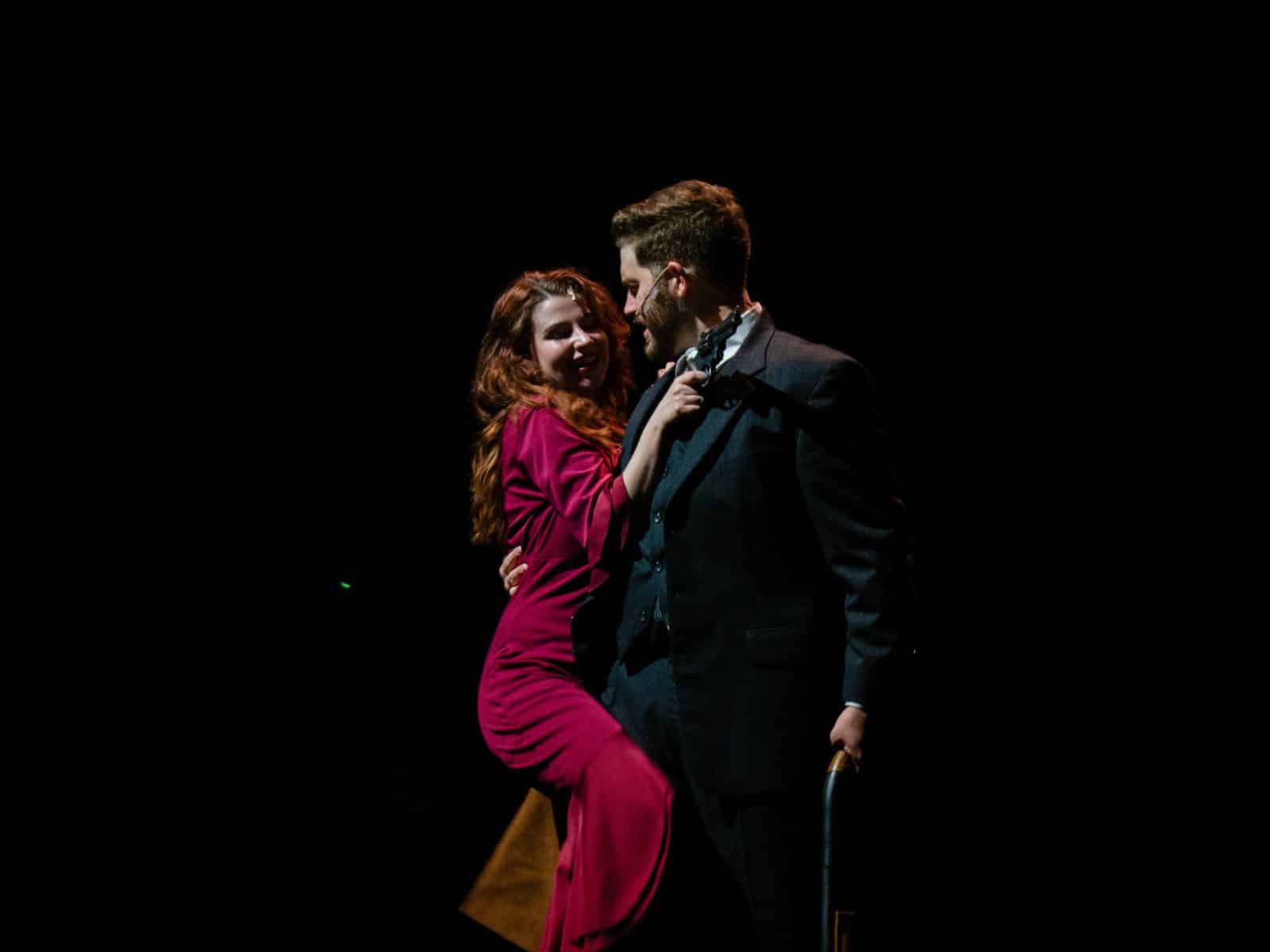
The cast of this show absolutely shines, with Megan (MJ) Cooper as Bonnie Parker and Ryan Kieft as Clyde Barrow. Damian and Kahwaty’s Directors’ Note reflects a deeply personal relationship with the material of this show, and Cooper and Kieft’s performances reflect that same intensity.
Cooper, who plays the audience’s strings perfectly, is a revelation. She keeps us empathetic to her position of feeling she has nothing to lose, even when she makes us furious with her on her own behalf when she makes unconscionably poor decisions. If Bonnie’s position were not convincing, the whole show’s plot’s conceit would collapse — we have to find her sympathetic, given that Clyde’s physical abuse of Bonnie, among plenty of other things, automatically writes him off as being supportable — and Cooper’s appeal as Bonnie is the puzzle piece that the show needs to narratively succeed.
It would also be easy for an actor to swing and miss in the portrayal of Bonnie’s prominent sensuality, but MJ’s performance choices make this element feel natural. Cooper’s choice to substantially increase Bonnie’s physicality when she interacts with Clyde also suggests Bonnie may feel she must bend to Clyde’s desires to escape her precarious social position — which also adds to her appeal, particularly when Clyde’s ruinousness begins to have an unalterable impact on her life.
Meanwhile, Ryan Kieft’s portrayal of Clyde works like clockwork with — or perhaps against — Cooper’s Bonnie. For much of the show, Kieft portrays Clyde as Bonnie’s only way out of life as a struggling waitress, and his constant thievery, almost manic desire to continue committing crime, and slap to Bonnie’s face early on make him detestable. As their relationship deepens, a heartfelt chemistry does appear to develop between them, as we especially see in the song “Bonnie” — which eventually makes Bonnie’s position more understandable. Kieft’s subtlety in portraying Clyde as the script requires, while making the character his own by bringing a particular intensity to the character’s highs and lows, further elevates the show’s narrative excellence.
Clyde also begins life already idolizing outlaws like Billy the Kid — we see him as a child, played boisterously by Daelyn Funk. He seems already lost from the starting line, even before he begins feeling socioeconomically trapped and developing a desire to one-up the lawmen who continue to come for him as he does what he deeply believes is necessary to assert his individuality and personal power in Depression-era America. While Clyde becomes less and less empathetic as the story progresses, we do understand from these early scenes that he was also, like Bonnie, in a challenging position to begin with, which Funk and Kieft together execute to create a perfect storm of complexity. Clyde believes, starting as a child, that he is built for adventure in the great wide somewhere. Who wouldn’t want that guy to win?Emmaline Taylor’s portrayal of Bonnie’s mother, Emma Parker, is a standout performance as well: soulful pleading with her daughter to not sign her own death warrant by running off with a wanted felon culminates in a scream of agony late in Act II that I will not soon forget. While the audience has been delighting in the outlaws’ exploits and rebellion, Taylor illustrates for us their harrowing impacts.
Cody Boehm plays Blanche Barrow, Bonnie’s counterpart, showing the audience an alternate path for women in Bonnie’s position: her husband, Marvin “Buck” Barrow, played by Garrett Walsh, is Clyde’s brother and has been pulled into the criminal life largely as a result. Buck is eager to stay out of crime and jail to give Blanche and himself a peaceful life, but Bonnie views this as a willingness to settle for their community’s suboptimal socioeconomic status quo. By the end of the story, Blanche and Buck agree to aid and abet Barrow to disastrous consequences. Boehm is a truly remarkable actress and a talent to watch.
The Arlington Players’ cast of Bonnie & Clyde is enormous, with a highly engaged ensemble that offer remarkable vocals and dance work throughout. The crew is also massive, and includes a deft orchestra that serenades with music ranging from blues to rockabilly.
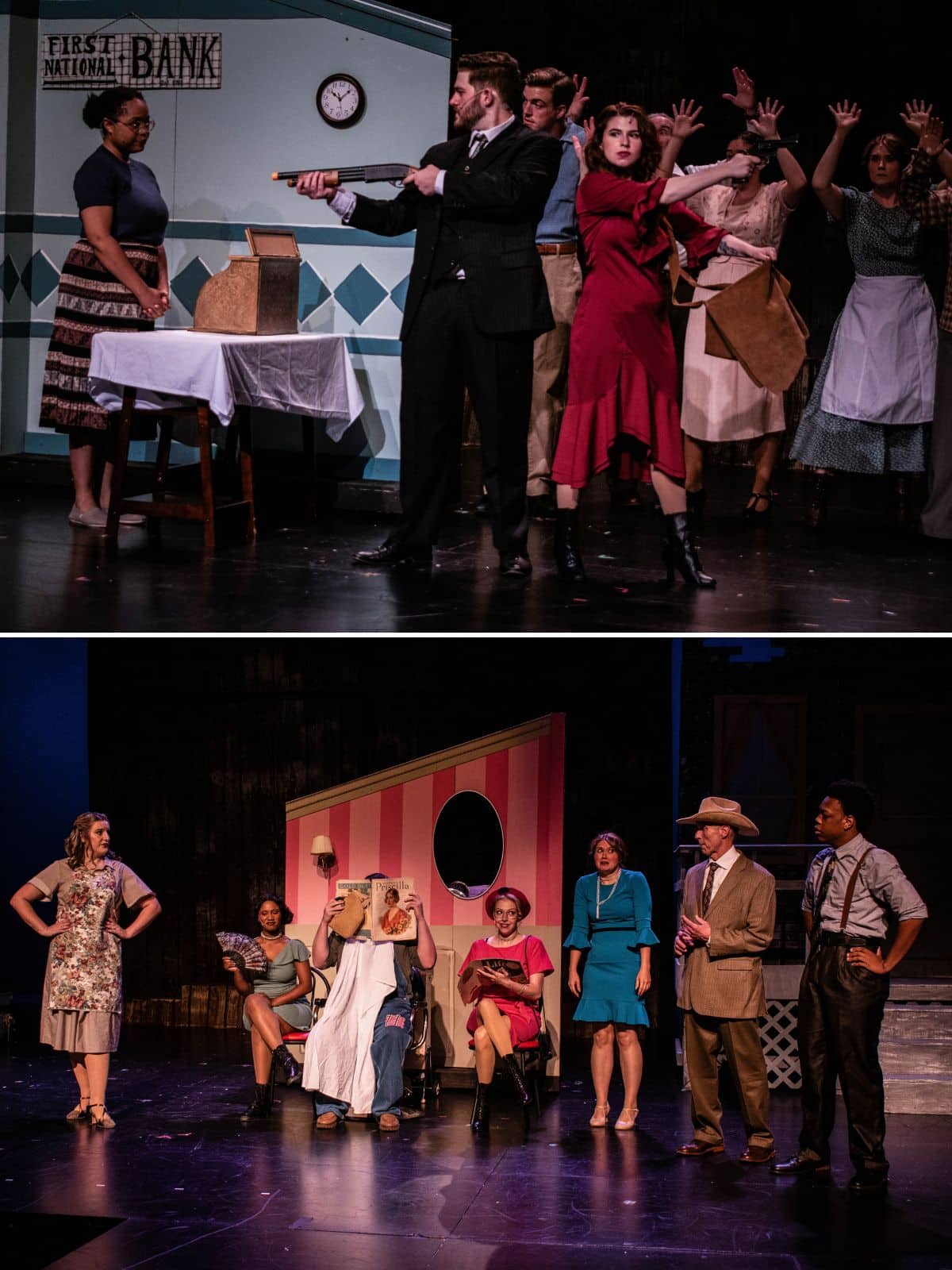
The production’s set work by set designer Madison Chupka is deeply impressive, particularly considering how frequently large setpieces must be shifted or altered to accommodate the rapidly evolving story. Lead carpenter Samuel Zion Thompson and lead painter Kim Leone, and their team of 28 set construction and painting crew members have done truly excellent work creating visually sumptuous setpieces that reflect the gritty world of Depression-era West Texas and also serve the production’s logistical needs.
Meanwhile, the costuming certainly meets the production’s basic needs, but in moments, some of the dresses and shirts leave the audience wanting for more texture and detail. Bonnie’s red dress, for example, feels clearly purchased from a modern store. Also, after Bonnie begins building wealth and changes permanently into her red dress to, in part, visually show that wealth off, she lacks any accessories — not even a holster for the gun she touts. We hear her excited about her money — why would this character not choose more clothes that reflect it? Further, neither Bonnie and Clyde’s costumes are at any point roughed up to reflect the fact they’ve been army-crawling while getting shot at, or recovering from bloody injuries. This is Depression-era Texas, after all — shouldn’t there be more dust and dirt on everyone, not just on the sets? Adding that extra mile of texturing and detail to the costuming would bring further immersion, realism, and believability to this production.
But the production’s set design, memorable performances, and strong material win out. Bonnie & Clyde is a phenomenal production and labor of love from its massive cast and crew and its directors, whose emotional connection with the work clearly shows.
Running Time: Approximately two and a half hours with one 15-minute intermission.
Bonnie & Clyde plays through September 20, 2026, presented by The Arlington Players, performing in the Thomas Jefferson Community Theater at Jefferson Middle School, 125 S Old Glebe Rd., Arlington, VA. Tickets ($33 for adults, $28 for seniors or military, and $23 for students) may be purchased online.
The cast and production credits are online here.