
The moment the curtain rises, playwright Oliver Cotton’s The Score — playing through October 25 at Shakespeare Theatre Company in a visiting production from Theatre Royal Bath — is designed for entrance applause. Johann Sebastian Bach, played by Emmy- and Olivier Award-winning actor Brian Cox, stands alone in his dim apartment, waiting patiently, like the suitcase by the door, for the audience to finish offering their regard before getting down to the business at hand. It proves to be a fitting start for Cotton’s nearly three-hour hagiography of the legendary composer.
Based on true events, The Score sees Bach summoned to Potsdam from his home in Leipzig by Prussian King Frederick the Great (Stephen Hagen). Bach is reluctant to leave his wife, Anna Magdalena (Nicole Ansari-Cox), behind, as Prussian soldiers have occupied Leipzig and are terrorizing its residents. But eager to see his son Carl (Jamie Wilkes, very good), who works as a member of the king’s orchestra, and to appeal for the withdrawal of the soldiers, Bach goes. The king has ulterior motives, however, and intends to humiliate the old man by presenting him with a complex musical theme and asking him to improvise a three-part fugue with it. Bach does so handily, of course, and seizes his moment to scold the king for his military transgressions.
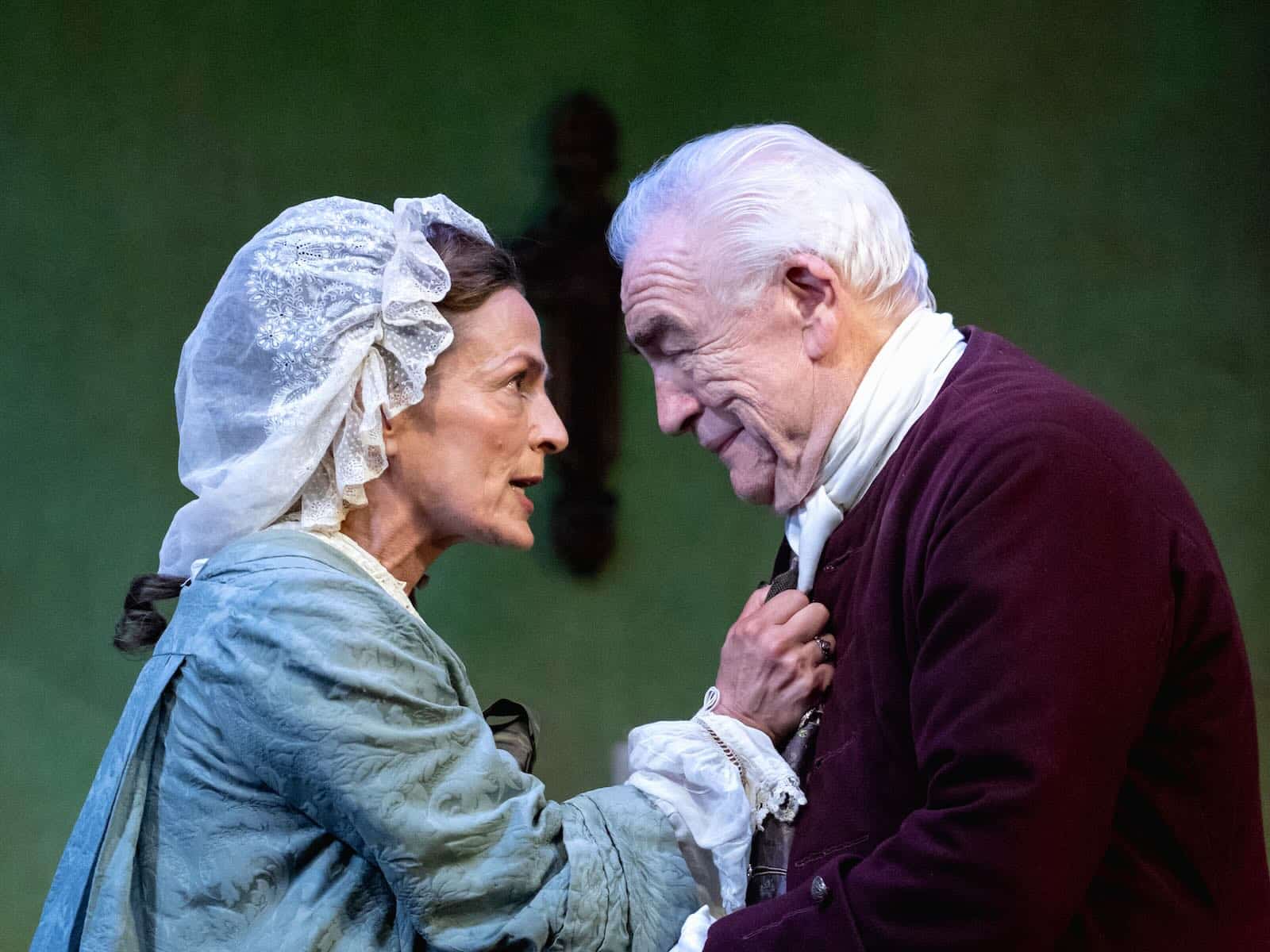
In Bach, Cox has found a perfect vehicle to showcase his stage prowess and dilute the ruthless reputation of his better-known role, Logan Roy in HBO’s Succession. His Bach is similarly commanding, but exponentially more kind and concerned with the grievous acts being perpetrated on his community. He is generous and pious, and his worst trait is occasional grouchiness. The magnetic Cox throws his arms around every moment of marital and parental tenderness Cotton’s script offers up, showing that genius and soft-heartedness are not mutually exclusive.
Bach’s nemesis King Frederick, on the other hand, is practically free of any redeeming traits, or the capacity for self-reflection that would foster a more compelling dramatic arc than the play achieves. He is vain, areligious, and unapologetically cruel. Cotton sets the king up for his own humiliation before the audience, many of whom learned the solfège under Bach’s watchful portrait in elementary school. The inevitable sequence that provides the hook for the play — the hawkish king failing to defeat the artist — is over in a blink, anticlimactically.
That leaves Cotton to pad The Score, which clocks in at just under three hours, with asides meant to raise the stakes, both in the palace and back home in Leipzig: a farcical wager the bettors can’t afford, a diversive confrontation between Anna Magdalena and a soldier intent on quartering in her home, and recurrent meditations on concealed emotion’s tendency to sneak itself into compositions. Cotton clumsily entwines two separate threads intended to humanize the king — one that hints loudly at Frederick’s gayness and his father’s responsive homophobia, and a second that indicates Frederick inherited his cruelty from his father — to inadvertently suggest that poor parenting can drive a gay child to war crimes. But Cotton nevertheless struggles to muster gripping drama in the moment it matters most, when Bach finally seizes his opportunity to confront the king. Instead, he presents a one-sided argument that boils down to the difference between right and wrong. When Bach presents the king with a story of a blind girl who was sexually assaulted by a group of Prussian soldiers, the king callously shrugs and dismisses the tragedy as an inevitable side effect of war. That our hero is so clear from the start, and proves himself easily over and over, makes for high moral satisfaction, but poor storytelling.
Cotton’s larger aim is clearly to show the artist speaking truth to power, and in light of events surrounding a particular performing arts facility in Washington, the parallels and messages are easy to deduce. But, oddly, The Score’s most compelling and cogent argument is something else entirely: the gifted Bach spends so much time tending to the demands of everyday work that he has little left to cultivate the genius inside of himself. With public arts funding in an ever more precarious position, and resources for those artists who’ve not yet had the time and space to prove their genius shrinking, this plea to let the artists focus on creation is uniquely moving.
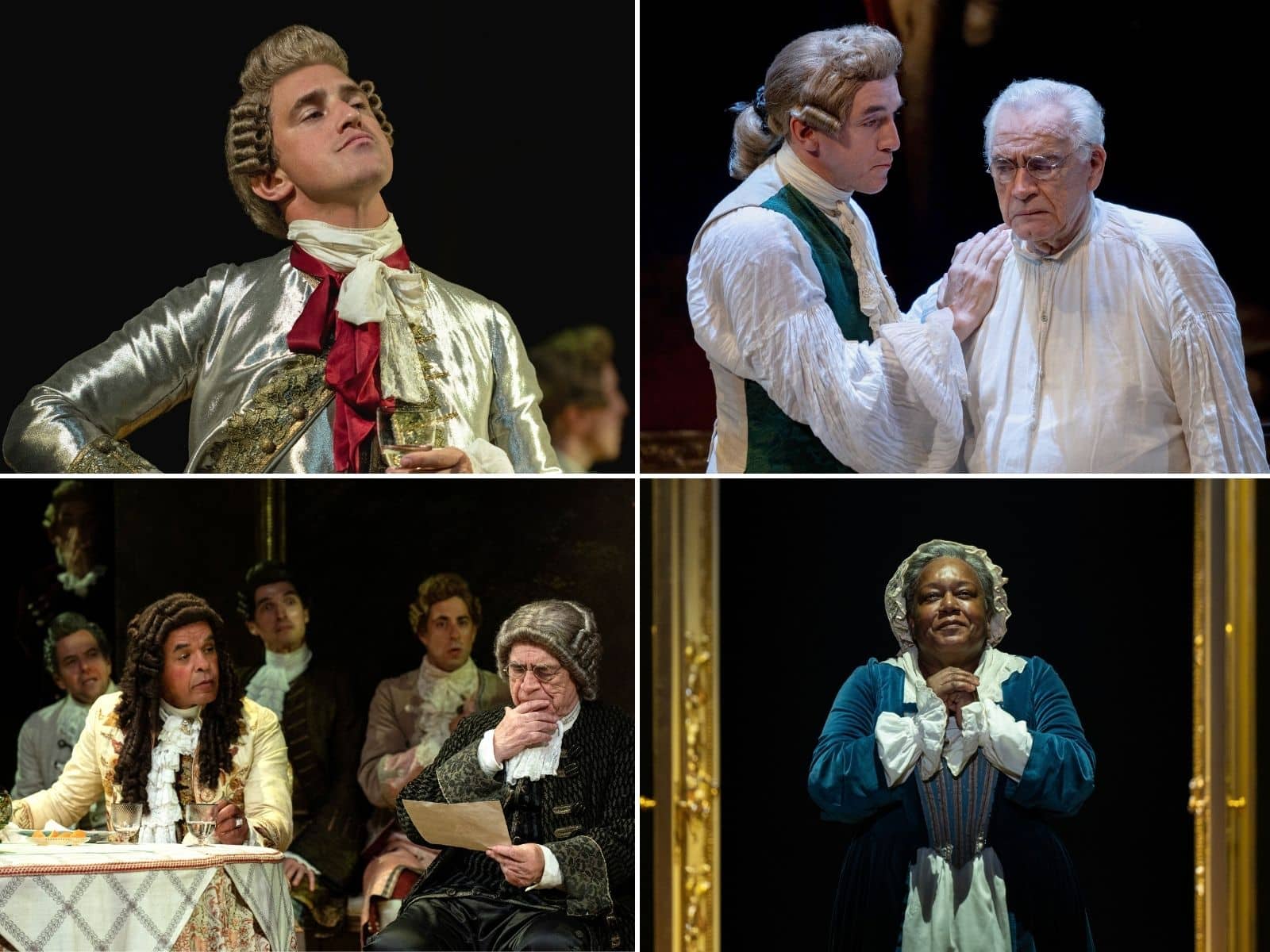
Despite the challenges of the play, director Trevor Nunn, his designers, and the ensemble put forth a handsome production that fits well in Shakespeare Theatre Company’s towering Harman Hall. Set and costume designer Robert Jones seizes on the contrast between the plain and pious Bach and the dandyish king in his scenic work. The Bach home is made of earthy tones, with a cross and a piano as its primary focal points. Jones’s gilded palace set pieces blend 18th-century French grandeur with characteristic Prussian militarism, and persistent window lighting (designed by Johanna Town) subtly bolsters Bach’s insistence that they all serve a force beyond the material world. Sound designer Sophie Cotton nicely handles (Handel’s?) the classical score that wafts from the king’s expensive Silbermann keyboard. An ensemble of deferential court musicians, courtiers, and soldiers emphasizes the power structure into which Bach enters, and all embrace opportunities for characterization that remind the audience of their individual humanity. Juliet Garricks is especially affecting as the servant Emelia, who illustrates the challenging position of working-class Prussians who feel the downstream effects of their king’s ferocious militarism.
Nevertheless, if the play itself leaves much unanswered, the performance at its center is unquestionably terrific. Fans of Cox and Bach will walk away from The Score satisfied at seeing one extraordinary artist paying tender tribute to another — and having the opportunity to do the same themselves.
Running Time: Two hours and 45 minutes with a 15-minute intermission.
EXTENDED: The Theatre Royal Bath Production of The Score plays through October 25, 2026, at Shakespeare Theatre Company’s Harman Hall, 610 F Street NW, Washington, DC. Tickets ($39–$195) are available at the box office, online, by calling (202) 547-1122, or at TodayTix. Shakespeare Theatre Company offers discounts for military servicepeople, first responders, senior citizens, young people, and neighbors, as well as rush tickets. Contact the Box Office or visit Shakespearetheatre.org/tickets-and-events/special-offers/ for more information. Audio-described and captioned performances are also available.
The Asides program for The Score is here.
The Score
Written by Oliver Cotton
Directed by Trevor Nunn
Set and Costume Design by Robert Jones; Lighting Design by Johanna Town; Sound Design and Additional Compositions by Sophie Cotton; Associate Direction by Cordelia Monsey