
There are few scripts so powerful that no company can mess them up. Jean-Paul Sartre’s No Exit is at the top of that short list. Even a kindergarten class attempting a performance would likely still leave one pondering the nature of existence, because that is what Monsieur Sartre dedicated his powerful mind to making sure you do.
No Exit presents a theory of hell, which of course is also a theory of the human condition. The show is currently playing at the ARTfactory in Manassas, directed by David Johnson. The production is one long act with no intermission — as it should be, since this play has no climax or narrative arc. Three main characters provide the constant yet chaotic dramatic tension.
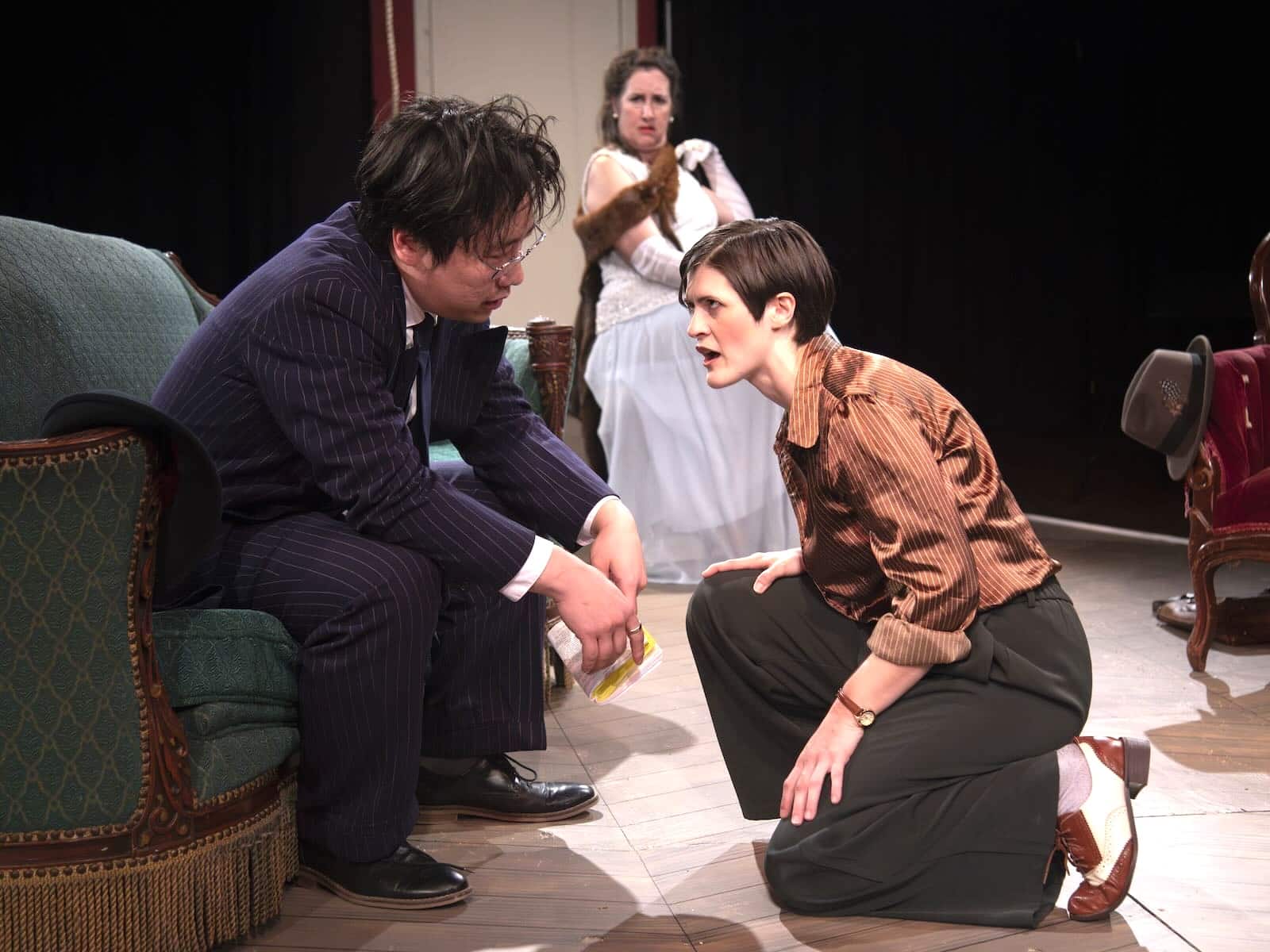
Andrew Chi plays Vincent, a high-minded journalist and unremorseful louse. (Chi stepped into this role only a couple of weeks before opening night, which makes his consistent performance an impressive artistic feat.) Becca Parsons plays Inez, a secretary with a sharp intellect and a sharp personality, and Amantha Peterson plays Estelle, a mindless socialite devastated by the lack of mirrors in the afterlife, who sits at the center of their love-and-torture triangle.
The entire show consists of these three characters butting up against each other as they reflect on their lives on Earth and process their new circumstances now that it’s ended. These circumstances are simple. They are trapped together in an ugly and uncomfortable waiting room. There are no whips, demons, or thumbscrews. The only element consistent with the traditional Christian concept of hell is that it’s too hot. Yet the characters know exactly where they are. And it doesn’t take long for them to realize that they have been specifically chosen to torture each other for eternity. It turns out, as Vincent famously puts it, “Hell is other people.”
This is one of many lines that assault you with ideas. As you watch the characters squirm in their tiny prison, you watch them realize what is happening, understand the nature of their torture, understand that they theoretically have the ability to end it at any moment, and likewise understand that they never will. Like an addiction or a toxic relationship, they know the source of their suffering but are powerless to break the cycle. Even when the hallway door bursts open, no one is willing to walk out.
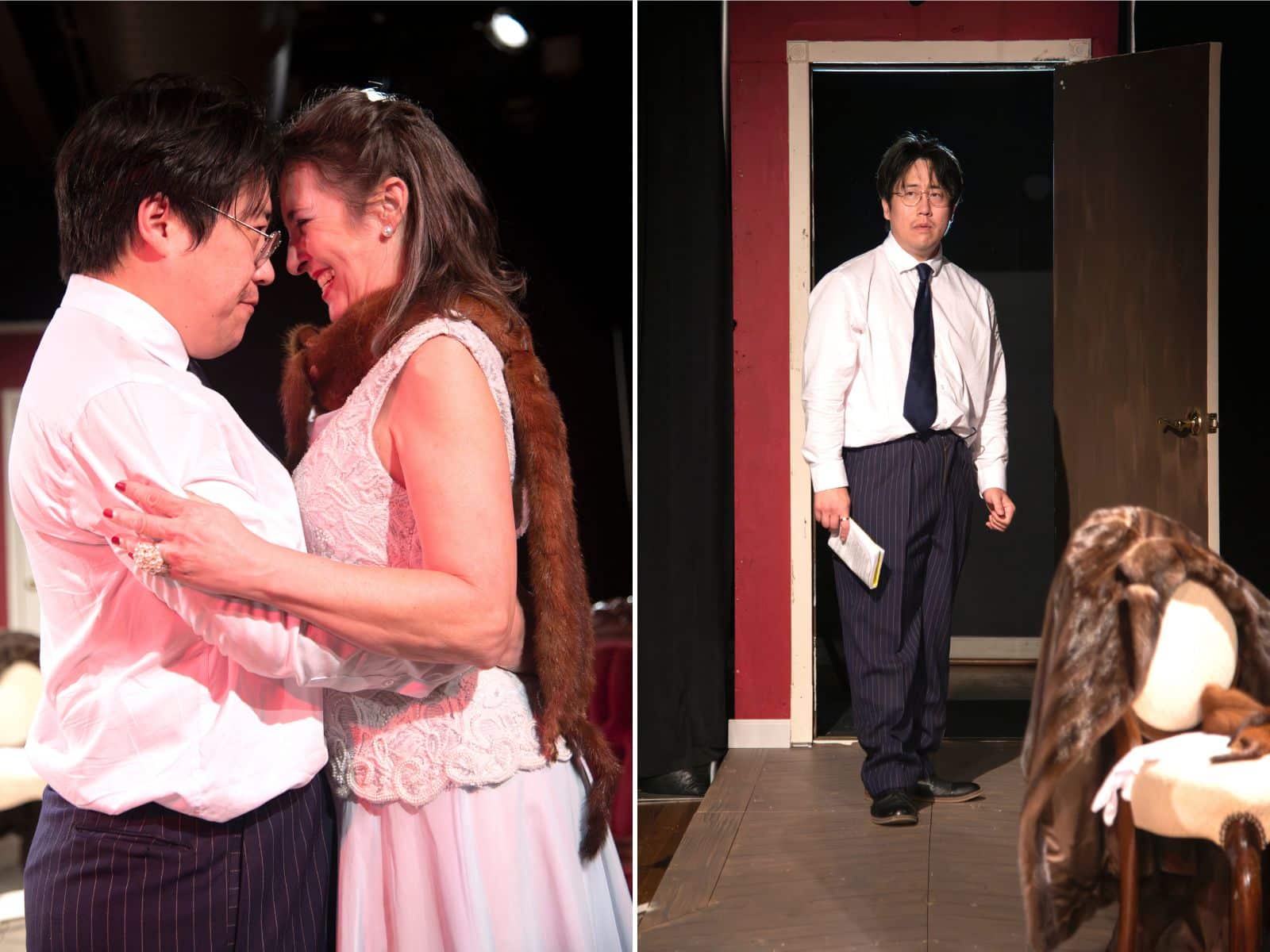
The waiting room has no windows and no way to turn out the glaring lights. (Anyone who has been stuck at a “team-building” in a hotel basement meeting room understands the applicability of such a setting for torture.) But most importantly, there is no sleep, no blinking even, and, as mentioned, no mirrors. Since the characters cannot see themselves or be alone with their own thoughts, each becomes what the others perceive them to be. Walking out of the door means walking away from those perceptions. If a tree falls in the woods and no one is there to hear it, did it make a sound? If a person exists but no other person is there to perceive them, do they really exist at all?
The ARTfactory creative team and crew nailed the ambiance for presenting these unsettling questions. The lights (lighting design by Matthew Sirocky) are bright and still, and all is silent except in flashbacks to Earth when the lights warm and dim. Suddenly, we hear music (sound design by Chris Beatley), adding dimension to these visions, which is then noticeably absent in the normal waiting room exchanges.
The room itself and the stage are set up in a triangle (scenic design by Lucas Weber), so each of the three characters has their own corner. They are thus always facing each other and seem to always have their backs against the wall. In addition to it being a very small area, this beautifully aids the tension. The furniture is uncomfortable on sight. The generic cursive “home” sign above the door is an expert touch, as is the deep cut indie song playing before and after the curtain. Neither Shazam nor I was able to identify it, but someone at the ARTfactory found the ideal mood-setter.
No Exit is always a show worth seeing because it discusses ideas always worth pondering. Sartre is not known for his optimism, but his existentialist philosophy has two sides. No Exit presents what happens when humans rely on the group for meaning and identity. We have limitless, eternal potential to torture ourselves and others. But if hell is a prison of our construction, we also have limitless, eternal potential to be our own salvation. At any moment, anyone who has the courage to define her own path can take it. Just because the characters fail to walk out of the door when they have the chance doesn’t mean we can’t take it.
Running Time: One hour and 45 minutes, no intermission.
No Exit plays through September 27, 2026, presented by the Actors Theatre at the ARTfactory, in the Wind River Theatre (third floor), 9419 Battle Street, Manassas, VA. Purchase tickets ($28.29 for adults, $22.94 for students and seniors, including fees) online or by calling (703) 330-2787.