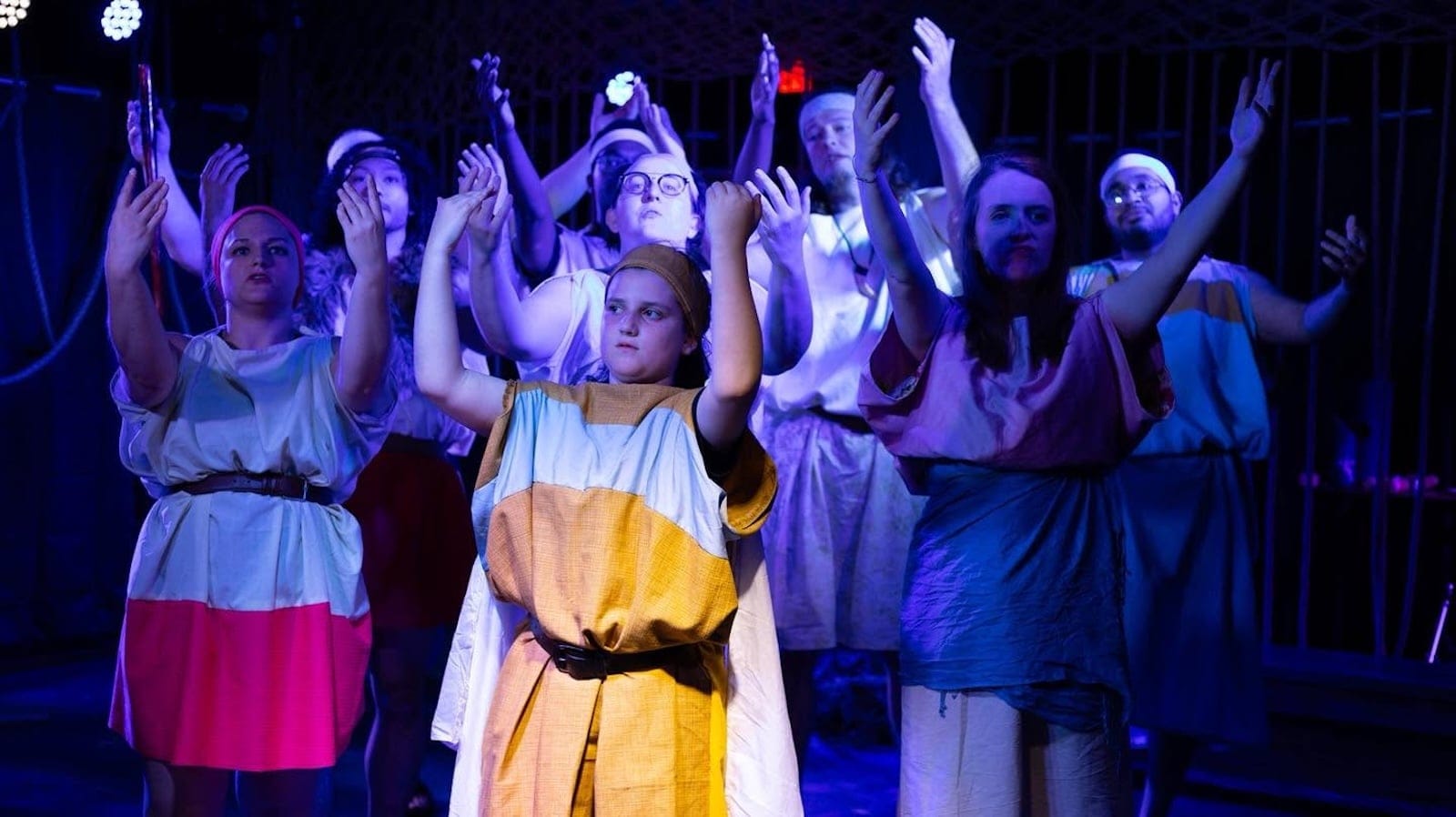
There is a moment late in City of Fairfax Theatre Company’s Argonautika when Athena stops the play cold and tells us to look up. Behind her, actors hold personal flashlights aloft, and the black box theater becomes a sky. It is a small effect — flashlights, darkness, a few bodies — and it is one of the most genuinely moving things I’ve seen on a local stage this year. Mary Zimmerman‘s retelling of Jason and the Argonauts is built for exactly this kind of invention, and director Joshua McCreary and his team have met it with a production that maximizes minimalism into something close to awe.
Mary Zimmerman’s Argonautika starts out as a classic, god-guided adventure, following Jason and his crew as they dodge monsters to steal the Golden Fleece and reclaim a throne. But the real heart of the play is the second act, which shifts to the tragic sorceress Medea, whose forced love for Jason drives her to betray her family and use dark magic to ensure his victory. It all builds to a haunting finale that reminds the audience just how terribly this love story is going to crash and burn.
This is theater made out of necessity, and necessity invents to the hilt. The space seats roughly 30. There is nowhere to hide, no wing to disappear into, no distance to soften anything. It feels like a double dog dare onstage. What the company does with that constraint is the show’s great pleasure. Olivia Hinebaugh‘s set is perfectly scaled and endlessly flexible — the benches alone go through so many transformations I stopped counting. The sky floor, painted by Katie Brunberg and Kaya Thomas, manages the rare trick of being invisible and magnetic at once, receding into the background when the story needs it and pulling focus when it doesn’t. The rope backdrop is used cleverly throughout, and the choice to let the night sky double as the water of the journey is inspired: the heavens and the sea as the same uncertain surface, which is more or less the whole thesis of the myth.
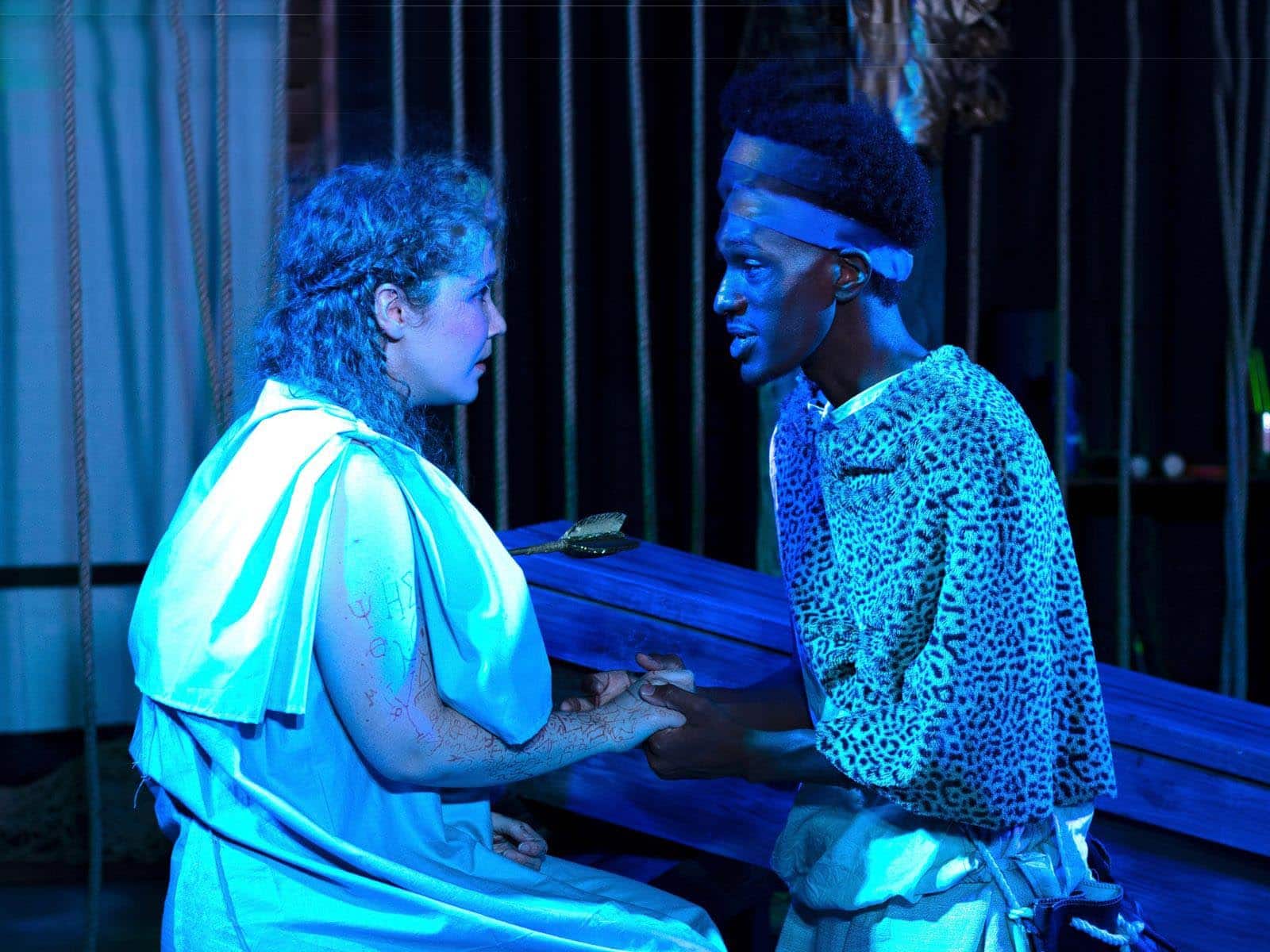
Misha McVay‘s costumes and Alexa Yarboro Pettengill‘s props are a tremendous nod to humanity’s theatrical past. Together they conjure something like an ancient street theater troupe in the best possible sense — performers with a trunk of cloth and objects, making gods out of nothing. The handmade sound effects are the production’s secret weapon: a water bottle cracking Pelias’s back, a wind machine grinding away, effects rendered by human hands in full view. They’re powerful choices, executed with real precision, and they left me feeling connected to a very old craft.
Jessie Tourtellotte‘s movement work is hugely creative and simply fun to watch, giving the ensemble a shared physical vocabulary that carries the story between locations and centuries. The puppetry — boats, baskets, masks, and a splendidly clever sea monster — does enormous work in encouraging the audience to suspend disbelief, and we do, gladly. The sequence in which the boat goes underwater, with Patricia Talmadge‘s lighting and McCreary’s own sound design working in tandem, is especially cool. So is the transformation of the single set into two distinct spaces for the encounter with the women of Lemnos, where scarves and movement do what a revolving set would do elsewhere.
Valerie Pesot is a chameleon through the first half, slipping between ensemble roles with total ease, and then hits like a ton of bricks when she’s unleashed as Medea after intermission. Do not miss her; the performance is nuanced, coiled, and genuinely unsettling. Molly Hanrahan is the ensemble MVP, morphing from Andromeda to Eros to the undead to a human baby puppet without ever seeming to catch her breath, though I occasionally wished for a bit more vocal clarity. Justin Belan carries excellent investment and weight, and as Idmon, his pain after the god-guided premonition that opens the play lands with real cost — you can feel him knowing. Katie Brunberg is a joy as Pelias, fully committed with comic timing right on point. Kai Yoffee‘s Hercules nails the comedy of a flawed, self-obsessed hero who somehow remains lovable, which is much harder than he makes it look; his cat-and-mouse grudge match with Hera is a running delight, and her snapping his oar in half got one of the night’s biggest laughs.
Liz Owerbach as Hera and Mikaela Fenn as Athena are the production’s anchors — truthful, invested, and meddling with purpose, each keeping the story bent toward her own will. Fenn’s closing monologue, her passion finally let loose, is a highlight of the evening and a reminder of how small we are against the span of history. Ennis Shahab is another strong ensemble presence across many ages and histories; his ghostly spirit beneath a black veil is a striking image. John L. Geddie brings a skilled earnestness to his characters. Aiden Abraham‘s Jason is consistent and steady, though I found myself wanting bolder choices from the center of the story. And Rhodri Mendenhall-Cordaro, all of nine years old, carries his part with honest, unfussy conviction — impressive acting chops, even if his focus on the onstage action wandered now and then.
The Argonaut roll call, delivered as a rap, is a high point, and the show as a whole captures the spirit of pursuit and adventure that makes the myth durable.
A production this exposed has nowhere to put its rough edges. Hinebaugh‘s fight choreography is solid in concept, but close quarters make sleight of hand difficult, and some exchanges read as clunky. More noticeable was an inconsistency in playing style: a handful of ensemble members, particularly among the Argonauts, broke into presentational delivery that the space simply won’t absorb. That may be a deliberate director-and-actor choice, but I didn’t read it from the group as a whole, and the unevenness registered. In a multi-role show, stark contrast between characters is essential, and several transformations felt like a tiptoe rather than a headfirst dive. A few transitions lost their sanctity to a late exit or an early light cue. These are fixable notes on a company otherwise working at a high level.
Credit where it’s due: a phone went off loudly during the first half, in a room where that should have been a momentum killer, and not one actor flinched. High praise, too, to stage managers Kaya Thomas and Terra Faye for transitions that were predominantly seamless.
“Don’t be so literal. You miss a lot,” someone says. This production takes its own advice, and it is the better for it.
Running Time: Two hours and 30 minutes with a 15-minute intermission.
Argonautika plays through September 27, 2026, at City of Fairfax Theatre Company, 11216 Waples Mill Rd Suite 103, Fairfax, VA. Tickets (starting at $16.81) were available online. The remainder of the run is sold out.