
The debate over whether or not a woman can play Hamlet might seem dated. After all, many successful actresses have played the role. But at a time when questions about whether women can serve in combat or vote have become part of our public dialogue, Theresa Rebeck’s Bernhardt/Hamlet is a timely tribute to a woman who never let anyone or anything stop her.
“There are five kinds of actresses: bad actresses, fair actresses, good actresses, great actresses — and then there is Sarah Bernhardt,” said Mark Twain. She was without question the leading actress of the late 19th century, and her name has become a synonym for theatrical genius.
Bernhardt had many lovers — among them the Belgian Prince Henri de Ligne and the future King of England, Edward VII. There were famous admirers of her acting, too: Victor Hugo, who was one of her lovers, and Sigmund Freud, who was not. Playwright Edmond Rostand, who appears as a character in Rebeck’s play, is said to have loved Bernhardt so much that he had his hair styled to match hers and even had his face made up like hers.
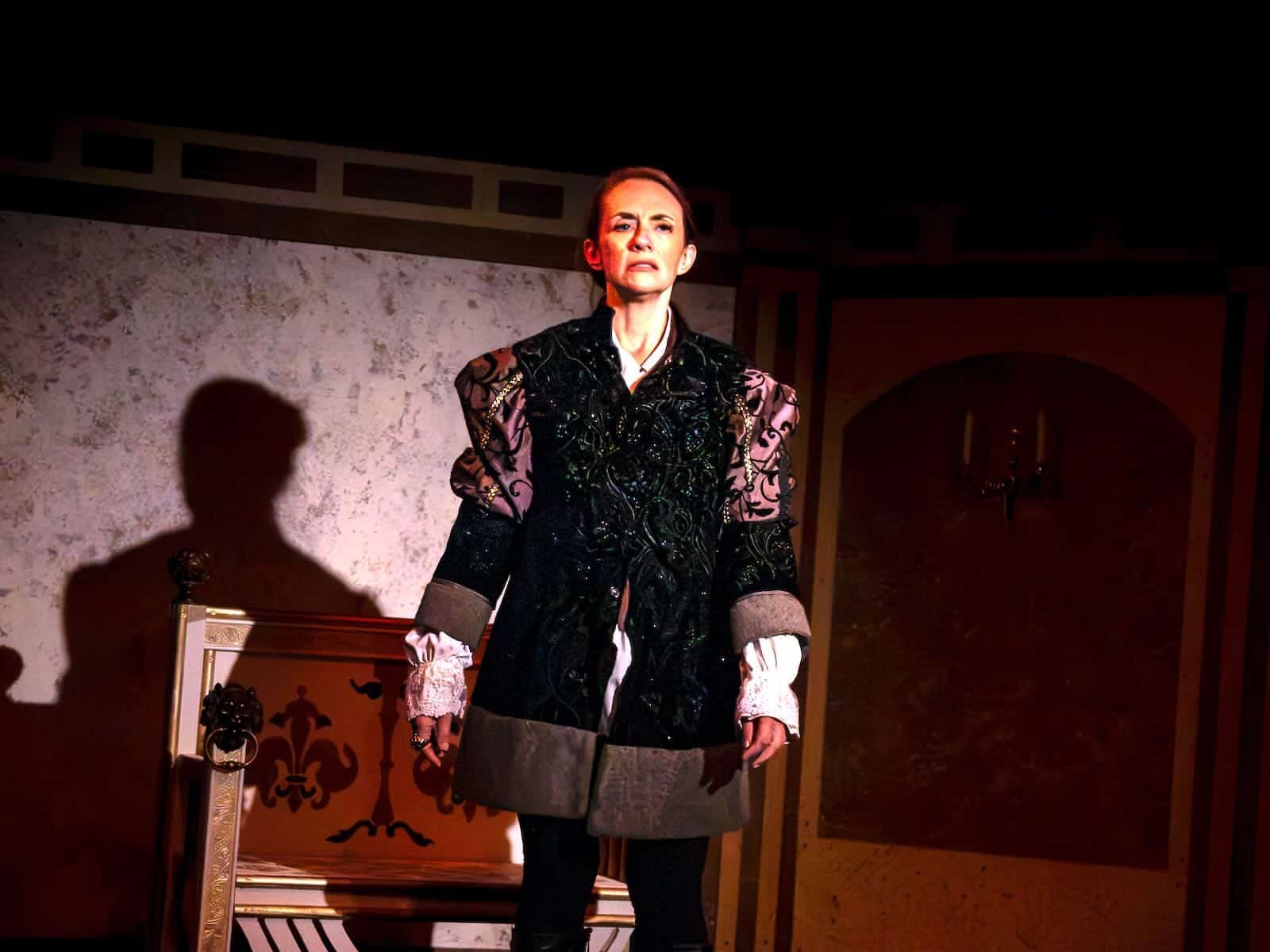
Bernhardt/Hamlet is set in Paris, 1897. As the play begins, Sarah (Andrea Spitz), in a striking black outfit (costumes are by Linda Swann), is rehearsing Hamlet’s famous “Oh, what a rogue and peasant slave am I!” speech. She is insulted when stage star Constant Coquelin (Tom Howley) (who reminds us that he has played the role four times) suggests that she doesn’t know her lines. Sarah, like many actors and critics before her, complains of Hamlet: “He speaks and speaks and yet does nothing.” Howley as Coquelin, Amanda Brenner as Lysette, Caitlyn Rooms as Raoul, and Daniel Ken Kato as Francois form a lively acting company in this scene, and the lack of solemnity in the approach to a storied text proves refreshing.
Sarah’s love affair with Rostand (Hanlon Smith-Dorsey) is a key element of the plot. They argue about love (he doesn’t want to leave his wife) and art (she considers Roxane in Rostand’s play Cyrano de Bergerac “an idiot”). Spitz’s Sarah is appealingly vociferous when defending her artistic opinions. Smith-Dorsey is at his best when defending his love for her to others.
Rachel Sclaff is passionate yet dignified as Rostand’s wronged wife, Rosamond, who was a poet and playwright in her own right. Kenneth A. Edwards adds a touch of comedy to his role as Alphonse Mucha, an artist who created Art Nouveau posters of Sarah’s stage roles. Sarah’s scene with her son, Maurice (Alan Gonzalez Bisnes), is a highlight of the production. (The real Sarah Bernhardt died in her son’s arms.)

As the critic Louis, Bill Hurlbut argues that the idea of a woman playing Hamlet is “disgusting” despite the fact that by the time Sarah played him, Hamlet had heen played by women as far back as the 18th century. Sarah, he claims, is too obviously a woman, too “light,” too “sensual.” In a scene with Rostand, they argue:
EDMOND: You mistake my meaning.
LOUIS: What is your meaning?
EDMOND: I have no meaning other than my dedication to our greatest actress. She commands our loyalty.
LOUIS: Oh is that what she commands.
EDMOND: Now I do not take your meaning.
LOUIS: Oh don’t you.
EDMOND: No I do not.
LOUIS: OH now, you can’t get offended because we all want to –
EDMOND: I am offended!
LOUIS: Why? She’s not.
EDMOND: I beg your pardon. I am tired. The new baby is … it cries.
LOUIS: Does it?
EDMOND: A lot.
LOUIS: No one told you to have children.
The play itself has flaws. The script is witty, but Sarah’s greatness is discussed a bit too often. The addition of a scene from Cyrano de Bergerac seems unnecessary. Sarah, as written, is fiercely dedicated to her art, but somewhat too obsessed by her own talent, which she refers to frequently.
There is perhaps too much text from Shakespeare, and it overwhelms the other dialogue. The Shakespearean acting is somewhat too modern in tone.
The music is light and entertaining (sound design by Jeff Miller). The set, by Maggie Modig, is attractive and tasteful. Lighting (designed by Andrew Harasty) and projections (designed by Brad Tehaan and Pam Burks) complete the handsome physical production.
Director Seth Ghitelman heroically explores every aspect of this sprawling, overstuffed play. At the end, a haunting archival projection of Sarah as Hamlet honors her appearance as the first person to play Hamlet on film.
Bernhardt, actress and icon, was rumored to sleep in a coffin and to possess, among her menagerie, a panther, a giant owl, a cheetah, and an alligator. Known for her fierce temper, she once slapped a more established actress at the Comédie-Française during a backstage dispute. She refused to apologize and was dismissed.
It would be difficult for any actress to play Bernhardt, especially when paeans to her greatness appear in almost every scene. Spitz does well in some of Hamlet’s monologues, and her performance strengthens as the play goes on.
In Rebeck’s play, Sarah endures an extraordinary amount of criticism for taking on perhaps the most famous male character in Shakespeare. But Bernhardt/Hamlet speaks to our time in a unique sense; in many ways, it is the story of the backlash women sometimes face when they have talent, power, or, even worse, both.
Still, here as everywhere, Sarah has the last word. She is, indeed, Divine.
Running Time: Two hours and 20 minutes, with one intermission.
Bernhardt/Hamlet plays through October 4, 2026, at Silver Spring Stage, 10145 Colesville Road, Silver Spring, MD. Purchase tickets ($30; $25 for students and seniors) at the door, online, or by contacting the Box Office at boxoffice@ssstage.org or 301-593-6036.
The program is online here.
The cast and creative credits are also here.