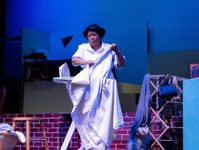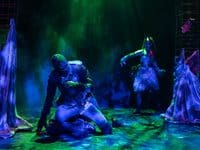
Bowie State University Theatre brings camaraderie and rivalry into close quarters with Ain’t Nothing But a Dog and Topdog/Underdog. Across an evening of strained relationships and competing ambitions, these student productions are strongest when their performers let a gesture, a look, or a silence reveal what their characters struggle to say.
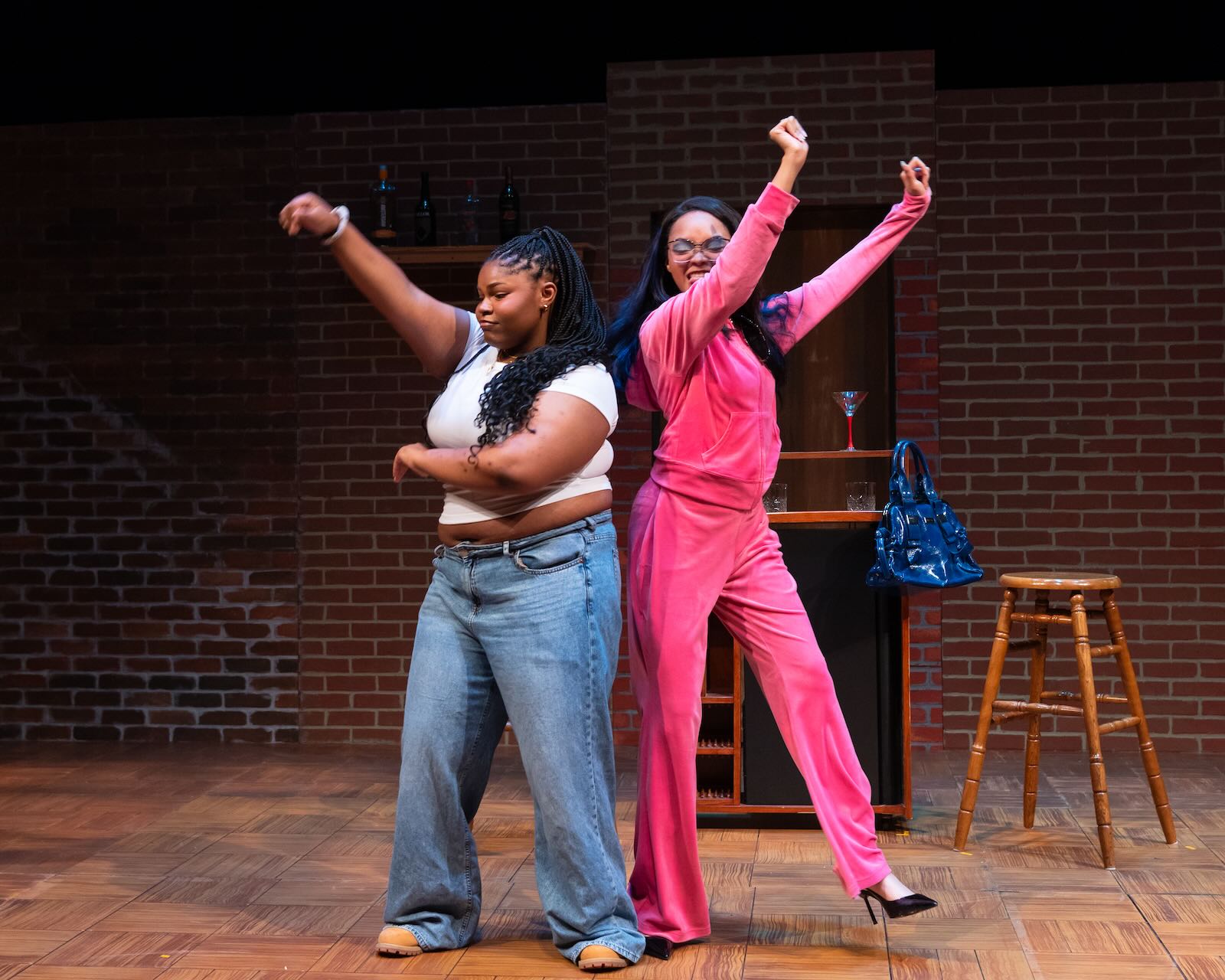
The evening begins with Ain’t Nothing But a Dog, devised and directed by Devin Harper. Set designer Brian Wise establishes a modest bar inside the Fine and Performing Arts Center’s (FPAC) black box theater, with two wooden stools, a compact drink cart, and bottles lining a shelf against a brick backdrop. The open floor gives the performers room to draw the audience into an increasingly revealing encounter.
Contemporary pop music from artists such as Doja Cat and Billie Eilish reinforces the show’s themes. Doja Cat’s “Vegas,” from the soundtrack to Baz Luhrmann’s Elvis, introduces the opening scene, setting a defiant tone for the conversation to come and an ominous foreshadowing of the subsequent play.
Cookie (Milan Hill) and Grace (Dana Goines) begin with an uneasy reunion, each trying to disguise the disappointments of her personal life. But every drink acts as a truth serum, loosening their defenses. Their guarded conversation gives way to confessions, romantic entanglements, and an unflattering portrait of the men audiences will soon meet. The companion piece lets these women tell their stories before Lincoln and Booth offer their own.
Goines brings flamboyant comic energy to Grace through clattering heels and exaggerated dance moves. Just as the performance approaches caricature, she pulls back to reveal vulnerability beneath the character’s vanity. Hill’s more restrained Cookie provides an effective contrast, delivering humor with an ease that makes her comic moments feel spontaneous. Their shifting alliance keeps the encounter lively as sympathy gives way to suspicion and back again.
The brick walls remain for Suzan-Lori Parks’ Topdog/Underdog, directed by Skylar Vincent, but the bar becomes a cramped efficiency apartment. A mattress and recliner occupy the background, while a cardboard box atop a set of crates forms a makeshift table between them. Here, Booth rehearses his three-card monte routine, practicing the confidence he hopes will change his fortunes. The furnishings show how little the brothers have before their arguments reveal how much is at stake.
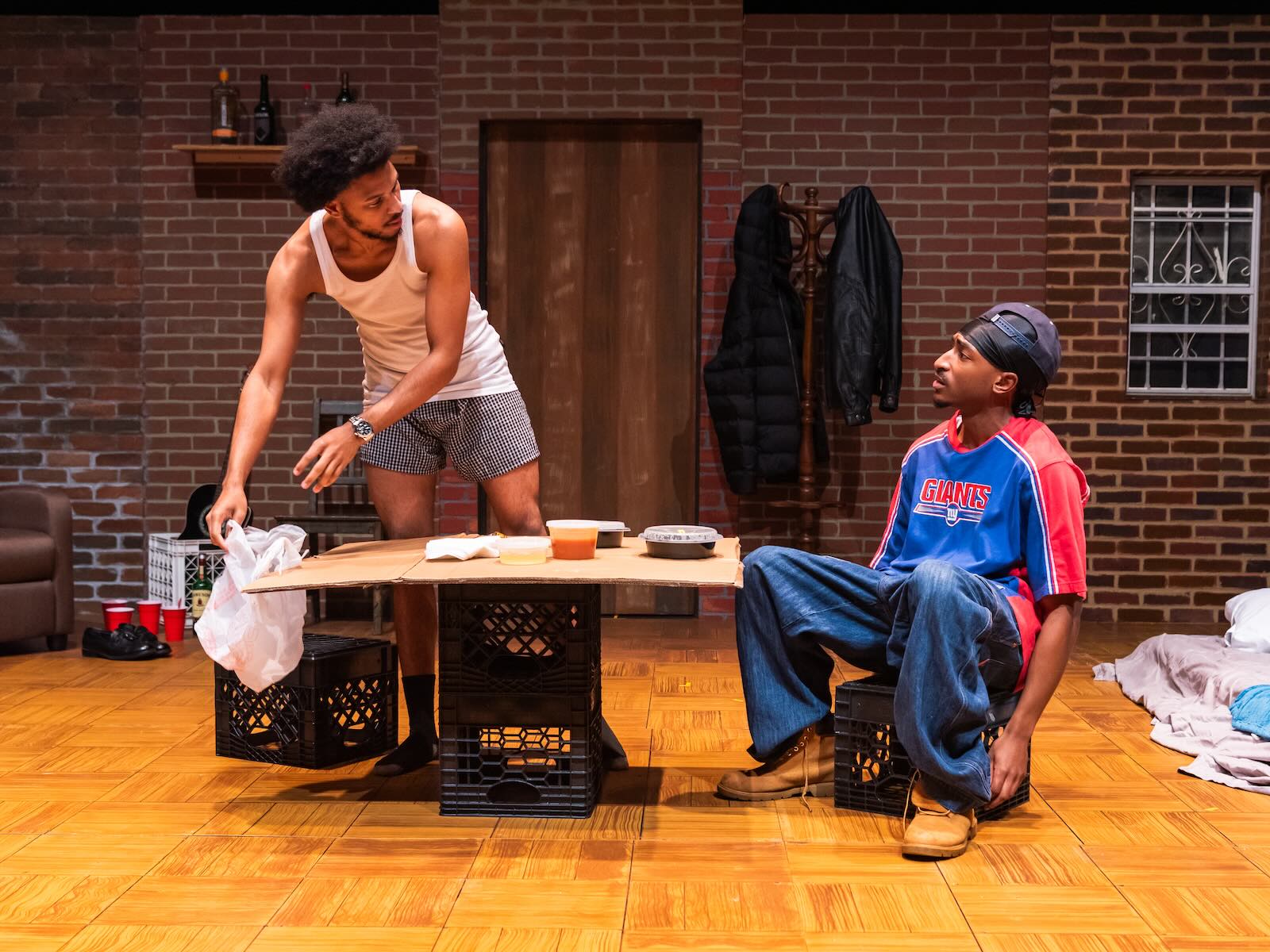
Lincoln’s arrival brings their relationship into focus. Sharing tight quarters, the brothers negotiate money, shelter, pride, and competing ideas of success. Lincoln earns a paycheck impersonating Abraham Lincoln at an arcade. Booth, meanwhile, gets by through petty theft and hopes to master the card hustling his brother has abandoned. Their names carry a warning, but their everyday struggles make the conflict personal.
Booth adopts the moniker “Three Card,” claiming the identity of the hustler he wants to become, but each time Lincoln slips back into calling him “Booth,” he exposes the distance between that image and the wounded brother he knows. Beneath the bravado lies a fear of abandonment that makes being fully seen feel less like intimacy and more like an existential threat — a sentiment that will come back to haunt them in the final sequence.
As Lincoln, Joshua Little acquiesces to his brother’s demands without losing his quiet authority or tenderness. Koda Carlton Myers lets insecurity, fear of abandonment, and a longing for acceptance show through Booth’s swagger. Together, their wit and physical comedy create an engaging rapport. Their quieter exchanges are especially affecting: a look or touch reveals the affection that their pride makes difficult to express.
Both directors make full use of the black box theater, engaging the audience seated on three sides. Costume designer Jazmin Grier’s velour tracksuits, baggy jeans, and fitted baseball caps evoke a 1990s New York City aesthetic. Sound designers Kofi Ames and Damien Ball connect music and movement with precision, while lighting designer Chayley Williams gives the opening piece an unsettling white glow and introduces red into the second play’s white and blue palette, suggesting an American promise under strain.
More varied pacing would strengthen the evening. Some exchanges settle into monotony; sharper shifts between teasing and confrontation could build tension. A shorter blackout between pieces would sustain momentum, while streamlining repeated costume changes and prop handling would keep attention on the relationships at the heart of the story. The actors’ expressive work deserves space to register without another task competing for attention.
Ultimately, the ensemble makes the card game feel like a contest over far more than money. Pride, trust, and the brothers’ fragile bond are also on the table. We watch to see who will gain the upper hand, but stay invested because we recognize what both brothers stand to lose.
Running Time: Two hours and 30 minutes, including one 10-minute intermission.
Content Advisory: Strong language, mature themes, and gun violence.
Topdog/Underdog plays November 5–7, 2026, presented by BSU Theatre at the Black Box Theater, Fine and Performing Arts Center, Bowie State University, 14000 Jericho Park Road, Bowie, MD. Tickets are $16 for general admission and $10 for students and seniors. Show information and tickets are available through the BSU Theatre box office.