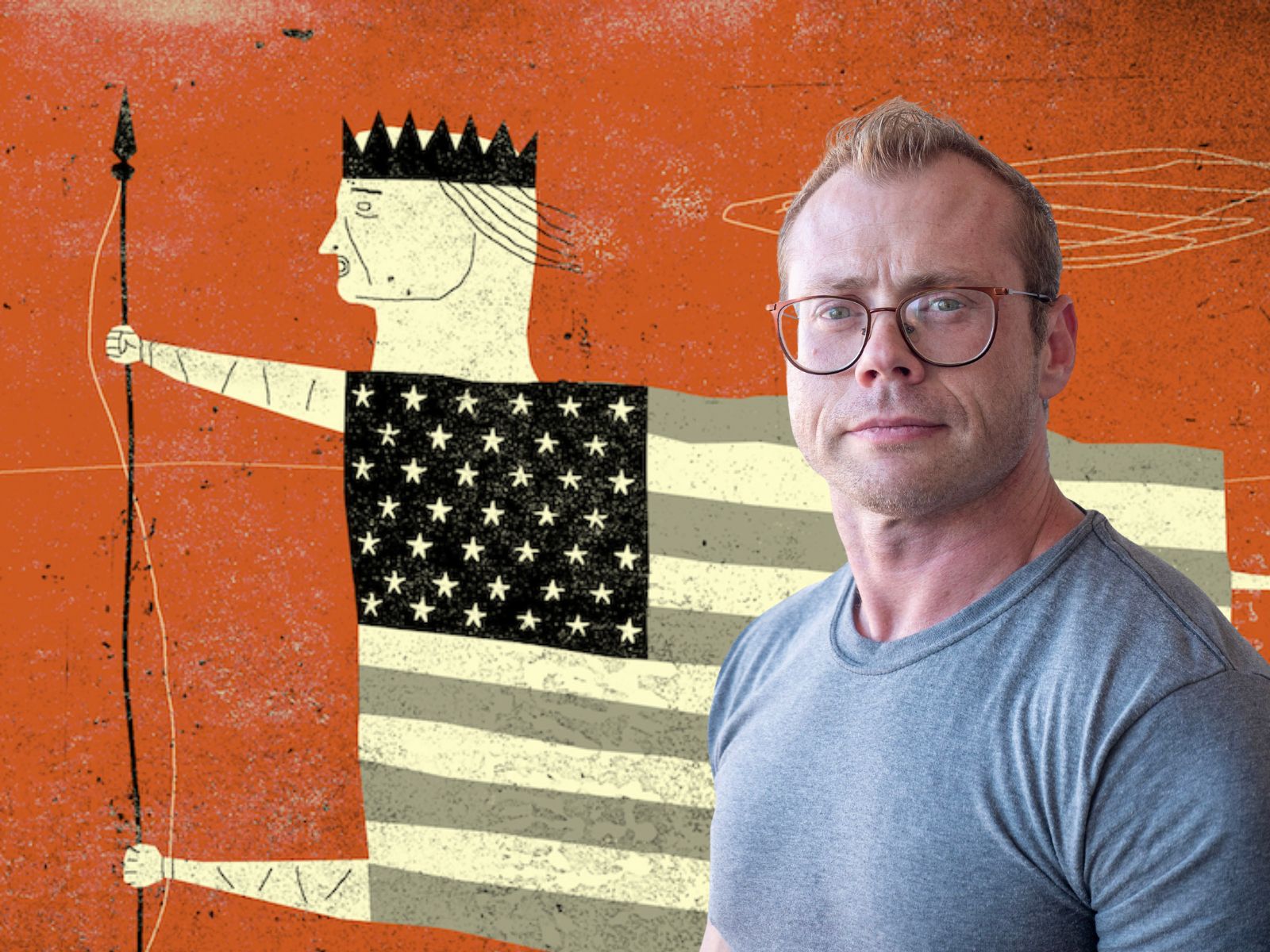
By Timothy Nelson, IN Series artistic director
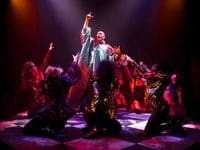
IN Series’ 2026/26 season, called Sic Semper Tyrannis, lifts up the ability of the arts, particularly music and theater, to unmask tyrants and tyranny. Obviously, we are living in a moment when such a season has urgent resonance, and we feel it is the privilege, but also the responsibility, of those with less to lose than perhaps their larger nonprofit neighbors to speak up, to make good trouble. It isn’t only about this moment, however; Sic Semper Tyrannis explores almost 1,000 years of music and text coming together to speak truth, to declare that emperors have no clothes. Even more, it isn’t just that the arts function in this way, but that they are uniquely able to do so with beauty, joy, pathos, catharsis, transformation, and laughter as well. As such, we open our season with The M.A.K.A.do: Make America Kingly Again!, a new version of the much-loved Gilbert and Sullivan operetta The Mikado, set in a contemporary gilded golden Oval Office, and hopefully at the same time serving as a model for how opera might deal with its own problematic canon.
It’s difficult to overstate the immense and immediate popularity and success of Arthur Sullivan and W.S. Gilbert’s The Mikado. The opera had its premiere on March 14, 1885, at London’s Savoy Theatre. It went on to play 672 performances before closing, making it the second-longest-running opera and one of the longest-running works of theater in history up to that point. Even more striking, after its March premiere and before December of that same year, it is thought that at least 150 companies around the world had produced the work. This uniquely beloved quality of The Mikado only proliferated in the century to follow as it consistently populated global stages with a regularity afforded to very few other works of its ilk, which are sometimes pejoratively referred to as operettas. Of that form, if it is a form in and of itself at all, The Mikado is most certainly the leading example, so much so that it is easy to lose sight of how original it was at the time of its composition, how apart it was from Gilbert and Sullivan’s operettas before or after its premiere, even those that have ridden its coattails to a similarly ubiquitous status.
The two artists had one early collaboration, a Christmas entertainment, but it was their next work, Trial by Jury, first produced by Richard D’Oyly Carte — who would become an important unnamed third collaborator in the ensuing canon’s success — that signaled the beginning of a wildly prolific artistic partnership. In those early years, they wrote together many of their most beloved works, including H.M.S. Pinafore and The Pirates of Penzance. Their British success, and even some international recognition, led D’Oyly Carte to form his own company and to build the two their own theater, The Savoy. This same D’Oyly Carte Opera Company stayed in active operation until 1981, more than a century after it was founded, an unheard-of legacy, and one that can trace its phenomenal quality to The Mikado.
Though Gilbert certainly played a hand in creating the myth of inspiration for The Mikado, it is generally agreed that no Japanese sword fell upon him in a moment desperately seeking a new subject, nor did he stumble upon the notion of a work set in the East because of a Japanese Village that had been constructed in the Knightsbridge section of London. Similar exhibitions of Japanese culture did inspire many of the orientalist works of the late 19th century, but in this case Gilbert had already sent an entire outline and practically finished the first act of the operetta by the time this London variation opened to the public. It is, however, little wonder that the world of Asia would inspire such a work, one where its creator sought to examine the idiocies, lunacies, hypocrisies of his own society from the safe distance of a mysterious and foreign land. Interest in the East had been growing throughout Europe in the 19th century and trade made tidbits of uninformed knowledge populate the ether of late Victorian London.
What makes The Mikado unique in the canon of orientalist works of this period, most of which fetishize, infantilize, and certainly diminish the lands and peoples they depict, is how little it has to do with Japan at all, how its maker was not really at all interested in the place or its people, but rather knowingly leveraged the mystery of such a place, a fictional place happening to also be called Japan, to safely poke satirical fun at the hierarchies and political nonsenses of his own time and place. Rather than looking down at the East through a Western lens, The Mikado looks down on the West with an unabashed fictional Eastern lens. There is no work of the time like it. Because of this, The Mikado could just as well have been set anywhere in the world or planet in the universe. The important quality is only that its setting is other enough that rules don’t apply, and the buffoonery of its place of creation can be illuminated.

This is not to say the work is free of problems. With the stumbles of any men of privilege writing from positions of elevated society and the greatest world power, empire even, of that time, Gilbert and Sullivan do resort to racist tropes in the use of pentatonic scales, Japanese-leaning names openly meant to also evoke British baby-babble, and even the use of the term “Mikado” itself, a use that was deeply insulting to a people who viewed the monarch as not only divinely ordained but also himself divine. Following its mad success, 100 years of unbridled joyful power in appearing in season programs throughout the globe, The Mikado — its music or humor never out of fashion as with some other works that are no longer often performed — fell from grace for this perceived cultural insensitivity.
It is easy to see in its use of Asian characters, places, and styles the same deep problems that exist in works like Turandot, Madama Butterfly, Les Pêcheurs de Perles. It takes much more time and contextual understanding to see that The Mikado is a very different piece. Its setting is actually irrelevant to its dynamic power as a comic masterpiece. Strip away its Japanese setting, and you lose nothing of this prowess. But, caught between the changing sensitivities of global audiences and stubborn refusal of an old-fashioned opera industry to treat their works with less precious sacrosanct original fidelity, The Mikado, perhaps the most brilliant comic musical play ever composed, has languished in a purgatory of affectionate memory tinged with fearful silence.
Everything about The Mikado seems unlikely: the pairing of its creators so different in personality, its composition in a time of deep divide, its unbridled popularity, its cancellation despite near-universal adoration, and, one hopes, its revival. Perhaps this revival, coming from such an unlikely canonic corner, can be instructive as to how other such works consigned to places of unbeing might appear and speak once more with meaning and power. Having the audacity to strip The Mikado of one of its most rightly celebrated aspects, that is Gilbert’s rhyming words themselves, and to turn to a living political satirist, Bari Biern, to re-language in a way that shows our America today — divided, ridiculous, odd and at odds, hyperbolic and hypocritical — that lampoons us ourselves, is doing the thing opera, unlike contemporary theater, rarely dares do. It, however, gives Gilbert’s masterpiece life; it makes it speak and live and dance and delight with immediacy once more. It is a tactic of which we believe Gilbert, and his less willing accomplice, would approve, and one that might show a possible way producers of great and troubled works, like our own great and troubled country, might approach saving those works by being willing to change those works.
Music makes the unpalatable delicious with its ability to spark wonder, beauty, catharsis, but also laughter. Hard truths become somehow approachable as toes tap to an irresistible beat and bodies dance despite themselves. This is the real brilliance of operetta generally, and particularly in the works of Gilbert and Sullivan. The tunefulness, the musical humor, and the wit with which Sullivan responds to Gilbert’s words make them magnetic. It is the particular way that these two mediums combust that the satire of The Mikado then, and The M.A.K.A.do now, becomes inclusive, eternal, and undeniable.
In DC: The M.A.K.A.do: Make America Kingly Again!, presented by IN Series, plays October 10, 11, 15, 16–18, 2026, in The Kogod Cradle at the Arena Mead Center for American Theater, Washington, DC. Tickets are available online and at TodayTix.
In Baltimore: The M.A.K.A.do: Make America Kingly Again!, presented by IN Series, plays October 23–25, 2026, at Baltimore Theater Project, 45 W Preston St, Baltimore, MD. Tickets are available by phone at (410) 752-8558 or online.
The M.A.K.A.do:
Make America Kingly Again!
An Operatico-Politco-Buffo-Satirico…
Based on The Mikado by Gilbert and Sullivan (London, 1885)
New English texts by Bari Biern
SEE ALSO:
Brash ‘M.A.K.A.do’ by IN Series mocks people in power with laughter (review by Gregory Ford, October 16, 2025)