After seeing Psalmayene 24’s staging of Measure for Measure at Folger, I left the theater exultant. I was overwhelmed by the brilliance and power of his production concept: setting the play in the segregated American South in the 1950s, in a stage space defined by signage separating “colored” from “white,” and framing the play explicitly through a lens of societal racism. It felt to me as if he had made Shakespeare’s play better, more relevant, more revelatory. When I saw him at the opening-night reception, I was raving with praise. With that enthusiasm still fresh in my mind, I was grateful for an opportunity to speak with him on Zoom and understand more fully what he has achieved. (This conversation has been edited for length and clarity.)
John Stoltenberg: Let me start by asking you about the inspiration for the concept, which was (as you say in your director’s note) an idea that struck you “like a lightning bolt.” What do you remember about that flash of principled creativity?
Psalmayene 24: Prior to the concept coming to me, I was still basking in the glow of the text of the play itself, to the point where I thought that the play could have been done as a very spare and sparse elemental production: no concept around it — just let the words shine. But then, thinking about my love of illuminating, interrogating, and celebrating Black history and culture, I thought there was an opportunity to be had with this particular Shakespearean play. I didn’t know what that was, and then it came to me: the Jim Crow South of the 1950s. And I think the reason was having thought about the themes of the play — which include power, hypocrisy, sexuality, corruption, mercy, redemption, forgiveness — and then thinking about the specific relationships in the play. All of those things seemed aligned with that time period; it felt like the time period could shed light on the text, and the text could shed light on the time period.
That definitely has happened. What did you want the play to be able to say in this conception?
Once we decided to set the piece in the Jim Crow South, we added the element of race, which is not an element that the original play tackles much at all. So once you put that extra layer of race on top of the play, then you begin to think about a particular sort of American spirit that the play alludes to; the play really says something specific about America.
And one of the things I think it says is that the problems that plagued us during that time period and that still plague us are really human problems. We deal with race, but race is a human issue that I think everyone has to grapple with. Some people may think of race or racism through their own particular lens of whatever group they identify with the most, but setting the play in that time period illuminates the universal nature of racism and difference and bias and prejudice, and that also can include elements of gender, which this play deals with.
I think there’s an opportunity for us to really think about what our American story is now and what it was in the past and what it can be in the future.
I was especially struck by how, in your production, racial politics illuminate and resignify the sexual politics in the play, starting with the relationship between Claudio and Juliet. In Shakespeare’s text, Claudio is locked in prison for impregnating Juliet out of wedlock. In your production, that happens, but also: Claudio is Black and Juliet is white — at a time (before the 1967 Supreme Court case Loving v. Virginia) when anti-miscegenation laws were still in place. So, in your production, the opprobrium Claudio faces is intensified, and audiences can sense that.
Would you talk about how you thought through the intersectional prejudice in that dynamic?
In that particular relationship between Claudio and Juliet, American history has done the dramaturgy for us because in the text, there are no explicit references to condemning this man because he slept with and impregnated a white woman, but it’s implied because of the poetry of the text. There are phrases and words that become redefined in this new context. For example, Angelo — the deputy who’s been left in charge, the man who condemns and sentences Claudio to death — has a line when he’s talking to Isabella where he mentions the beauty that’s underneath black masks. The original definition was not implying anything about race, but with this treatment, we understand there’s a fetishization of Isabella by this white man.
And I began to think about that in terms of the history of the Jim Crow South and about why Black men were lynched. They were commonly and falsely accused of raping white women or making passes at them. And in our production, it makes me think about the sexual violence and sexual abuse that Black women have undergone during that time period.
We had a historical consultant, Modupe Labode, join us for this production from the National Museum of American History. And she said that we know that that type of sexual violence against Black women by white men happened a lot, but we don’t have a lot of reportage on it because of the power dynamics and Black women’s fear of speaking out. And that’s connected directly to Isabella’s “to whom should I complain?” monologue. So, what I wanted people to think about was not only the time period that we’re investigating in terms of history, but also how malleable Shakespeare’s text is, how it changes, and how you can approach it from almost any cultural perspective and you can glean meaning from that.
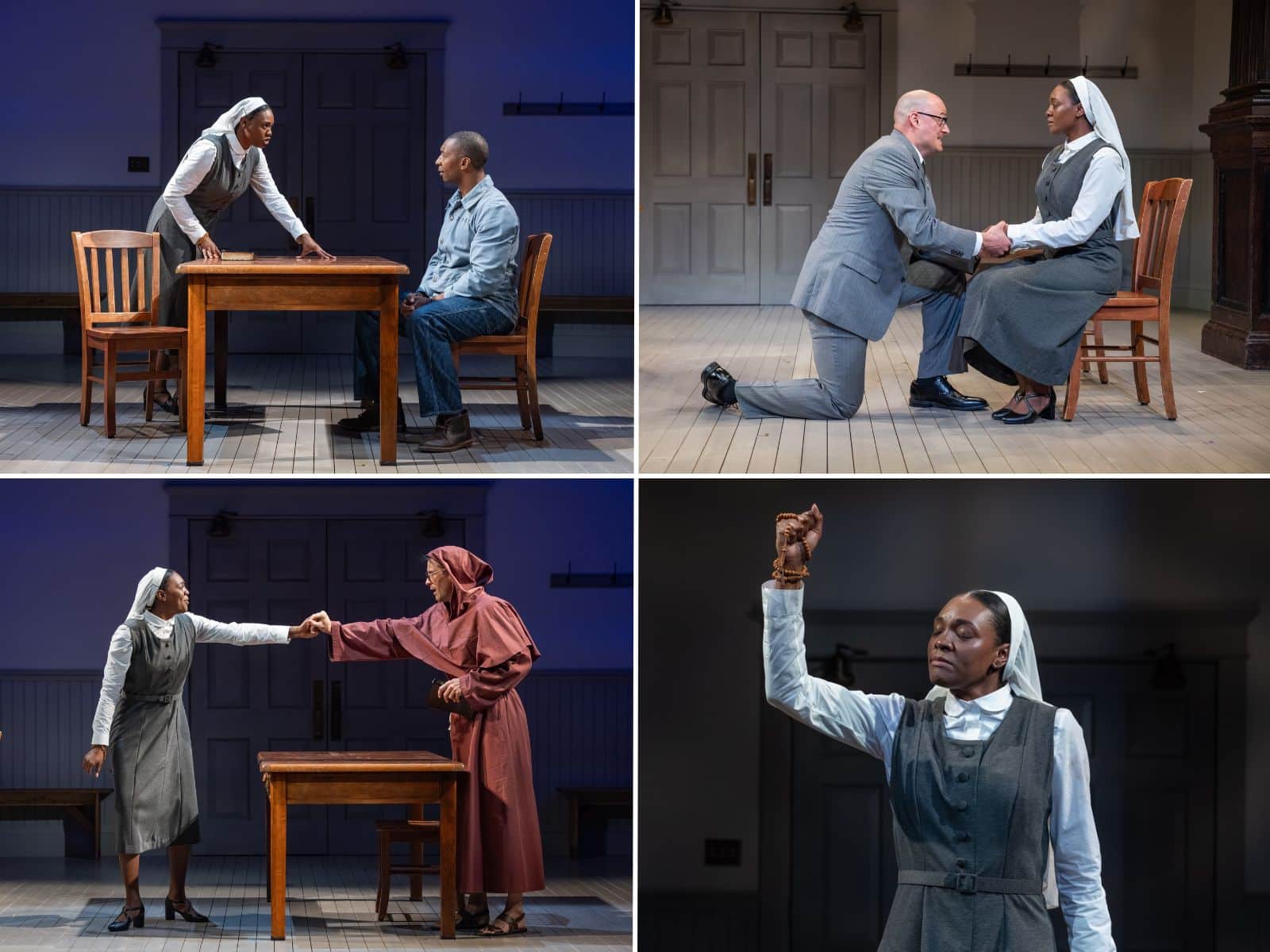
TOP LEFT: Isabella and JaBen Early as Claudio; TOP RIGHT: Lee Osario as Angelo and Renea S. Brown as Isabella; ABOVE LEFT: Renea S. Brown as Isabella and Nathan Darrow as The Duke (disguised as Friar); ABOVE RIGHT: Renea S. Brown as Isabella, in Folger Theatre’s production of William Shakespeare’s ‘Measure for Measure,’ directed by Psalmayene 24. Photos by Erika Nizborski.
Measure for Measure is often considered a “problem play” for its tone swings, but to my mind one of its biggest problems is its so-called bed trick — when Angelo, the Duke’s proxy, tells the nun Isabella that he will grant clemency to her brother Claudio if she will let Angelo have sex with her. Then the Duke, disguised as a Friar, offers Isabella a way out: in darkness he will send Mariana, Angelo’s ex, to a tryst with Angelo instead. We can infer from Shakespeare’s script that Angelo’s a sexist for whom all women are alike in the dark, or else the trick wouldn’t work. Echoing that in your production — where Angelo is white, and both Isabella and Mariana are Black — is the trope that to racist whites all Blacks look alike. That amplification of dramatic import and impact in the bed trick just blew me away. Would you talk about that?
I did not explicitly look at the bed trick through that specific lens, but I do think it’s valid, and it speaks to how race and sexuality are so intertwined. That’s something that we did talk about in terms of the bed trick. But we looked at it from a different angle: the desire for the Black body and whether that desire is so fervent that it’s blinding. And you’re so enamored or obsessed that it doesn’t matter what Black woman fills that slot.
So, I think there are many different ways of looking at it. And there are things that audience members say to me that I didn’t necessarily intend or see, but I think that’s valid. Any great work of art invites multiple viewpoints and perspectives that are valid. I mean, when Shakespeare wrote Measure for Measure — 1604 is when it was premiered — could he ever have imagined that in 2026 we would be doing the play in America and then setting it in the 1950s where Jim Crow and racism are rampant? I mean, that’s part of the brilliance of Shakespeare: he can hold multiplicities, in terms of concepts and ideas and humanity.
I think you make it more meaningful than it was even then. And the overlay of racial politics and sexual politics also plays out in the relationship between Isabella and the white Duke disguised as a Friar.
Absolutely.
In the play, he clearly desires her. And I’m not going to give away your newly devised ending, which is amazing — except to say that it reads as a stunning moment of simultaneous resistance to both racial and sexual oppression.
Yes.
I think that’s implicit in your ending.
Yes.
I want to backtrack a bit and ask how the concept developed during pre-production in collaboration with other members of the creative team.
Well, we had to think about obviously what the scenic design would be. And in talking to [set designer] Deb Booth, we knew that we had to do something that worked well in the Folger, and she came up with a brilliant idea to use as inspiration the courtroom that the murder trial of Emmett Till happened in. There are elements of that specific courtroom that look like the inside of the Folger Theatre, with wooden rails and open space. And then she added pendant lights and fans. And then thinking about the musical world and how to use the genres of the time, but then thinking about how the popular music of that time was rock and roll, which is created by Black people, and then thinking about also the major players of that genre, who were Chuck Berry and Little Richard, but then Elvis obviously was the most famous. And then thinking about how appropriation plays into the musical palette that we’re creating.
One of the major points of investigation for us happened during the first couple of weeks of rehearsal. The first week was primarily table work, where we analyze the play; actors sit around a table, and we probe the play and interrogate it.
And the question came up: when are we leaning into the 1950s Jim Crow South world, and when are we strictly looking at the play through its original lens? And then at one point, I said, let’s just do a reading where everything is redefined in terms of this Jim Crow lens. So that’s how we tested not only the concept, but the malleability of Measure for Measure itself.
Working with the actors and really diving into the specifics and nuts and bolts of Shakespeare’s text was where we really discovered a lot of windows where this Jim Crow world could seep through.
DC audiences, you gotta love ’em, are very welcoming of so-called race-blind casting.
Oh, right.
Your Measure for Measure, though, would necessarily be race-conscious.
Race-conscious, exactly.
I’m interested to know how that concept informed the casting process and the rehearsal process.
That was an early conversation that I had with Farah Karim-Cooper, who’s the director of the Folger Shakespeare Library. And I had a conversation with Ayanna Thompson, who’s a well-known Shakespeare scholar, and she’s also on the board of Folger. And, obviously, there were conversations with our casting director, Danica Rodriguez. In talking to them about casting, we all agreed we had to root it in the historical realities of the time, because otherwise you water down the impact and you’re just not really being truthful with what the reality of that time period was. So, we decided to just go ahead with a binary casting system where it’s very much black and white, and then go from there.
When actors came into the audition room, they either discovered then or right before that we would be using a Southern accent. And we started to talk about the play from there. Some of those conversations ended up informing exactly how I approached the play.
Going back to your director’s note, you describe yourself as “a director who is driven to interrogate, elucidate, and celebrate Black history and culture through theater in universally accessible ways” — which I think is totally accurate. And you have absolutely done so in Measure for Measure. The show is hands-down a must-see.
Oh, man.
Which brings me to my last question: What’s your advice to creatives early in their careers about how to make meaningful art that matters?
I think you have to go within yourself and figure out what is meaningful personally to you, and what sets your soul on fire, and then go from there, because then you’ll always have the fuel to not only create, but to make it through this business.
I mean, this is a very tough business. It’s tough being an artist, I would imagine, anywhere on the planet, but I think it’s especially tough being an American artist. Support for the arts is not easy to come by. And by hook or by crook, you have to figure out a way to express your vision. So start with what you’re truly invested in and experiment with new things, too.
This idea of experimentation is very important. It’s the dichotomy between doing what you love and what you feel comfortable doing, but also being willing to go outside of your comfort zone. If you can marry those two things, I think you’ll find fulfillment as an artist. Success is something entirely different, but I think you’ll at least feed your soul.
Running Time: Two hours and 35 minutes, including one 15-minute intermission.
Measure for Measure plays through November 1, 2026, at the Folger Shakespeare Library, 201 East Capitol Street, SE. Tickets (starting at $20) are available online, by calling the Folger Box Office at (202) 544-7077, or at TodayTix.
The cast and creative team credits are here, and the program is online here.
SEE ALSO:
Folger Theatre’s ‘Measure for Measure’ turns a problem play into a revolution (review by Daniella Ignacio, September 29, 2026)
Folger Theatre announces casting for ‘Measure for Measure’ (news story, August 24, 2026)