Lights dim and voices swell as curtains burst open upon a dazzling youth ensemble dancing and singing the catchy opening number of Roald Dahl’s Matilda the Musical.
Before the gray plaid uniforms arrive, the children wear their personalities in color. Then school begins, and individuality gives way to regimented movement. That costume shift captures what Silhouette Stages’ exuberant rendition of Matilda the Musical understands about childhood: learning to fit in can come at a cost. This funny, inventive production gives its young rebels plenty to push against.
With a book by Dennis Kelly and music and lyrics by Tim Minchin, the musical adapts Roald Dahl’s story of a gifted child whose parents dismiss her and whose headmistress mistakes cruelty for discipline. Directed by Amy Haynes Rapnicki, this staging finds its heart in Matilda’s bond with Miss Honey, the teacher who recognizes what other adults refuse to see.
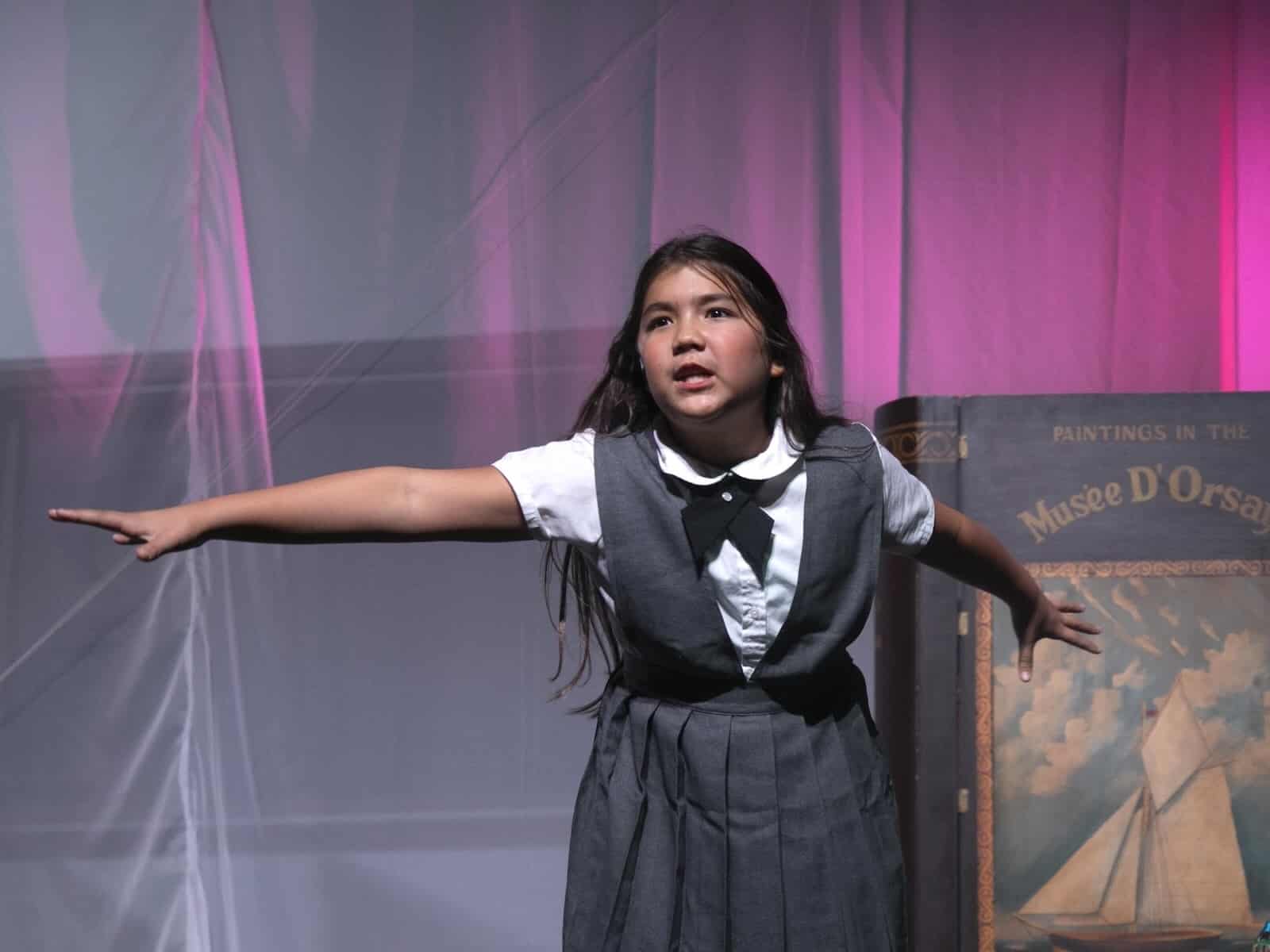
Caroline Anderson, who played Matilda on opening night October 9, anchors that struggle with conviction (the role alternates with Mary Fliehman; this review reflects Anderson’s performance). Opposite her, Ellen Quay gives Miss Honey a sublime singing voice. Their relationship makes the story’s concern with being seen feel personal, and reminds us that adults sometimes need a child’s courage, too.
Patrick Mulheron’s Miss Trunchbull is a comic force. The staging withholds the headmistress’s face until talk of stepping outside the rules ushers in “The Hammer.” It is a deliciously calculated introduction to a character obsessed with keeping everyone inside prescribed boundaries. The reveal shows how much a well-timed entrance can accomplish before the spectacle takes over.
Rosie Binnie brings a strong voice and an endearing stage presence to Bruce Bogtrotter, particularly in the cake sequence surrounding “Bruce.” As Lavender, Iris Hopwood-Meyer is delightful, drawing the audience into the fun after intermission. Brian Sackett as Mr. Wormwood also makes that audience interaction a comic pleasure. His character and Megan Mostow’s Mrs. Wormwood inhabit a household where volume and appearances routinely outrank understanding.
The younger and older children move together with impressive cohesion. Hunter Lubawski’s choreography draws on tap, ballet, and contemporary movement to create lively stage pictures, while the smooth first-act transitions sustain momentum. With music direction by Terin Kelsey, the production has ample energy; its most persuasive moments give that energy a clear dramatic purpose.
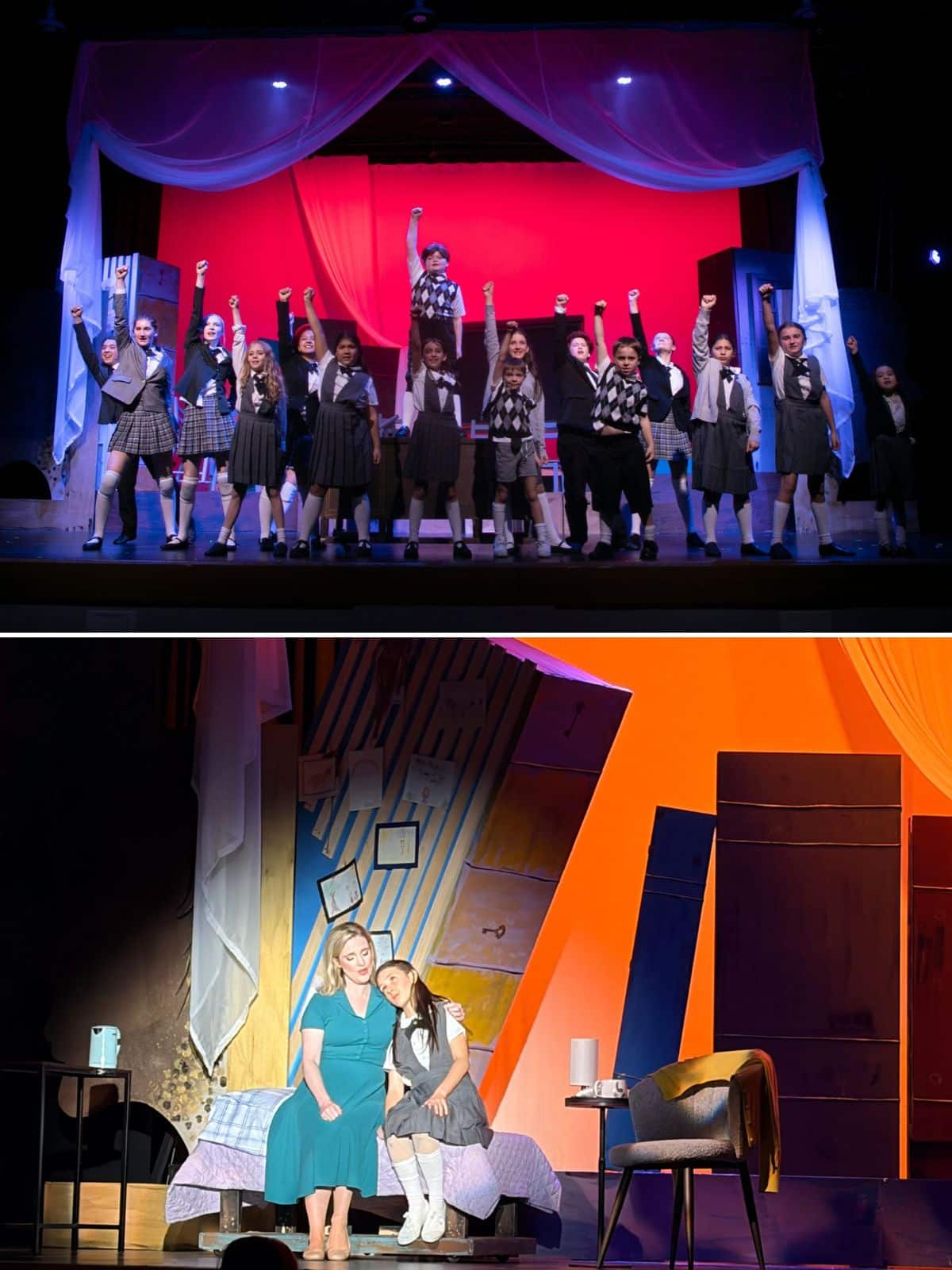
Heather Bertaux’s costumes do precisely that. The children’s colorful clothes in “Miracle,” followed by their gray school uniforms, make the pressure to conform visible. The change in their movement reinforces the impression of individual children being processed through an assembly line. It is an effective visual argument for the rebellion to come. Subtle metaphors like this one are sprinkled throughout the musical like Easter eggs waiting to be found.
As a movie fanatic growing up in the ’90s, the film version of this story has always been among my favorites. Rapnicki’s direction of the musical keeps that childhood nostalgia alive with cinematic-quality reimaginings that make this iteration feel electric and fresh.
Smartphones and VR headsets also give this staging a contemporary texture. Marshall Logan Gibbs’ projections help establish the world, while shifts in Atticus Cooper Boidy’s lighting sharpen its changing moods. Mime, puppetry, and Derek Cooper’s props add imaginative possibilities. There is considerable pleasure in watching a community company explore so many theatrical tools.
At times, though, those tools compete for attention. During the busiest sequences, I wanted a clearer focal point. The physical education scene also feels extended, and the roughly two-and-a-half-hour evening occasionally tests its momentum. More selective staging and a brisker pace would give the strongest moments room to register. I also wanted a clearer emotional connection between Matilda’s mistreatment and her pranks, so that resistance carried more weight than retaliation.
One absence troubled me more deeply: I did not see Black children or adults represented onstage. In a story about children demanding to be seen, that gap felt glaring. Silhouette Stages’ website celebrates Black artists and diverse stories; that commitment should also shape who gets to inhabit stories presented as universal.
I am not asking for tokenism. I am asking for sustained inclusion of Black artists and the broader global majority in leading roles, ensembles, and the creative decisions behind them. A production that brings Matilda into the present through technology should bring the same imagination to who belongs in its world.
For all its excesses, this Matilda offers humor, memorable performances, and children worth cheering for. Its invitation to question unfair rules lands. The next challenge is making the circle of belonging as expansive as the story’s imagination.
Running Time: Approximately two hours and 30 minutes, including one 15-minute intermission.
Roald Dahl’s Matilda the Musical plays through October 25, 2026, presented by Silhouette Stages, performing at Slayton House in Columbia, 10400 Cross Fox Lane, Columbia, Maryland. Tickets ($25 for adults; $20 for seniors, military, HCPSS educators, and students; and $15 for children 12 and under) are available online. For additional information, email info@silhouettestages.com or call 410-216-4499.
Roald Dahl’s Matilda the Musical
Book by Dennis Kelly
Music and Lyrics by Tim Minchin
Based on the book Matilda by Roald Dahl
Additional cast: Patricia Anderson, Ryan New, Shea Gardner, Chris Binnie, Noah Anderson, Lily Anderson, Julia Ballenger, Judah Moe, Cole Severt, Brooke Bloomquist, Emma Schreier, Carolina Tomasi, Rowena Winkler, Emmy Favero, Cora Kennedy, Corawyn Quay, Nicoletta Toscano, Gwendolynn Watters, Bryn Hummel, Ellie Kilberg, Lily Martin, and Kerrigan Winkler
Additional design credits: Sound by Terry Edwards; scenic design by Sammy Jungwirth and Amy Haynes Rapnicki