Prince William Little Theatre’s Man of La Mancha, written by Dale Wasserman, with music by Mitch Leigh and lyrics by Joe Darion, unfolds in a grim 16th‑century Seville prison where writer Miguel de Cervantes and his manservant await trial by the Inquisition. Director Susy Moorstein frames the production with a powerful vision: that the injustices depicted in the show — unlawful incarceration, sexual violence, mental health struggles, and the fight for equality — are not confined to history. They remain urgent, human realities. Her staging embraces the idea that imagination, empathy, and community can lift even the darkest corners of life.
To defend himself before the other prisoners, Cervantes proposes to tell a story — transforming the dungeon into the imagined world of Don Quixote. Vince Worthington’s set design immediately establishes the tone: a stark, oppressive prison environment that conveys confinement and despair from the moment the audience enters. As the tale unfolds, the bleak space becomes a canvas for Quixote’s idealism, shifting under Ken and Patti Crowley’s dramatic lighting, which uses dazzling effects, haze, and fog to contrast harsh reality with the glow of fantasy. Riley Leonhardt’s costumes reinforce this duality, blending grimy prison garments with dreamlike embellishments that reflect Quixote’s hopeful worldview.
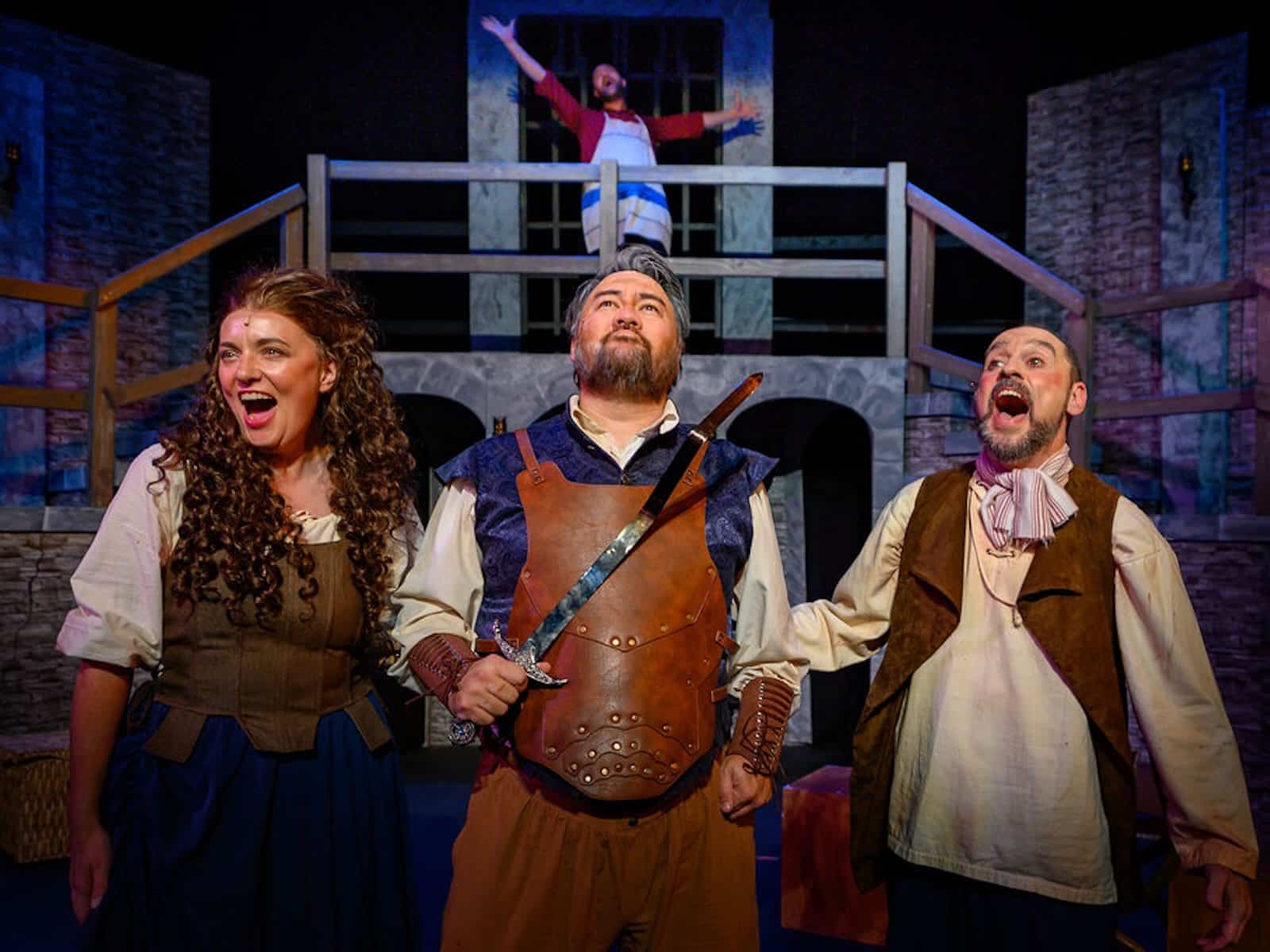
As Cervantes becomes Don Quixote, Nate Mikami leads the narrative with raw emotional intensity and commanding vocal strength. His Quixote is a man who refuses to surrender his ideals, and his stirring performance of “The Impossible Dream” becomes the production’s emotional centerpiece — an embodiment of Moorstein’s belief that dreaming boldly is an act of courage.
Quixote’s loyal squire Sancho Panza, played by George Fulda, infuses the story with warmth, humor, and irresistible charm. Fulda’s rendition of “I Really Like Him” is infectiously delightful — an earnest, joyful declaration of devotion that perfectly captures Moorstein’s celebration of “the silliness of friendship.” Fulda and Mikami have many delightful comedic moments, especially in the absurdly hilarious horse‑riding sequence, where he and Quixote gallop around the prison on imaginary steeds, and the iconic battle of the windmill.
The story’s emotional core rests with Aldonza, portrayed by Emilie Marshal Peace, whose performance is nothing short of electrifying. Her rendition of “Aldonza” is emotionally devastating and vocally brilliant, a raw outpouring of pain, fury, and longing that stops the show in its tracks. Peace’s powerhouse vocals cut through the gloom with clarity and fire, embodying Moorstein’s vision of a woman fighting to reclaim dignity in a world determined to deny it.
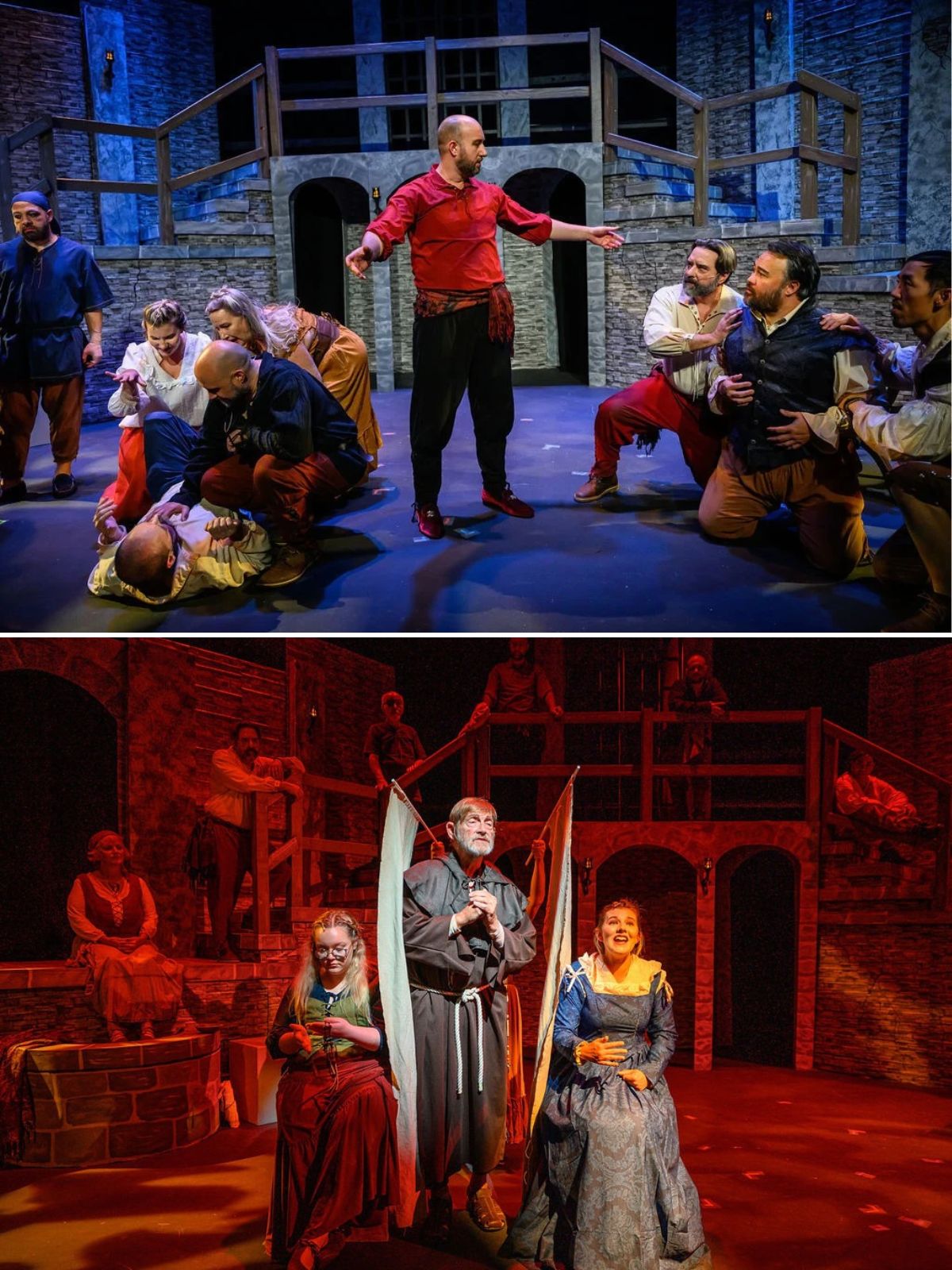
As Quixote’s idealism meets resistance, Chris Anderson’s Carrasco (The Knight of the Mirrors) emerges as a formidable presence — his resonant, powerful bass voice adding weight and authority to every confrontation and underscoring the harshness of reality that Quixote refuses to accept. Moments of levity are woven throughout the narrative, reflecting Moorstein’s belief that laughter is a vital form of resistance. Adam Cook’s hilarious Innkeeper — especially in “Knight of the Woeful Countenance” — brings bursts of joy to the production. Luis Vasquez adds charm and buoyant energy as the Barber, enriching the ensemble with delightful comic presence. John Totten provides sympathetic warmth and grace throughout as the Padre, while Caroline Kinney and Kaitlin Craig stand out as Don Quixote’s real niece, Antonia, and the Housekeeper.
Under Chuck Schmidt’s musical direction, a soaring 14‑piece orchestra elevates the show, filling the theater with Mitch Leigh’s sweeping score. The ensemble’s richness and precision support the cast’s vocal performances with warmth, depth, and dramatic intensity, creating a musical landscape as grand as Quixote’s dreams.
The result is a production that honors the legacy of Wasserman, Leigh, and Darion while fully embracing Moorstein’s vision: that imagination, empathy, and community can illuminate even the darkest places. PWLT’s Man of La Mancha succeeds as both an entertaining musical and a thoughtful reflection on the resilience of the human spirit. It is a passionate, polished production that speaks directly to contemporary audiences.
Running Time: Two hours and 15 minutes, including intermission.
Man of La Mancha plays through October 18, 2026 (Friday at 8 PM, Saturday and Sunday matinees at 2 PM, and Saturday evening at 7 PM), presented by Prince William Little Theatre, performing at the Gregory Family Theater, Hylton Performing Arts Center, 10960 George Mason Cir, Manassas, VA. Purchase tickets ($35 adult; $29 senior; $25 student, youth, military) online or in-person at the box office. Prices include fees. Seats are general admission.
Cast and creative team credits are online here.