If you decide to see Woody Sez: The Life and Music of Woody Guthrie, come to the Dupont Underground early. Or stay late. Or both. There is a lot of material on display about Woody Guthrie’s life and the life of an America you may not know much about, or may have forgotten.
This year Washington, DC, has hosted two productions about Woody Guthrie. Something about his work is important again. Each of the two shows that surfaced here has provided something useful — but different — for DC’s citizens to consider.
On the one hand, Theater Alliance’s production of Woody Guthrie’s American Song was the heartening tribute many Washingtonians had been thirsting for in this troubling time. But Voices Festival Productions’ Woody Sez: The Life and Music of Woody Guthrie is something else.
It is one thing to sing a well-studied song as a tribute to the inspiring work that someone has done and the life that they have lived.
It is a different thing entirely to use a song as a tool in the process of figuring out and articulating the meaning and purpose of your own existence.
The Woody Sez production lays out for us:
1) the life of the man,
2) how that life shaped his vision to enable him to wield music as a weapon, and
3) how he chose which side he would be on.
From the very beginning, when the musicians casually amble onto the performance platform and begin strumming their instruments, it is clear this isn’t the sort of musical revue where songs and performances are commodities sold to the audience. It’s more as if this music is being showered upon the audience like an offering of rain.
Through songs and reminiscences, the performers tell Woody Guthrie’s harrowing journey through generational trauma and poverty, leading him to a place where he could bear witness to how America made it all but impossible for people who were not white, not wealthy, and not male to live with dignity.
With characteristic laconic dryness, Woody quips:
“I didn’t know how far I was gonna have to go to know my own self.”
“I never did know that the fight was going on so long so bad.”
Woody’s journey leads him to become a documentarian and celebrator of the dignity he witnesses in the lives of people American history would ignore and bury.
These people get his attention because, as he notes, in his journeys he has discovered that:
“Everybody might be just one big soul. That’s the way it looks to me.
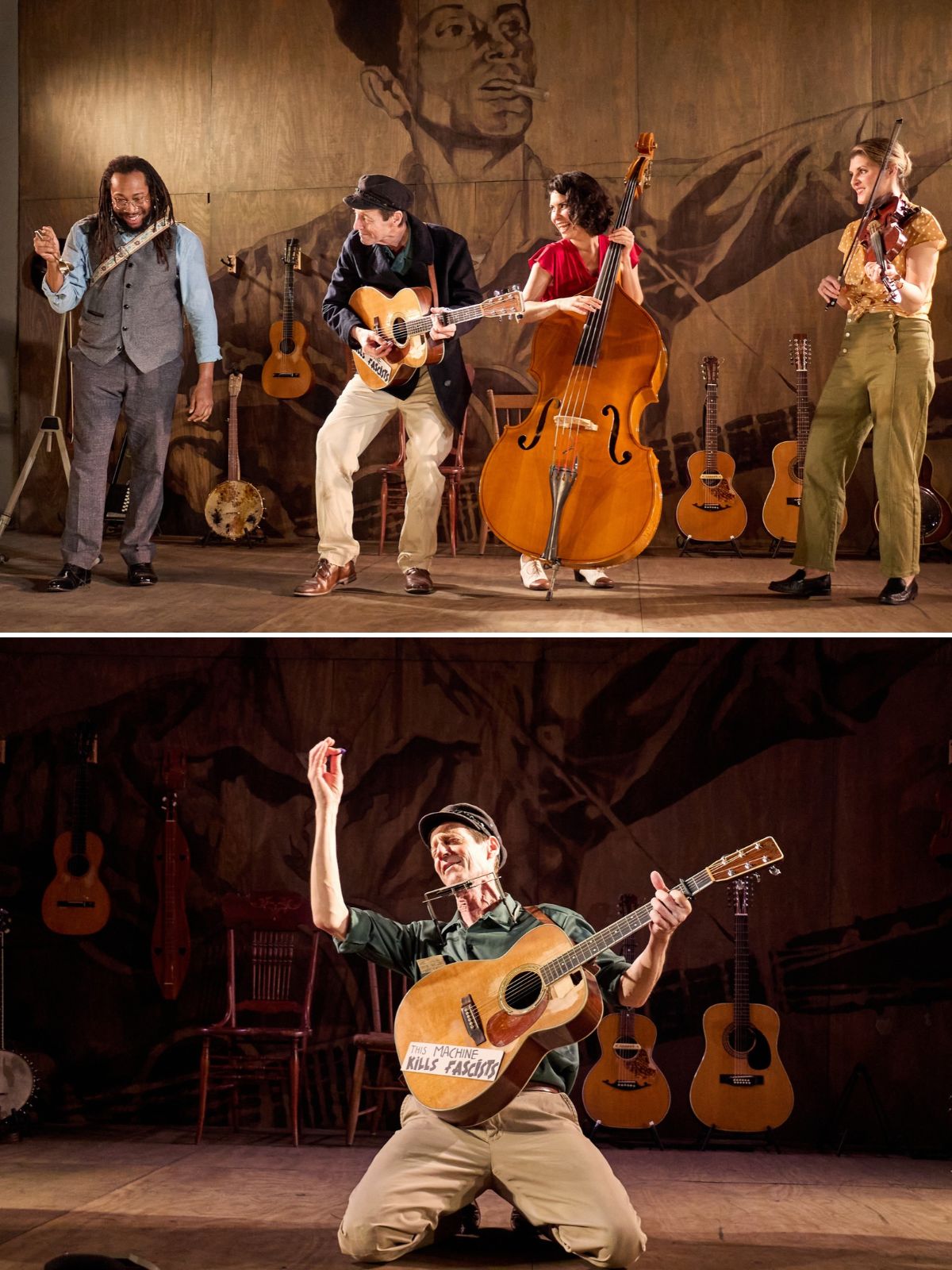
David M. Lutken, one of the work’s devisers, plays the role of Woody Guthrie with bottomless affability and a lot of humility. The other performers — Raquel Chavez, Margaret Dudasik, and Hubby Jenkins — are musicians who play people Woody encounters throughout his life, including his mother, his girlfriends and wives, and the legendary blues musician Leadbelly.
The laid-back, four-square pace continues throughout the show, with musicians and narrators constantly playing different instruments and portraying the people in Woody’s life.
Every Woody Guthrie song preserves a moment of human dignity for posterity. The audience at Woody Sez isn’t waiting for the next Woody Guthrie hit on the song list. Instead, they take in these tokens of dignity and feel the emotions that surrounded each incident as captured in the song.
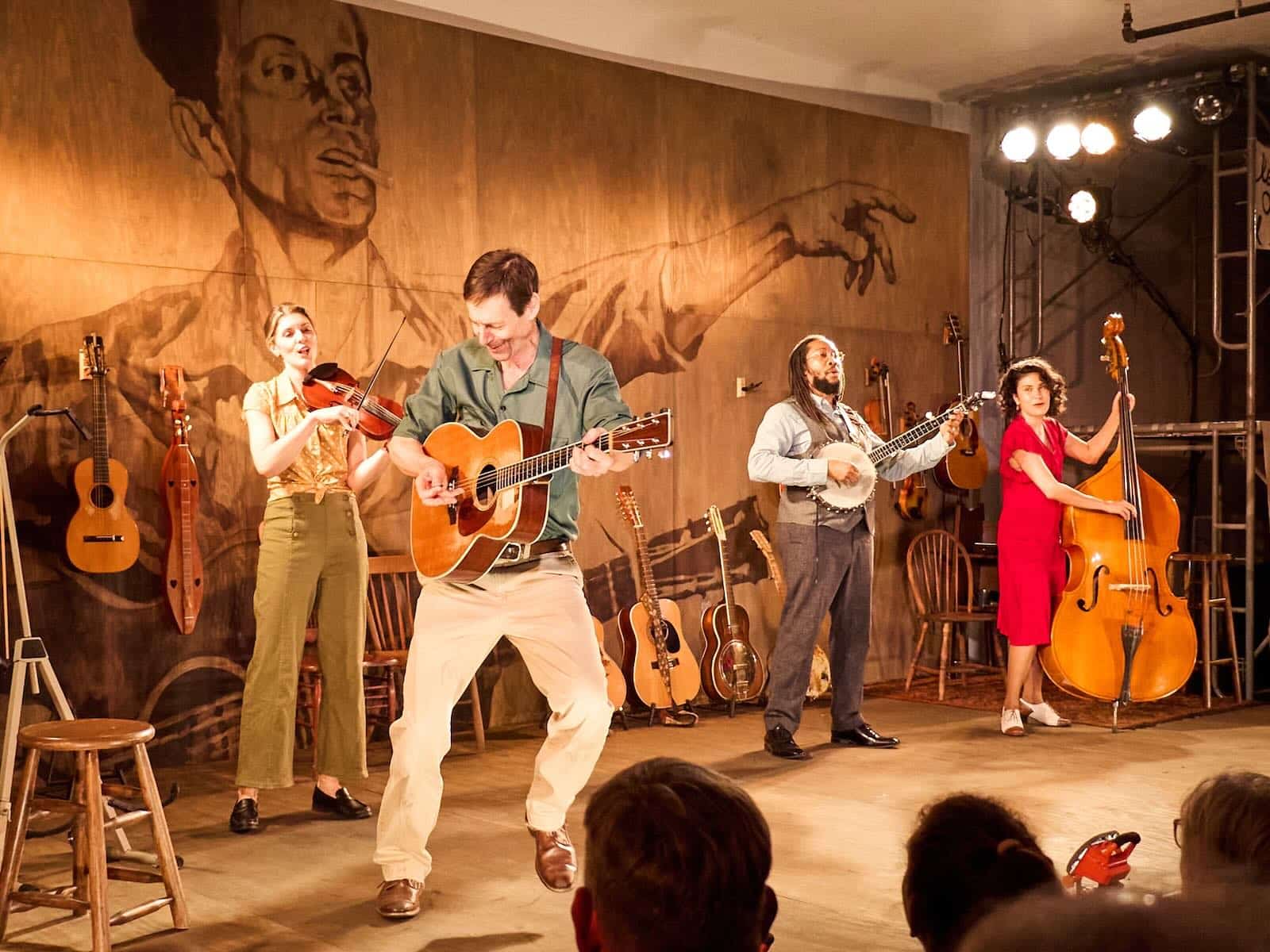
The costumes (designed by Raquel Adorno) are vintage without looking like they are costumes. The clothing has bold yet somber colors. They look like something musicians would wear for comfort rather than fashion.
A gorgeously weathered country-and-western-style portrait of Woody Guthrie takes up the entire upstage wall (set design by Andrew Boyce). All the instruments you will hear in this show are hung on the wall when they are not in immediate use. The entire installation of the production felt like it could have authentically been in a performance tent at a state fair.
The staging (directed by Georgette Verdin) is so economical and natural as to seem almost invisible except for the occasional gag choreography. Everybody just seems to be comfortably seated or leaning. Every now and then you might notice that the performers have suddenly moved into an intentional formation.
Maybe we can glean some idea about the zeitgeist of Woody Guthrie, the citizen artist, by heeding these two observations that he made about his own growth:
“I began to learn the difference between wanting something to stop and wanting to stop it.”
And my favorite:
“We all better take a left turn at the next election or we’re all going to end up in a ditch.”
Running Time: Two hours, with a 15-minute intermission.
Woody Sez: The Life and Music of Woody Guthrie plays through October 25, 2026, presented by Voices Festival Productions, performing in Dupont Underground, 19 Dupont Circle NW, Washington, DC. All seats are general admission, and tickets ($ 47.50; under 30, $21.75) may be purchased online. Tickets are also available at TodayTix.
Cast and creative team credits are here (scroll down).
Woody Sez: The Life and Music of Woody Guthrie
Devised by David M. Lutken with Nick Corley and Darcie Deaville, Helen Jean Russell & Andy Teirstein
Directed by Georgette Verdin
Featuring: David M. Lutken, with Raquel Chavez, Margaret Dudasik, and Hubby Jenkins
SEE ALSO:
Behind the scenes and songs of ‘Woody Sez’ with musician-actor David M. Lutken (interview by Debbie Minter Jackson, October 16, 2026)
Voices Festival Productions announces 2026/27 season: ‘Breaking the Binary’ (news story, July 5, 2026)