It is amazing how different kinds of productions can emerge from the same source material. The Legend of Sleepy Hollow sprang from the pen of Washington Irving in 1820 as a charming short story full of humor, quirky characters, picturesque scenery, and mouth-watering descriptions of old-fashioned food. It also gave birth to one of the classic monsters of modern literature: the Headless Horseman, a Hessian soldier decapitated during the Revolutionary War, riding pell-mell through the dark woods at night, searching for his missing head.
Synetic Theater’s Legend of Sleepy Hollow, now playing at the Mulitz-Gudelsky Theatre Lab at Olney Theatre Center, although featuring the same monster and setting, could not be more different. Synetic is a unique dance and physical theater company founded in 2001 by two immigrants from the Republic of Georgia who dreamed of presenting classic works that overcame the barriers of language. The company mounts complex and complete wordless productions of famous literary works and folk tales. What is lost in eliminating the words is more than replaced by the richness of the movement and music.
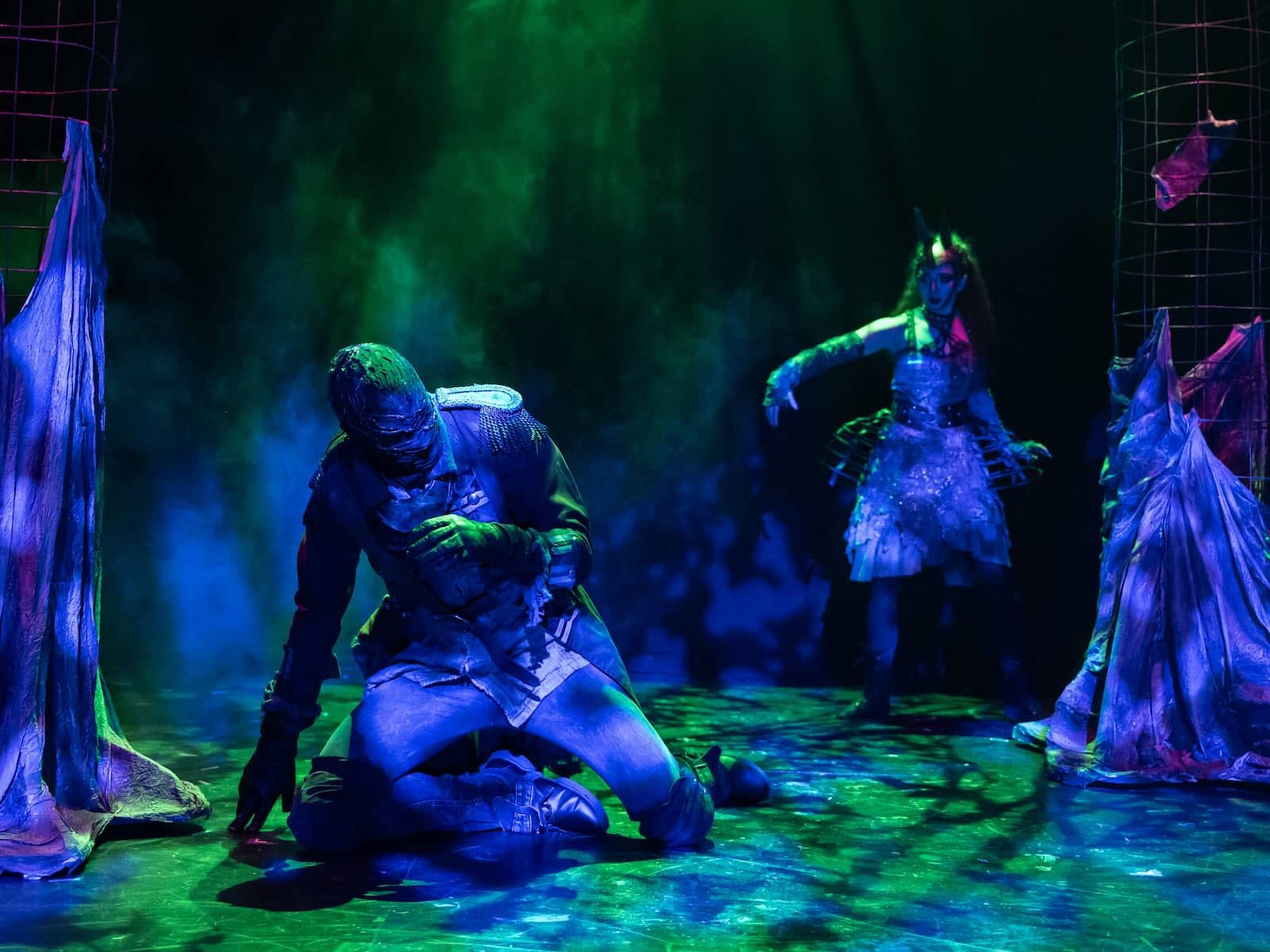
Synetic’s Sleepy Hollow is gorgeously spine-chilling. The adaptation, by resident dramaturg Nathan Weinburger, takes what was a light-hearted menace in the original tale and cranks it up to terrifying. But at the same time, it flips the story on its head, imbuing the monster with feeling, love, and longing while making the human antagonist the monster.
The creepiness sets in from the outset, with absolute darkness broken by forceful, eerie, howling music by Koki Lortkipanidze (who at one point portrays the Headless Horseman himself, playing mystical notes on a crumbling piano while his severed head stares ghoulishly out at the audience). The lights rise only to a penetrating gloom to reveal a soldier riding a galloping, armored horse, a magnificent puppet handled by several ensemble members and a principal dancer, Maryam Najafzada. The soldier and his beloved horse are killed, but Najafzada’s Horse Spirit manifests and reanimates her rider (Philip Fletcher), who embarks in search of his head — and his killer.
The lights warm and brighten to reveal a tavern where villagers drink and dance, and a romantic rivalry plays out between Icabod Crane (Vato Tsikurishvili) and Brom (Tony Amante) over the lovely Katrina Van Tassel (Sia Li Wright). (In the original story, Icabod Crane was a scarecrow-like schoolmaster and Brom was the lunkheaded town hero, but here the roles are in a sense reversed, with Brom sensitive and Icabod bullying.) Icabod wins the contest and departs with Katrina, leading to a sensuous pas de deux — ravishing as is all the choreography by one of the founding duo, Irina Tsikurishvili. All of the company members are fine actors as well as dancers. Particularly pleasing is the spirited Najafzada, prancing proudly and tossing her hair like a mane as the Horse Spirit. The burly, proud, and brutal Tsikurishvili as Icabod rouses suspicion and dislike immediately, and his shaven head seems progressively skull-like as his doom unfolds. And kudos especially to Fletcher’s horseman, who conveys a range of emotion from rage to tenderness without his face being seen.
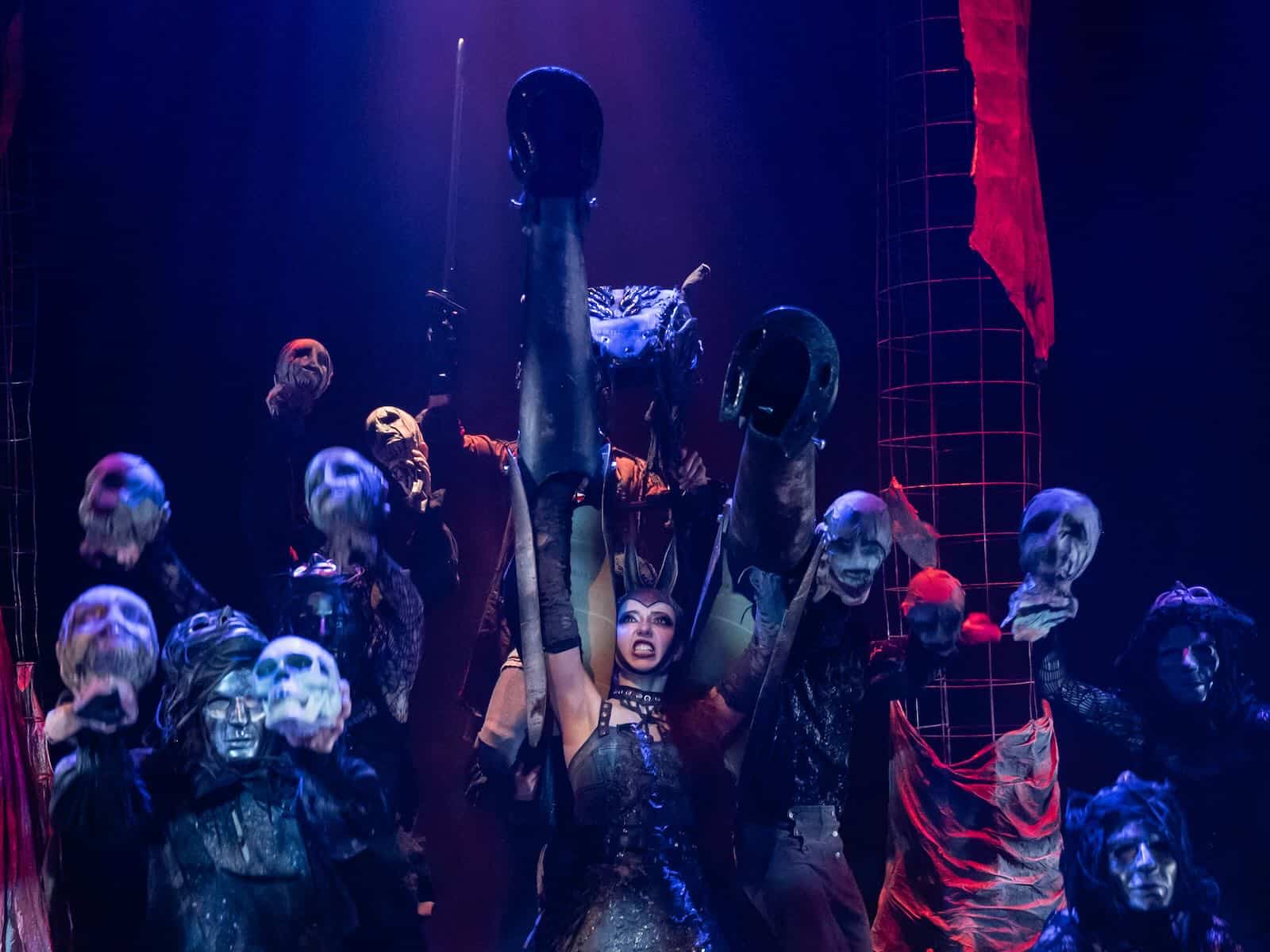
Meanwhile, one of the drunken revelers has returned to the forest, to a bad end at the sword of the Horseman — the first of many. The set, by Phil Charlwood, consists only of several movable trees and a table, plus some platforms stage right surrounding the piano. Founder and director Paata Tsikurishvili uses these to excellent effect, sometimes having ensemble members move them past a fleeing Icabod running in place, or deploying them deftly to obscure the many decapitations that the story requires. Brian Allard’s lighting design is also crucial here, low and atmospheric or pinpointed with spotlights when need be, and utterly black when murdered characters must vacate the stage.
The roughly Revolution-era costumes by Eric Teague are also essential to the unfolding tale, with some very nice touches, such as the Horse Spirit wearing panniers, which was the name for both the baskets on a horse’s flanks and supportive hoops used to hold an 18th-century woman’s skirts wide. The Horseman’s garb is particularly effective. In his stint at the piano, his costume is built up in the shoulders to literally hide his head more effectively than most of the kind, especially in the atmospheric lighting.But it would be impossible for a dancer to have full range of motion in such an outfit. The actual Horseman is dressed as a Hessian soldier with his coat of arms on his cape, strips of which he leaves on his victims’ bodies as a grisly calling card. covering. The designer made an interesting choice in giving the Horseman a full-head covering, but not making it entirely black, which could have looked almost nonexistent in the gloom. Instead, he added a few faintly metallic lines to catch the light. This seems to have been chosen to allow the Horseman a greater range of attention and emotion; one is able to tell where he is looking and even how he is feeling from the movement of the glints. Another extremely effective costume choice is to have the ensemble wearing masks with spooky faces on both back and front, along with spidery black bodysuits, allowing them to assume frightening contortions in a scene where ghosts and severed heads are driving Icabod insane.
As the story unfolds, we learn that Icabod hides a dark and evil secret concerning the Horsemen, which only Brom knows, while Brom and Katrina have noble and compassionate hearts.The one-and-a-half-hour piece plays out without intermission, and a break would have broken the spell. But a few of the sequences, such as the torturing of Icabod by the spirits of the Horsemen’s victims, might be slightly too drawn out.
Synetic Theater’s The Legend of Sleepy Hollow is an ideal entertainment as the days get shorter and the night draws in, the perfect combination of eerie beauty and spectral chills.Catch it while you can for this spooky season, before it gallops off into the mist.
Running Time: Approximately one and a half hours with no intermission.
Synetic Theater’s The Legend of Sleepy Hollow plays through November 1, 2026, in the Mulitz-Gudelsky Theatre Lab at Olney Theatre Center, 2001 Olney-Sandy Spring Rd, Olney, MD. Tickets are available online, by calling the box office at 301.924.3400, or on TodayTix. Discounts are available for groups, seniors, teachers, active military, first responders, and students. Visit olneytheatre.org/discounts for details.
Appropriate for ages 13+
Cast credits and bios are here (scroll down).