The Rocky Horror Show is a longstanding tradition at Baltimore’s Iron Crow Theatre, but this year’s production was special. After 17 itinerant years on rental stages, Iron Crow inaugurated its new, permanent space with a joyously over-the-top rendition of Richard O’Brien’s now-classic mix of science-fiction sendup, sexuality of every flavor, and enthusiastic audience engagement.
In the theater’s intimate three-quarter-round seating arrangement, no one in the audience is more than a few rows from the action. The actors take full advantage, interacting with audience members at every opportunity. On one occasion, an actor briefly exchanged jackets with a woman in the front row (it was a perfect fit for both). Following an intermission auction, the winning bidder got to have a lap dance with Brad during the second act. From the balconies that surround three sides of the rectangular space, cast members pelted the audience with items related to moments in the show. I wound up with some play money, copies of several pages of the show’s musical score, and a plastic tarantula. Audience enthusiasm throughout the show was palpable.
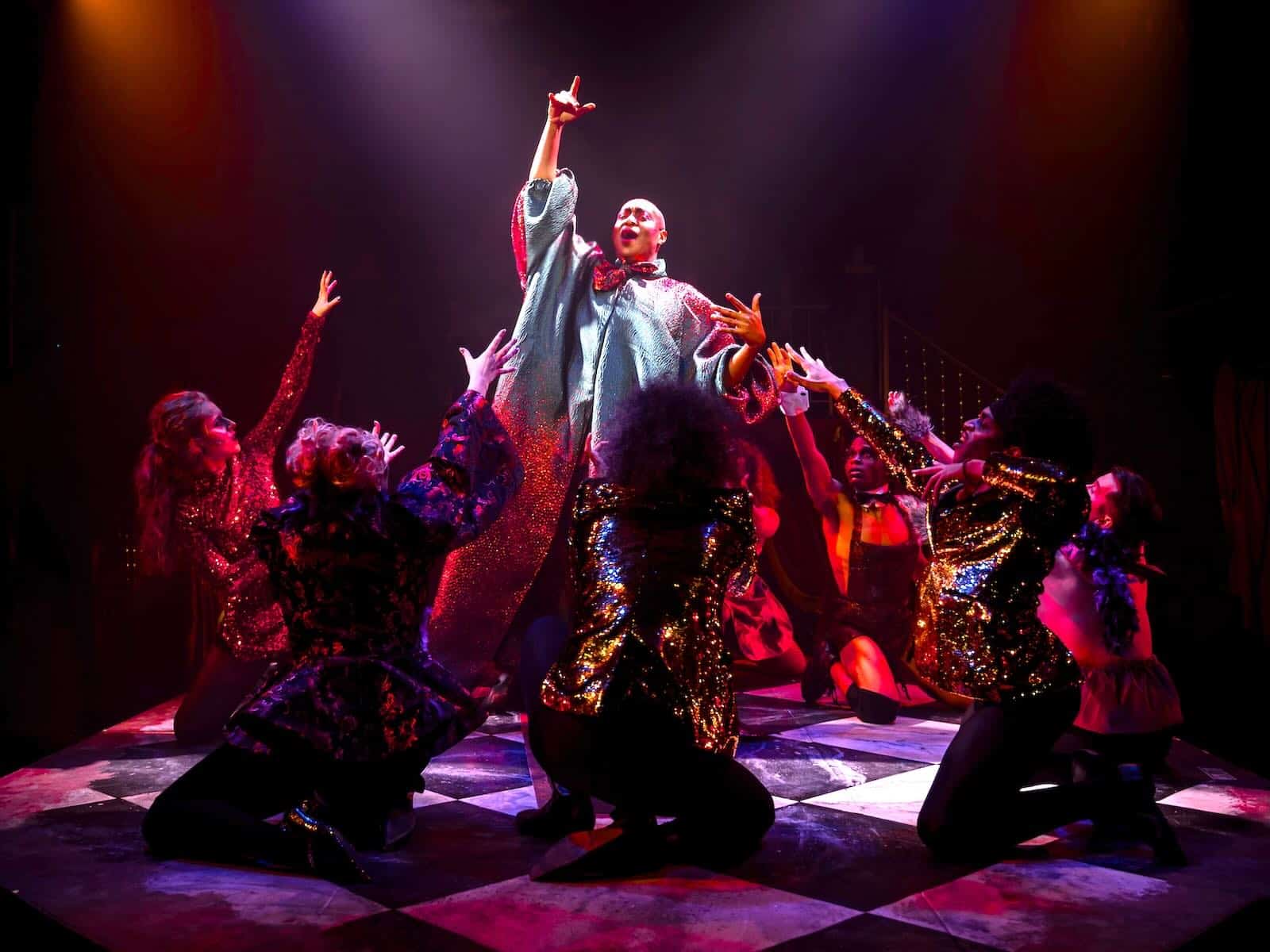
The cast is uniformly strong, headlined by Nicholas Miles as Dr. Frank-N-Furter, that sweet — not to mention sexually omnivorous and entertainingly bitchy — transvestite from transsexual Transylvania. With a commanding presence and an outstanding voice that turned “I’m Going Home” into an emotionally powerful torch song, Miles made the good doctor someone the audience could not take its eyes off, even in his chainsaw-wielding moments. In a sweet note of its own, Iron Crow had set up a small, candlelit shrine in the lobby to the memory of the recently deceased Tim Curry, who originated the role.
Magenta (Christin Wright), in a compellingly sexy black and mesh dress, belts like nobody’s business; her character is not to be messed with. Janet (Jay’na Johnson) puts her high soprano to fine use throughout, combining it with her character’s own burgeoning sexual appetite in “Touch-A-Touch-A-Touch-Me,” as she gets excited by Frank and dominates Frank’s creation, Rocky (Kobe Morrison), in a nice bit of kink flavor. Janet’s boyfriend Brad (Brett Klock), nerdy even during prolonged, hair-mussing sex, has fine vocal moments too, as in “Dammit Janet” and the plaintive “Once in a While.” “Hot Patootie,” the score’s purest tribute to ’50s rock, is always a highlight number, and Geradan Ward (who doubles as the Dr. Strangelove-like Dr. Scott) nails it, as Eddie emerges from a trapdoor in the set’s central platform.
Meghan Gosse gives Columbia a very sweet edge. Like Rocky and Dr. Frank himself, she cannot escape the sinister plotting of the sometimes snarling and ultimately homicidal Riff-Raff (Benjamin Ensenhour) and Magenta. David Forrer is a sprightly narrator, popping onto the center stage platform from time to time to advance the plot. Vocally, everyone on stage is powerful and in character; there are no weak spots to be found.
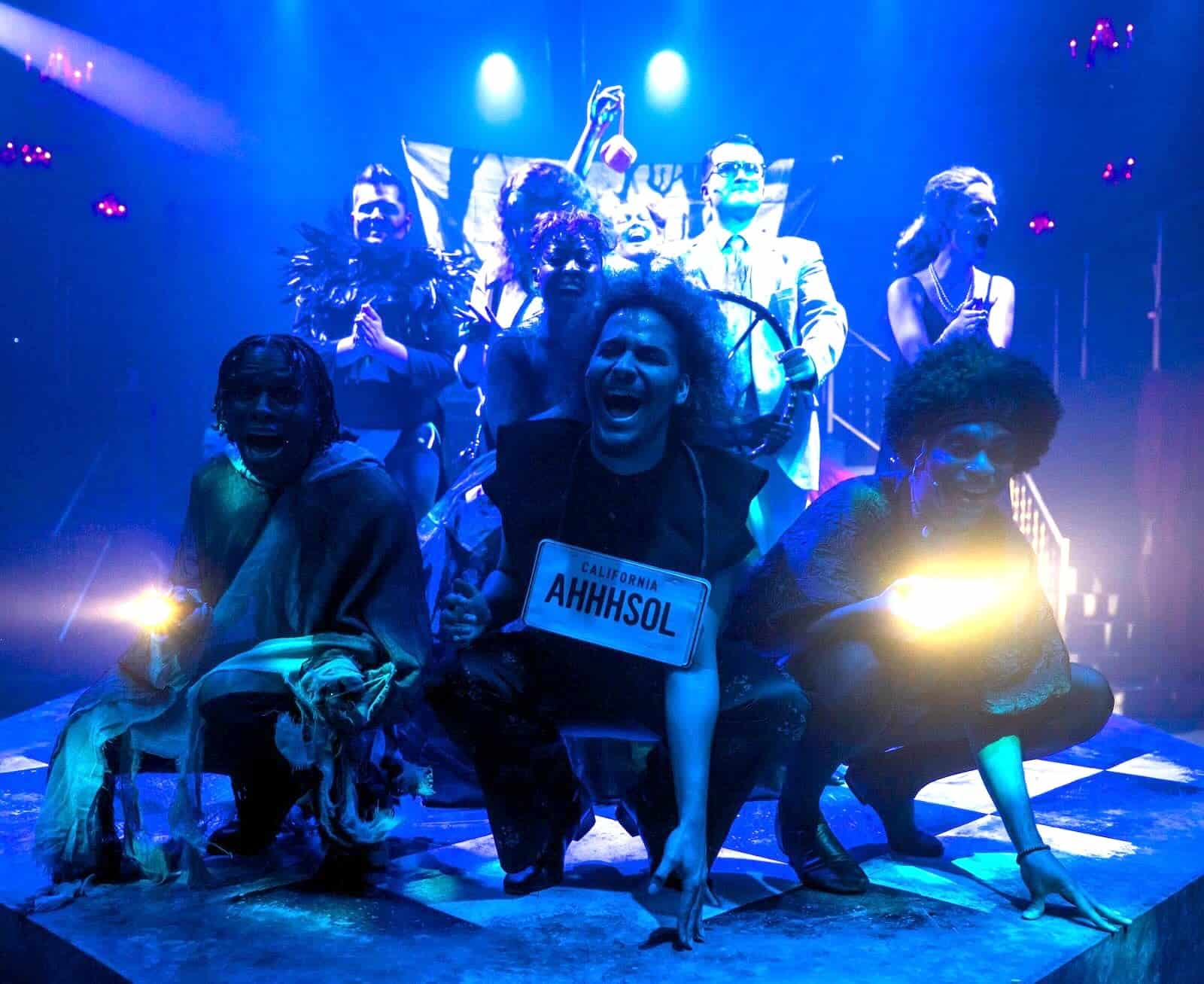
Rocky is a great ensemble show, and starting with the trio version of “Science Fiction Double Feature,” the ensemble shines. “The Time Warp” is always a hit, and in this and other ensemble numbers, Unissa Cruise’s lively choreography keeps the show moving and the audience fully engaged.
For a show as well-known as Rocky, a production needs to touch the familiar bases that audiences love while providing a fresh look at the material. Director Sean Elias and the creative team fully succeed in doing so. They are greatly aided by the new facility. With action taking place on the center platform, around its periphery, and on all three balconies, the show and the audience’s view of it are genuinely immersive. There’s something happening, and often surrounding you, wherever you look.
The sound and lighting resources of the new space are impressive, starting with the booming thunder and lightning that announce the show’s opening, appropriately gothic, dark and stormy night. Thomas Gardner’s lighting design is a gem, with precision beams of LED light in various colors pinpointing actors for even brief moments (one very short, delightful example being hitting an actor in green light as the word “wicked” is spoken). Riff-Raff’s antimatter rays that zap characters at the end of the show are equally and dramatically accurate.
The lighting design also had real emotional impact in the second act’s “Don’t dream it, be it” sequence, where relatively low, reddish light blended with the mostly red hues of Xorlali Plange’s costumes for the scene — sparkly for the ensemble, a lovely flowing caftan for Frank. It was a perfect look for the scene’s erotic peaceable kingdom. The costuming was excellent throughout, including the rough and sexy black looks for the ensemble in many scenes (I might have preferred tighty-whities for Brad’s underwear, but that’s a mere quibble).
As one might expect in a Rocky production, intimacy director Shawna Potter had a busy time of it, as in the “Touch-A-Touch-Me” scene. The well-performed, varied simulated sex scenes are mostly played for comic effect, with something closer to actual intimacy reserved for “Don’t dream it, be it.” And in contrast to the frantic escape of Brad and Janet at the conclusion of the film and many stage productions, in this production the pair have a tight, emotional embrace. Perhaps through their wild experiences in Frank’s castle, their love has grown into something more than romantic commonplace.
Sometimes a show that has been around for decades, rather than becoming dated, has greater impact as times change. In his program note, Elias points to the current political efforts to legislate queer, and particularly trans, people out of public life, commenting that Rocky creates a world that invites the audience “to take a chance and step through the castle doors without knowing exactly waits on the other side, all while celebrating pleasure, transformation, freedom, and queerness.” It’s a fun, sexy, wonderful place to be, but don’t forget that, with Riff-Raff’s and Magenta’s extraterrestrial coup, the plot of Rocky always ends on a jarring, violent note that shatters that world. The show carries a warm invitation and a warning.
Running Time: Two hours and 10 minutes, including one intermission.
Richard O’Brien’s The Rocky Horror Show plays through November 7, 2026, at Iron Crow Theatre, 2600 North Howard Street, Baltimore MD. Tickets ($45–$89) are available online.
Cast and creative credits and bios are here (scroll down).
SEE ALSO:
After 17 years on borrowed stages, Iron Crow Theatre finds its first permanent home (news story, August 19, 2026)