As GALA Hispanic Theatre’s latest GALita performance for young audiences opens, wintry winds howl, and flames crackle as three figures huddle around a fire for warmth.
The oldest figure (Máximo Cáceres) speaks up first, introducing himself as Alfredo Chaparro, a great-great-grandfather. Describing himself as being abandoned in his old age, “dumped like an old piece of furniture … like a chair without legs,” old Alfredo bitterly fears being forgotten nearly as much as he fears engaging with his memories. Yet when the others around the fire (Dani Lock and Patricia Meneses) reveal themselves as Alfredo’s younger selves, they lead him (and the audience) on a high-energy journey through time, memory, and the Mexican Revolution.
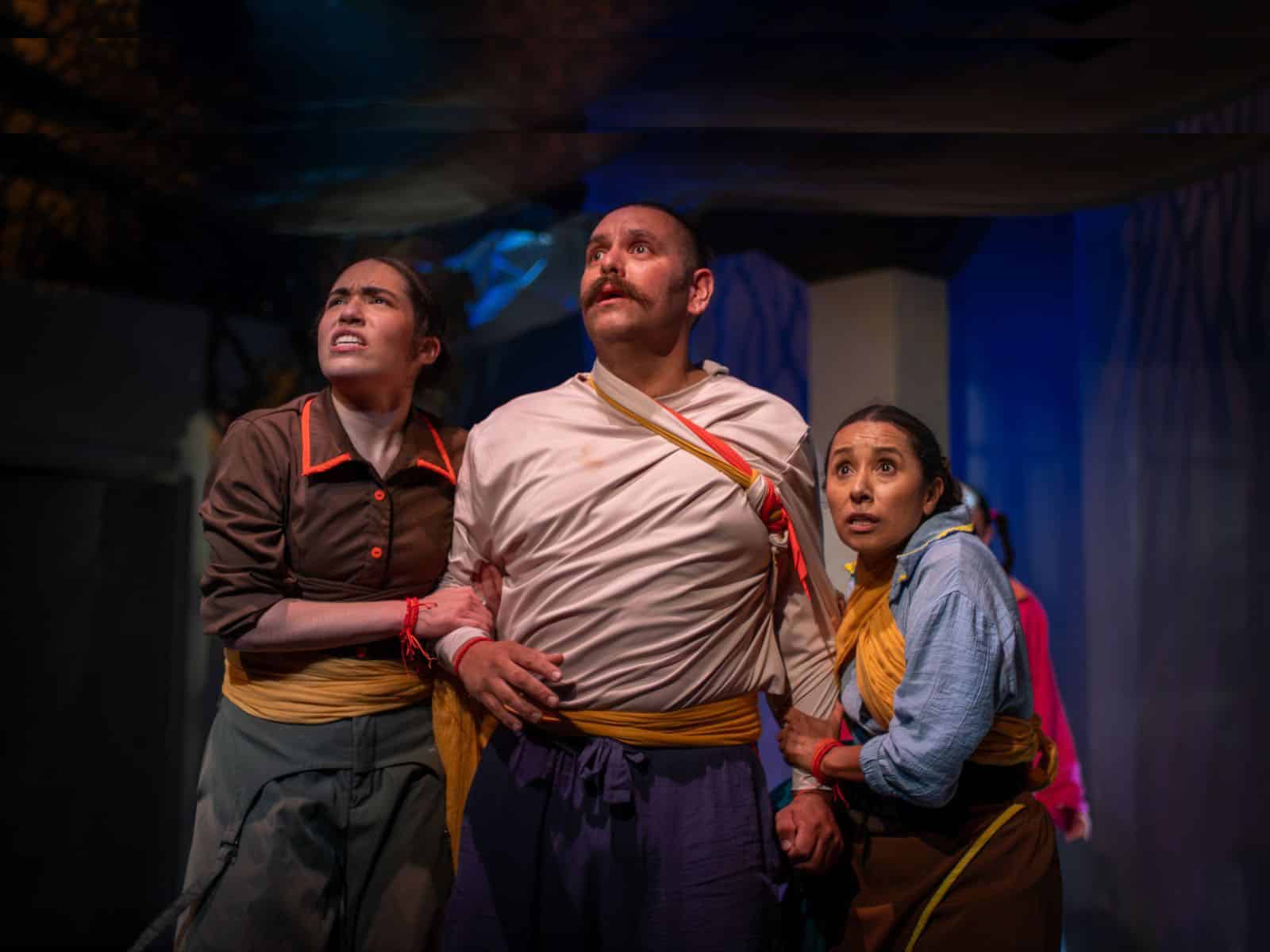
Written by Mexican playwright Antonio Zúñiga, Pancho Villa y los niños de la bola (Pancho Villa and the Children of the Revolution) makes its U.S. premiere this month at GALA, directed by Mauricio Pita. A talented cast of six (Cáceres, Lock, Meneses, Cristina Sánchez, Nadia Palacios, and Delbis Cardona) seamlessly switches between Spanish and English, sometimes mid-sentence, in this bilingual version of Zúñiga’s script, translated by Heather McKay, GALA’s director of education and arts engagement.
I witnessed GALA’s education and arts engagement efforts firsthand when I attended a weekday matinee of Pancho Villa with the fourth- and fifth-grade Spanish students from Elsie Whitlow Stokes East End Campus, a Ward 7 dual-language elementary school. Climbing up and down the stairs on either side of the audience, reaching out to shake hands with students in the front row, bringing students up on stage to join in a dance and a game, GALA’s cast invites young audiences into the production throughout, and the Stokes students matched their energy, eagerly engaging with Sánchez’s call-and-response narration in both languages.
Lighting and shadow (Arthur Kohn, lighting designer) and clip-clopping sound effects (Lee Martinez, sound designer) build up audiences’ anticipation for Pancho Villa’s first appearance on stage, and Cardona appropriately channels the revolutionary’s look in cowboy hat, boots, and fake mustache, with brightly colored clothespins on suspenders standing in for the bullets in the general’s bandolier (Rukiya Henry-Fields, costume designer). Cardona plays Pancho Villa as an exaggeratedly, sometimes comically gruff generalissimo (one fifth-grade student observed that “he wasn’t very happy”), although Zúñiga’s script reveals little of the leader’s character or history.
As Pancho Villa y los niños de la bola journeys deeper into Alfredo’s memories, we meet three “children of the revolution” that he knew in his youth. José León, a boy born mute, finds his voice as a trumpeter in Pancho Villa’s army. José León’s story is told primarily by his mother, Ercilia (Palacios), with the character himself represented by a ghostly white sheet formed into a handheld puppet. While the bold inclusion of a nonverbal central character often feels underdeveloped, one fourth-grade student found “the boy who couldn’t talk when his friends could” to be the most compelling character in the play.
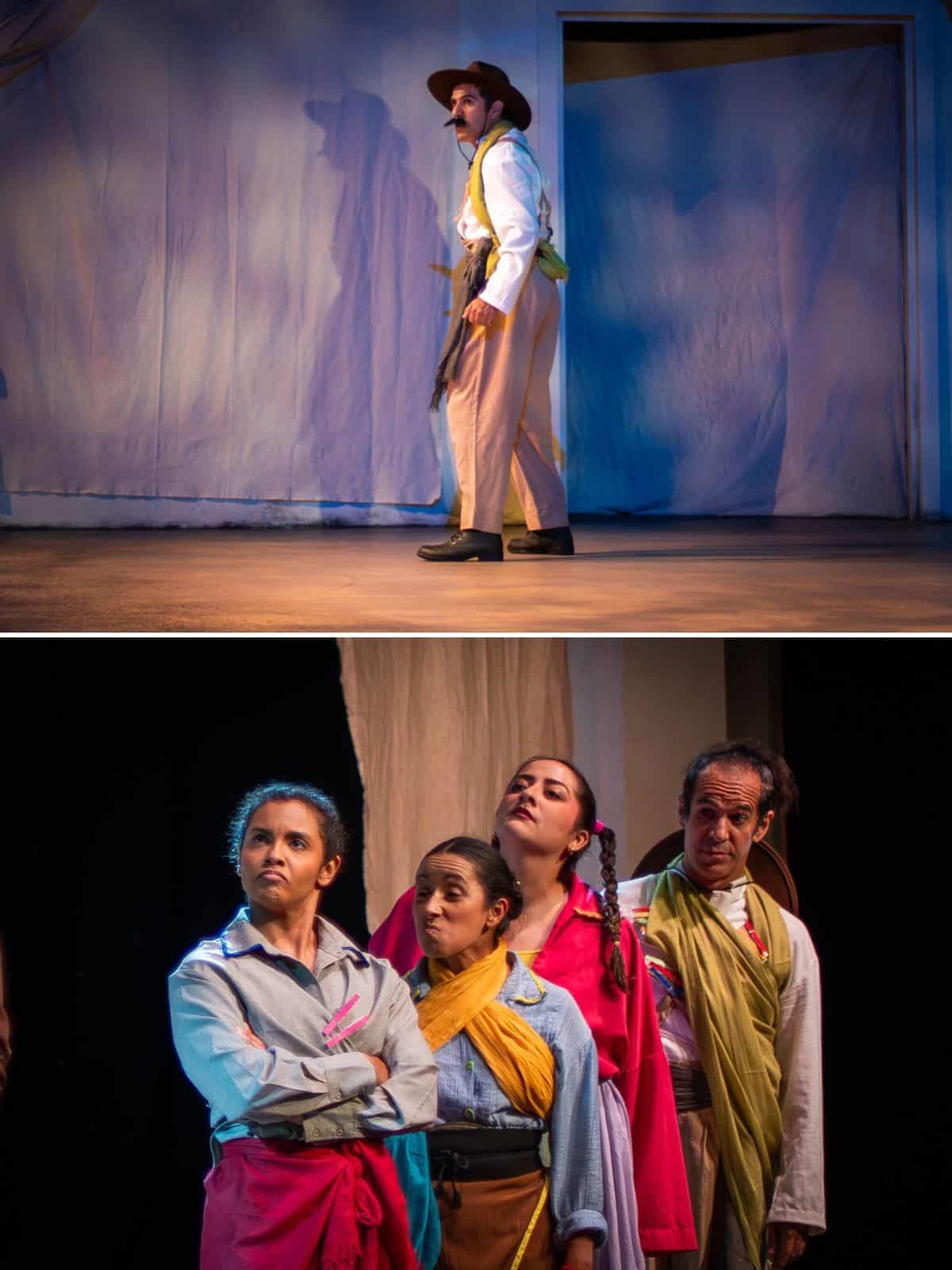
Torcuata, the second “child of the revolution,” is a survivor. Climbing on and over trains (and into the audience), defiant and unbroken even when imprisoned for theft, Lock as Torcuata delivers a commanding performance with a powerful singing voice. Her character also brings the realities of life during revolution into the clearest focus, as noted by fourth-grader Kadin: “Why did Torcuata rob trains? It was the Mexican Revolution, and people were hungry!”
Where Lock’s Torcuata endures change and hardship through a fearless attitude, Rosa (Sánchez) finds another way to survive the turmoil of revolution, holding onto play, beauty, and the desire to be loved — her earnest softness a contrast to Torcuata’s aggressive, knees-and-elbows physicality.
The animals of the Mexican countryside, wild and domestic, serve as characters in their own right, with multiple species of birds (grouse, dove, woodpecker, crows, golden eagle, chickens, and ducks) featuring both literally and symbolically in Zúñiga’s script. Fourth-grade student Yisak observed that “the actors use their bodies to make lots of different shapes” and use their voices to make very lifelike bird calls. A dog marionette (Elias Hall, props designer) operated and voiced by Cáceres delighted the students as it walked across the stage, sat, and raised its paw to shake, although the biggest laughs came when the dog’s legs started falling off in an unexpected blooper.
Students connected not only with the visual aspects and sound effects of GALA’s production, but with the language of the bilingual script. Fourth-grader Savanna noticed “that there was a lot of repetition in the play. And repetition is a form of poetry!”
Told as a series of lightly sketched vignettes, GALA’s production of Pancho Villa delves deeper into memory than history, with the events of the Mexican Revolution loosely woven threads. One fifth-grade student reflected that he expected to see more details of the revolution itself, but that he imagined that young audiences were “not ready to watch that.” Nonetheless, students from both classes agreed that they would recommend the play because it is important to understand history, and connected with the characters living through times of change and upheaval. Fifth-grader Cody noted that Pancho Villa reminds us “that problems are going to happen.”
Students also deeply connected with the energy and interactive nature of the production, and the lively post-show discussion with the cast. Fourth-grader Karsyn observed, “They actually were talking to us … they used the play to reach us in a fun way.”
Above all, GALA’s production of Pancho Villa y los niños de la bola reminds audiences of the power of storytelling, memory, and human connection — and of live theater’s ability to create these connections across cultures and generations.
Running Time: Approximately 55 minutes, no intermission.
Pancho Villa y los niños de la bola (Pancho Villa and the Children of the Revolution) plays through October 31, 2026, at GALA Hispanic Theatre, 3333 14th St NW, Washington, DC. Performances are 10:30 AM on weekdays and 3:00 PM on weekends. Tickets are $12 for adults and $10 for children ages 2-12. Purchase tickets online or call 202-234-7174.
A study guide is downloadable here.
GALA Theatre is fully accessible, with an elevator and wheelchair seating. Validated parking ($4) is available at the Giant garage on Park Road NW, with additional parking at the Target garage. GALA is one block from the Columbia Heights Metro (Green/Yellow lines).
Pancho Villa y los niños de la bola
By Antonio Zúñiga
English translation by Heather McKay
Directed by Mauricio Pita
CAST
Cristina Sánchez: Narrator, Rosa
Máximo Cáceres: El viejo, Roberto
Dani Lock: El joven, Torcuata
Patricia Meneses: El niño, Austreberta, Garrotero
Nadia Palacios: Ercilia
Delbis Cardona: Pancho Villa
CREATIVE TEAM
Mauricio Pita: Director
Dani Lock: Music Director
Sophie Smrcka: Scenic Design
Arthur Kohn: Lighting Design
Zavier Taylor: Projections Design
Lee Martinez: Sound Design
Rukiya Henry-Fields: Costume Design
Elias Hall: Properties Design
Bayron Celis: Stage Manager
Solis Pettitt: Assistant Stage Manager