It’s no surprise that NextStop Theatre has put out yet another brilliant show! Their current play, Kristoffer Diaz’s The Elaborate Entrance of Chad Deity, directed by Stefan Sittig, offers a darkly humorous, deeply sympathetic look at individual identity and ambition versus societal expectations and greed. The play “wrestles” with larger conversations about the monetization and commercialization of race and culture through the lens of the professional wrestling world — an industry well known for heavy use of stereotypes in its storytelling.
The purposefully ironically titled play follows Macedonio Guerra, better known as “The Mace” (Oscar Salvador Jr.), a Puerto Rican man from the Bronx who’s dreamed of being a professional wrestler since his early days sitting in front of the TV in Underoos, watching the height of Americana programming — ’80s wrestling. Mace now works for THE Wrestling; yet, despite being the better wrestler, his job is to make the other guy look good—the other guy being the high-and-mighty Chad Deity (Tyler “T” Lang).
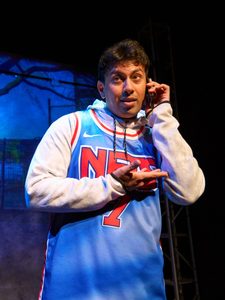
When Mace meets the smooth-talking, code-switching Vigneshwar Paduar, or “VP” (Vaibhav Taparia), a young Indian man from Brooklyn, he decides they should team up to create new personas and achieve his American dream. They pitch the idea to THE Wrestling CEO Everett K. Olsen, or “EKO” (John “Jack” Elmendorf), who quickly realizes he can capitalize on the industry’s long-standing racial stereotypes and rebrands the duo as terrorists.
Disregarding their actual races entirely, Mace is reestablished as Che Chavez Castro, a Mexican revolutionary stereotyped character complete with sombrero (despite the name also referencing Cuban and Venezuelan leaders), and VP is dubbed as The Fundamentalist, a vague Middle Eastern terrorist, complete with turban and strapped bomb pack. They are the heels to Chad Deity’s hero. In VP’s words, they are “caricatures in a world of cartoons.” But as the reality of their decisions sets in, the two must reexamine how they see themselves and how they want others to see them.
The play is presented largely through a narrative structure, with Mace serving as our cynical yet somehow also hopeful narrator. Salvador delivered the sharp dialogue with quick, fluid lyricism that gave the entire show a jazzy rhythm. I could have been content to listen to him talk all night, which was lucky, because Macedonio Guerra has perhaps three times as many lines as the other three speaking roles. Salvador led the group with comedy, heart, and confidence, even while being slammed to the ground!
All five performers had moments when they shined, however, including the understudy Marcus Martinez filling in for Jess Sondheimer as miscellaneous other wrestlers such as classic cowboy Billy Heartland and the red, white, and blue–studded Old Glory — two fighters parallel to Mace and VP meant to embody the American spirit. Sondheimer’s real-life experience in the world of professional wrestling may have brought Tim German’s and Joey Ibanez’s fight choreography to the next level; however, the team on stage within that center ring still managed to bring a powerful energy to every flying kick, throat punch, and utter smackdown
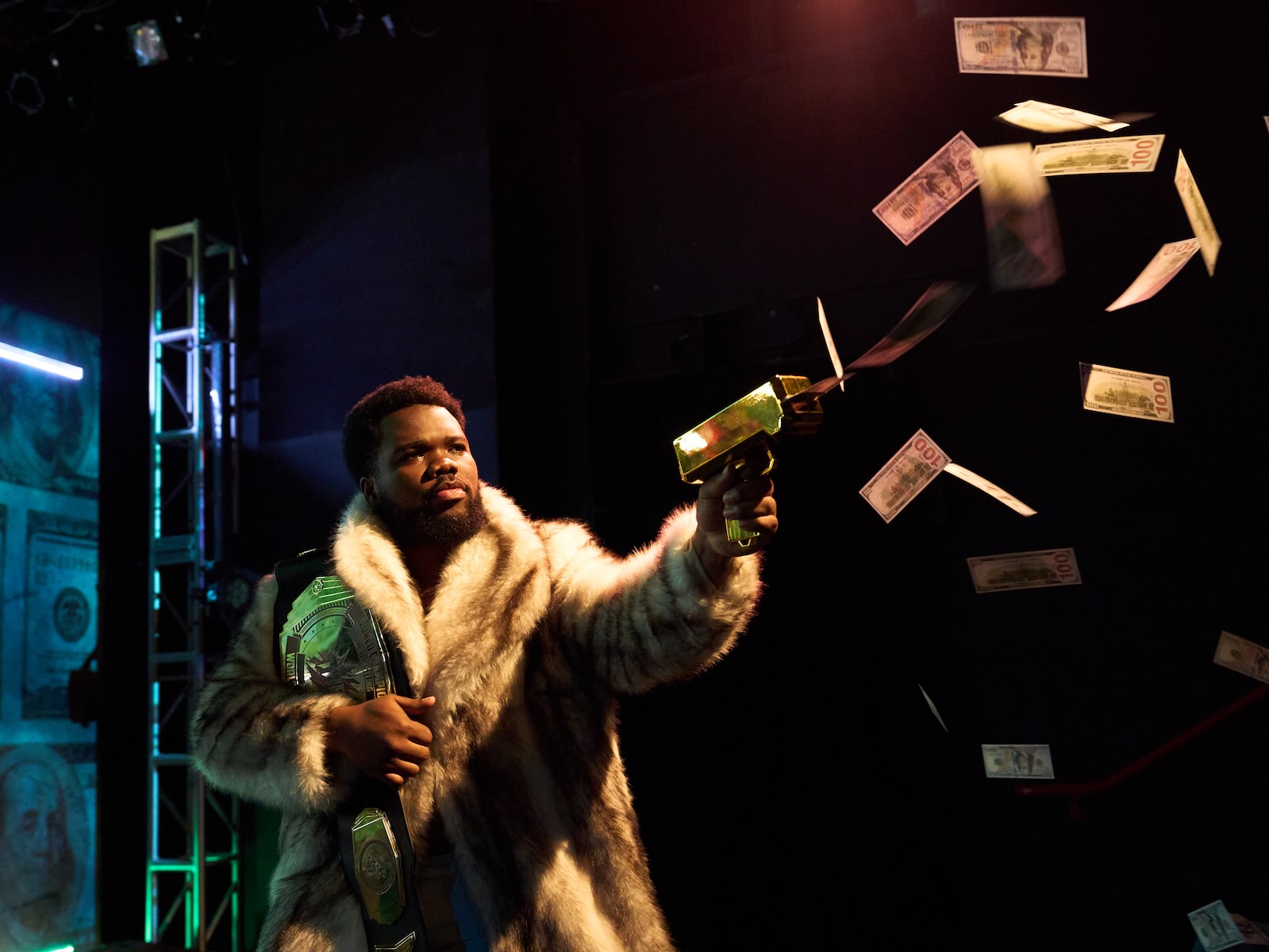
Lang’s charming smile and bravado emanated through the character of Chad Deity. When he first appeared on top of the stairs and sauntered down in a fur coat, shooting money into the air, you wanted to holler and clap for him despite the annoyed look on Mace’s face. Elmendorf as EKO managed to toe that line where you realize it’s not that he’s merely ignorant; he knows what’s right and wrong but will always choose the road that leads to the highest profit. Then there’s Taparia as VP, whose turn from being always up and always on to being suddenly lost, scared, and rejected when he realizes he is being booed as a terrorist by thousands of people left me utterly heartbroken.
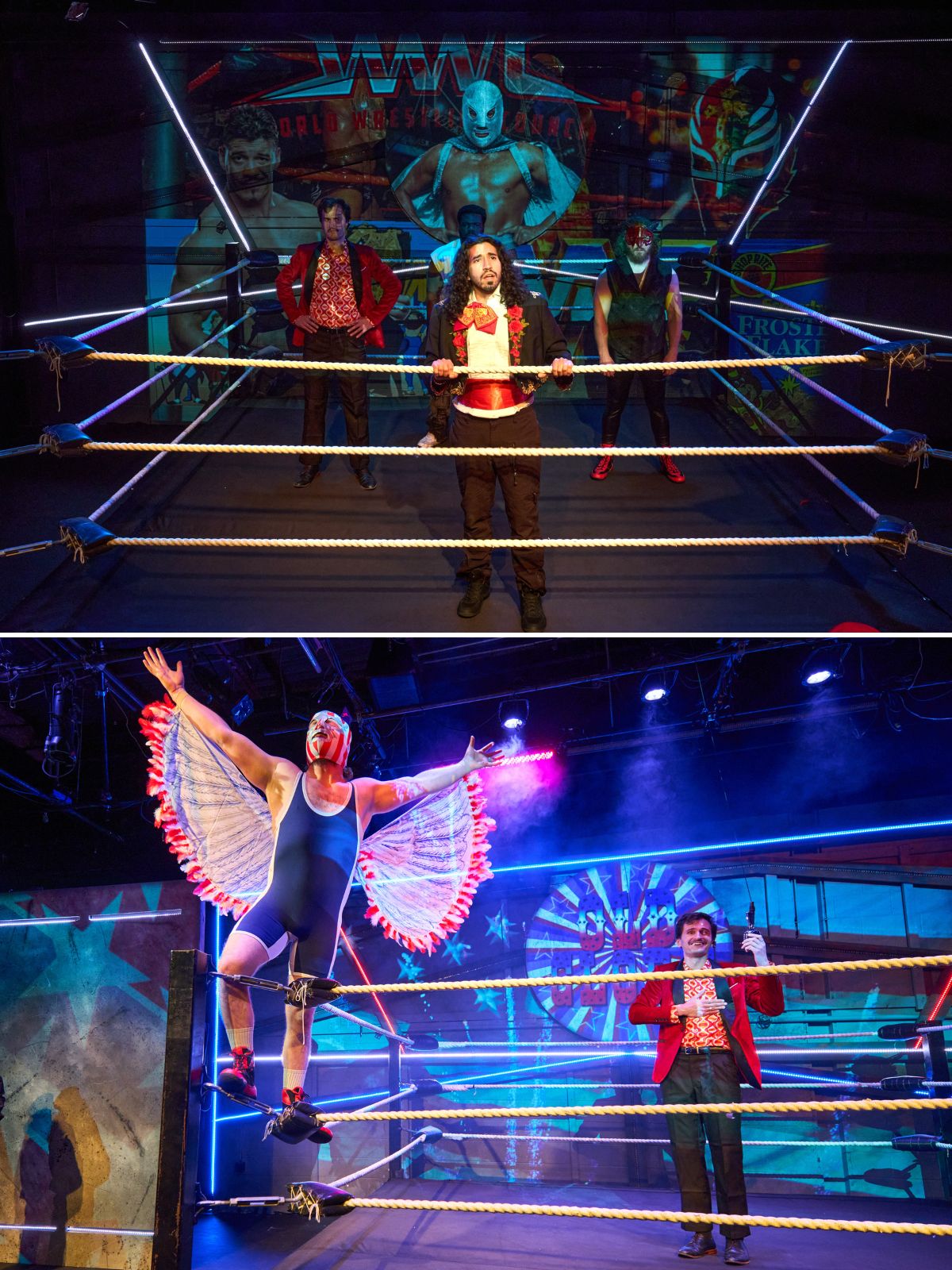
By breaking the fourth wall and inviting the audience to participate, the performance inherently becomes more of a conversation, thereby furthering the social impact. From the beginning, we are encouraged to cheer, boo, and comment freely as one would at a true wrestling match. The reason the wrestling industry could get away with presenting such blatant stereotypes for so long is that they fed off the large part of America’s propaganda-based and conspiracy-fueled fears and xenophobia. Everyone in the audience was perfectly willing to participate in this meta structure, and as we grew more emotionally invested, so grew our vocal reactions.
The show was further elevated by the lighting from lighting designer Maddie Southard, the sound production from co-sound designers Lee Martinez Cruz and Rachel Borczuch, and the visual projections from projection designer Sean Preston. All three elements worked together to set the tone and provide seamless transitions as we flowed through Mace’s memories.
When Mace was remembering the days of old-school Americana, the retro light rods lit up red, white, and blue, classic ’80s rock played over the speakers, and images of famous wrestlers such as Hulk Hogan flashed across the screens. And, to prove how ubiquitous wrestling really became in American culture, images from the children’s toys and Saturday morning cartoon programs they inspired appeared alongside them. When Mace began to delve into the impact certain Latin American cultures had on the sport, however, the lights turned the colors of the Mexican flag, a soft acoustic guitar score played in the background, and images of famous Latin wrestlers appeared on the screens. This device of alternating between various states was used throughout the show to indicate the layers Mace had to navigate.
These special effects also took us to the pickup basketball courts in Brooklyn where we first met VP. We danced from one end of the stage to the other as the two moved across the borough, even taking the subway provided by visual projections. Sound effects recreated subway tracks and furthered the illusion, but they were also used to build out our narrator’s internal and emotional dialogue, like later when we hear a casino slot machine spewing out coins. The lighting also brought internal expressions to the forefront, even in moments perhaps unintentional. At one point, the lighting created a shadow effect on the wall where Chad Deity’s shadow stood large, looming over the small shadow projected by Mace, positioned further away, thereby reflecting his emotional stance at that moment.
All the pieces of this show came together to produce something truly memorable. The Elaborate Entrance of Chad Deity started a conversation with the audience. A conversation I can only imagine will continue well after leaving the theater.
Running Time: Approximately two hours, including a 15-minute intermission.
The Elaborate Entrance of Chad Deity plays through November 29, 2026, presented in partnership with Flying V, at NextStop Theatre, 269 Sunset Park Dr, Herndon, VA. Purchase tickets (starting at $45) online or by calling 703-481-5930 x1.
Advisory: Strong language, simulated violence/fighting, racial stereotypes, flashing lights and haze effects, loud sounds.
The program is online here.
The Elaborate Entrance of Chad Deity
By Kristoffer Diaz
In partnership with Flying V
Directed by Stefan Sittig