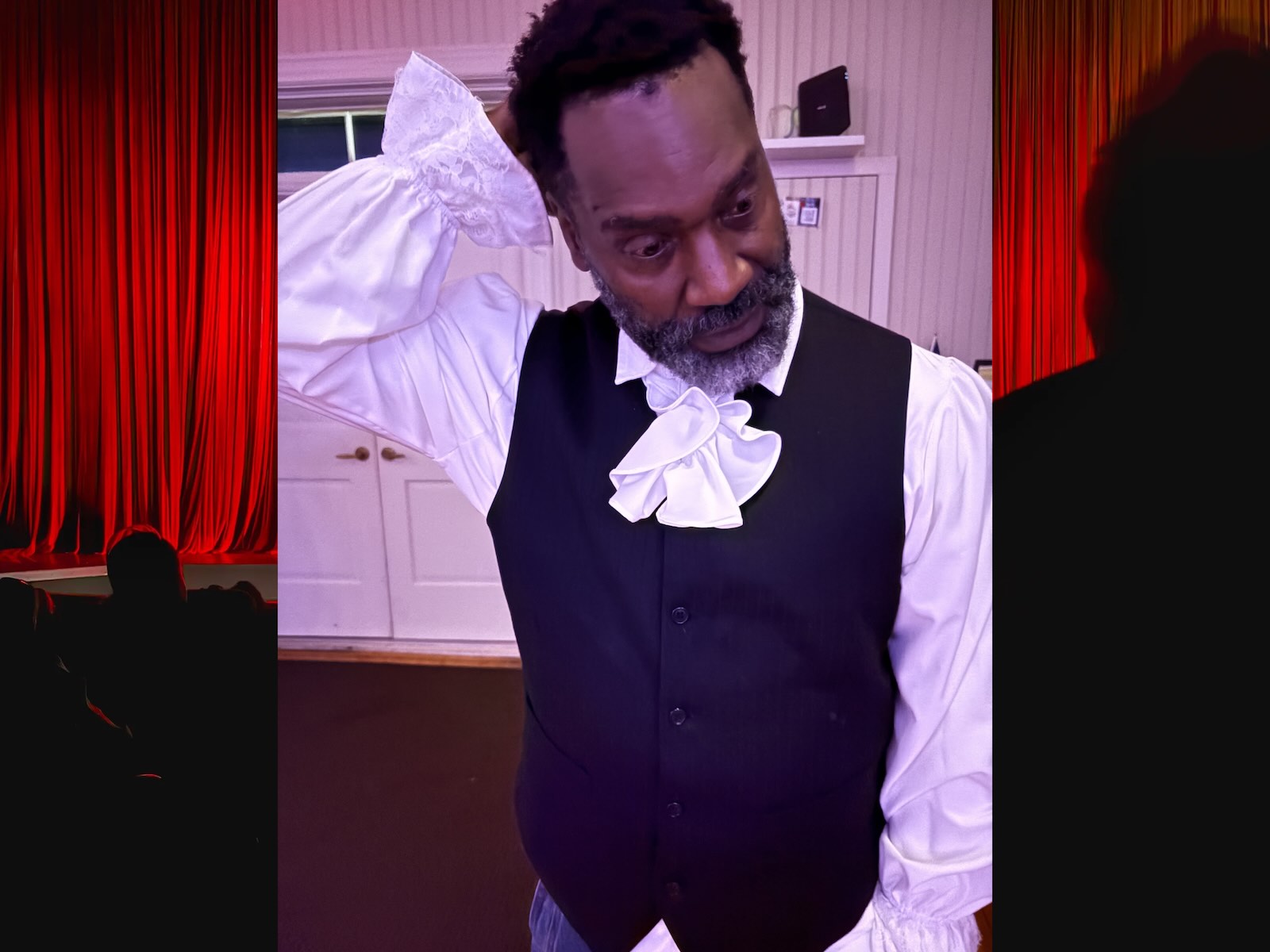
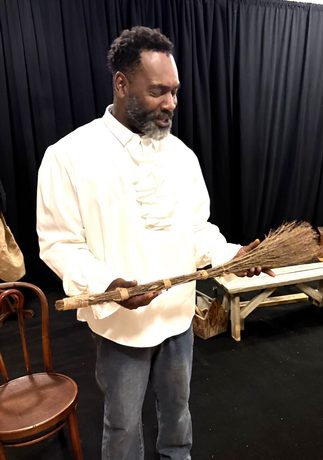
Josiah Henson: No Uncle Tom started with promise when Henson, played with power and grace by Curtis McNeil, referred to the Constitution’s “All men are created equal.” Actually, even before McNeil as Henson took to the stage, he greeted audience members like parishioners at church service, walking along the front and back rows like they were “pews,” welcoming the attendees and extending good wishes. McNeil’s buttoned-down vest and long waistcoat made him instantly recognizable as coming from a different place and time, nicely rendered by costumer Dawn Chapman.
Back to what ended up being the most creative and promising aspect of the production, Henson ponders what the term meant to the enslaved. Who and what is referred to with the statement “All men” when enslaved persons have no agency over their lives and bodies? Henson invites the audience to participate in “call and response” to reinforce the value of freedom, which helps us query the true meaning of the words. From there, he proceeds to share aspects of his life by responding to several “frequently asked questions” about his experiences to help differentiate his history from the derogatory term we might be more familiar with.
Well, so much for the creative part. The rest of the show delves into Henson’s history, which is necessary and valuable, but in such a plodding, disjointed way that we learn the content but lose the impact of his life. The script answers a pivotal question: Who was Josiah Henson? But it skirts over the second issue with just a couple of lines in the second act: How did his name become the personification of the wretched stereotype of “Uncle Tom”? This is a significant omission considering the title of the show — Josiah Henson: No Uncle Tom. Another oversight is the lack of attention to Henson as a preacher in the ministry, a significant aspect of his life as projected from the beginning. The script provides no insight about that either, although he was known as Reverend Josiah Henson.
At the outset, playwright Percy W. Thomas provides a touching backstory and brings the character to life, starting with an inquisitive six-year-old asking his father about his lineage after being teased for having two fathers. The script handles the issue delicately, with Pops indicating how the plantation owner is considered everyone’s father, but then describes the brutal assault on his wife, implying questionable parentage. Henson’s life is filled with lashings and dismemberments, but all the while, he tried to be a man of honor and live by his word. In one particularly heinous situation, as a devoted slave to his owner, Mr. Riley (with acreage near Rockville and Bethesda), he tried to protect Riley from others ganging up on him by shielding him from a blow and accidentally pushed one of the white men away. He was severely beaten for “touching” a white man, which left him impaired for the rest of his life. We know from history that he lost the full function of his arms, but the script skips from the wrenching assault to him wooing his sweetheart Charlotte with no transition.
The next portion of the show covers Henson’s role as a trusted servant willing to do anything he was asked, even lead enslaved families across state lines to remain in the owner’s domain, all while ignoring the freedom opportunity nearby, and lead every single one of them back into slavery as requested, where they were split apart and sold. How and why was he so steadfast in obeying his master? Henson asks the audience to consider his conundrum as he wrestles with his decision, wondering aloud why he made that choice. In that crucial moment, he looks out and confidently states that it was a profound sense of honor, but in a subtle shift—beautifully expressed by McNeil—he confides the truth and softly admits pride in being the best servant he could be. More insightful touches like this would have improved the script and experience immensely.
The remainder of the script recalls historical events that can be found with minimal research. Henson realizes that no matter how trustworthy he tries to be, he’s still chattel susceptible to being sold, and thus escapes with his family to Canada. The script then reveals the little-known fact that Henson heeded his father’s admonition to help others escape slavery and that he made multiple trips, leading over a hundred enslaved to Canada and freedom.
How did such a strong and resilient man get relegated to being represented as the fawning, obsequious “Uncle Tom”? Thomas’s script mentions that Harriet Beecher Stowe may have been inspired by Henson’s own biography when she created a noble character in her book, Uncle Tom’s Cabin — and that an early film probably contributed to the ugly caricature. Whatever the reason, AmaZing Theatre’s production of Josiah Henson goes a long way to set the record straight. It’s just unfortunate and a little frustrating that it doesn’t go far enough. Henson’s life and accomplishments in Canada — his role as a freedom fighter before the term was even established a century later — could have been explored. Instead, the script belabors specific brutal incidents, with glacial direction, that detract from the premise of establishing the character. Curtis McNeil works wonders relaying the character’s physical and fiery emotional intensity throughout his travails and is worth the trip to watch. With better pacing to move the scenes along, and a more insightful, adept script, the show would be a marvel.
Running Time: Almost two hours, including a 15-minute intermission.
Josiah Henson: No Uncle Tom plays through November 22, 2026 (Saturday and Sunday at 2:00 pm), presented by AmaZing Theatre Company, performing at the Odd Fellows Lodge, 1308 Olney Sandy Spring Road, Sandy Spring, MD. Purchase tickets ($27.70–$43.30) online or by calling (301) 503-3403.
The program is online here.
Josiah Henson: No Uncle Tom
Author and Director: Percy W. Thomas
CAST
Curtis McNeil
PRODUCTION TEAM
Executive Producer: Alice H. Thomas, Ph.D.
Stage Manager: Michael “Donnie” Stroud
Costumer: Dawn Chapman
Lighting Designer: Charles Danforth
Sound Designer: Jennifer Jones & Percy Thomas
Sound Tech: Paulette Nixon