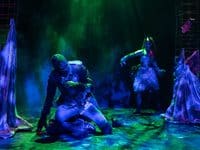
Octet, Dave Malloy’s a cappella musical now enjoying a regional premiere at Studio Theatre, is unlike anything else on local stages right now. Set in a church basement, the 100-minute one-act follows eight members of a technology addiction support group who process their online compulsions — social, emotional, financial, informational, and sexual — through song. There is no band, no orchestra, no electronic backing of any kind. The voices are the instrument. On a purely musical level, that feat alone is astonishing.
I am a huge fan of composer and lyricist Dave Malloy. His award-winning Natasha, Pierre and the Great Comet of 1812 lived on my Spotify playlist for years, and his reputation as one of musical theater’s most adventurous composers is well earned. This makes my reaction to Octet all the more jarring: I disliked it with such visceral ferocity that I spent much of the show wondering if I could hop over the folks seated in front of me to beeline it out of the theater.

And yet, when the lights came up, my partner turned to me and said, without hesitation, “That was amazing.”
How does one piece of art land so differently — so violently differently — with two people who usually agree on things?
It’s easy to see what works in the show. Octet’s score is dense, intellectually ambitious, and remarkably eclectic. Malloy draws on chamber music, gospel, punk, electronic textures, sacred hymns, and even Mongolian throat singing, weaving them into a tightly structured a cappella tapestry. Under director David Muse’s careful guidance, the eight performers, all exceptional vocalists, execute these intricate harmonies with deceptive ease. Their voices function as melody, rhythm, percussion, and atmosphere simultaneously, creating a soundscape that is rich, layered, and surprising.
As a musical experiment, Octet is undeniably impressive. As a piece of storytelling, however, it left me cold.
Malloy wrote the music, lyrics, and book, and the show feels like it was created by an artist overflowing with ideas and unwilling to leave any of them on the cutting-room floor. Unfortunately, this excess of source material prevents the show from coalescing into a satisfying narrative arc. The lyrics pull from a dizzying array of sources: pastoral imagery, scientific discourse, internet comment threads, twelve-step programs, and Sufi poetry. The songs, for no reason that I could discern, are each subtitled after individual tarot cards. The goal seems to be to create an intellectual collage, but the result feels cluttered and disappointingly didactic. Lyrics like “addiction, obsession, insomnia, depression, and the fear that I’ve wasted too much of myself on rapid and vapid click clicks” land less like poetry than like a scientific study set to music.
Structurally, Octet resembles A Chorus Line, with each individual cast member getting their moment in the spotlight to tell their story. But where A Chorus Line builds toward an emotionally cumulative climax, Octet remains stubbornly static. After the third or fourth solo number, I found myself counting how many confessions remained and wondering what new terrain the show could possibly explore. Musically, the songs vary wildly in style; dramatically, they blur together. The show beats us over the head with the idea that technology is harmful, but never moves beyond a listing of grievances. I kept waiting for the characters to grow, for the narrative to coalesce into a resolution, but it never did.
The opening number, “Hymn: The Forest,” exemplifies this problem. It begins abstractly, before we know who these people are or why we should care about them, and takes its time circling around to technology at all. Without narrative grounding, the song’s beauty feels untethered.
Studio Theatre’s production is polished and thoughtfully designed. Debra Booth’s set — a dingy parquet floor, stackable plastic chairs in a circle, a percolator of coffee available to both the cast and the audience — feels uncannily real, evoking both church basements and the quiet desperation of support groups. The staging is necessarily restrained; because the score demands near constant eye contact among cast members to maintain their razor-sharp precision, the performers mostly remain facing one another. Occasional chair rearrangements and stage rotations add visual variety but rarely deepen the storytelling. Lighting design by Mary Louise Geiger skillfully adds emotion to the scenes, while Nick Courtides’ sound design succeeded through thoughtful, nearly transparent choices.

Octet is truly an ensemble piece in which each performer functions as a distinct vocal instrument, sometimes leading, sometimes supporting, sometimes supplying rhythmic texture for others to launch from. Each cast member makes the most of their featured numbers. Ana Marcu and Jimmy Kieffer’s duet, “Solo,” poignantly captures the paradox of online dating: infinite connection breeding acute loneliness. Aidan Joyce’s “Actually” offers a chilling glimpse into online radicalization among young men, its lyrics adapted from real internet forums — a choice that lends the song a stark, unsettling authenticity.
Yet the sum of these isolated moments — Chelsea Williams (Jessica), Angelo Harrington II (Henry), and Tracy Lynn Olivera (Paula) each shine in songs highlighting cancel culture, online gaming, and the pitfalls of cellphones in the bedroom — fails to accumulate into something larger. Instead, the show grows increasingly unmoored. David Toshiro Crane’s solo as Marvin, a neurochemist who argues on scientific message boards while caring for a newborn, veers into surreal territory with a lengthy tangent on God appearing as an eleven-year-old girl in a mermaid costume. Perhaps this is meant to suggest the internet as a new deity — omnipresent, seductive, all-consuming — but the storyline arrives so abruptly that it feels more random than revelatory.
Throughout, I kept waiting for some sort of epiphany to rise from all these grievances. We all know that porn addiction is bad, online trolls are bad, fake news is bad … but what should we do with that information? Octet doesn’t seem to know any more than I do. Near the end, Amelia Aguilar’s Velma, a first-time visitor to the group, reverses course entirely, singing about finding a kindred connection online and rejecting the group’s despair. Her pivot is striking but thematically muddy. Is the internet the villain, the savior, or simply everything at once?
I suspect Malloy’s intention with Octet is to mirror the internet itself: overwhelming, contradictory, infinite. If so, Octet succeeds almost too well. The experience left me neither enlightened nor moved, but vaguely discomfited. I felt as though I had spent 100 minutes scrolling — absorbing information, reacting intellectually, but never feeling changed, inspired, or entertained. The show diagnoses our collective tech addiction with relentless precision, but offers no revelation, no transformation, no emotional release — only more data, more noise, more stimulation. In other words, it replicates the very condition it claims to interrogate.
And yet, I would be remiss to dismiss the show outright. What Octet lacks in emotional payoff, it compensates for in ambition. It is a daring experiment by one of theater’s most idiosyncratic composers, and there is value in witnessing an artist push form to its limits, even when the result doesn’t cohere. Working through why this piece failed for me has been its own kind of intellectual reward, a reminder of why I love thinking critically about theater.
Octet might not appeal to fans of easy, narrative-driven musicals. It certainly didn’t work for me. I sulked out of the theater with the traitorous thought that my afternoon might have been better spent playing Candy Crush Saga. Still, if you’re drawn to innovative scores, vocal virtuosity, and theatrical risk-taking, this production may resonate deeply.
Go see it, and decide for yourself.
Running Time: One hour and 40 minutes with no intermission.
EXTENDED: Octet plays through March 8, 2026, in the Victor Shargai Theatre at Studio Theatre, 1501 14th Street NW, Washington, DC. For tickets ($68–$150, with discounts available), go online, call the box office at 202-332-3300, email boxoffice@studiotheatre.org, or visit TodayTix. Studio Theater offers discounts for first responders, military servicepeople, students, young people, educators, senior citizens, and others, as well as rush tickets. For discounts, contact the box office or visit here for more information.
The program for Octet is online here.
Note: Octet is a phone-free experience. Audience members will be asked to lock their phones in a pouch for the duration of the show.
SEE ALSO:
Amelia Aguilar on finding acceptance and honesty in ‘Octet’ at Studio (interview by Nathan Pugh, January 25, 2025)
a trio of internet diary poem reviews of ‘Octet’ at Studio Theatre (response in poetry by Daniella Ignacio, January 28, 2026)