Braving record cold and the onset of a historic snowstorm, I attended The Reading Room Festival at the Folger Theater this weekend. It was the kind of adventure that I almost canceled — it would have been easier to back out because of the freezing weather, the threat of snow, and my college-aged daughter showing up unexpectedly with one of those it’s-the-end-of-the-world-problems-if-I don’t-get-it-down-this-weekend challenges.
First, kudos to the staff at the Folger Theatre for anticipating the weather challenges and quickly moving the Sunday event to Saturday afternoon. Second, thank you to my husband for stepping in and handling the college daughter crisis. Third, thank you to the wonderful servers at Quill & Crumb for their delicious cups of tea with steamed milk that I partook of between productions. Lastly, a special note of well-wishing to Karen Ann Daniels, Artistic Director of Folger Theatre and Director of Artistic Programs, who could not attend the festival due to illness, but was acknowledged by all as the creative driver behind this innovative program.
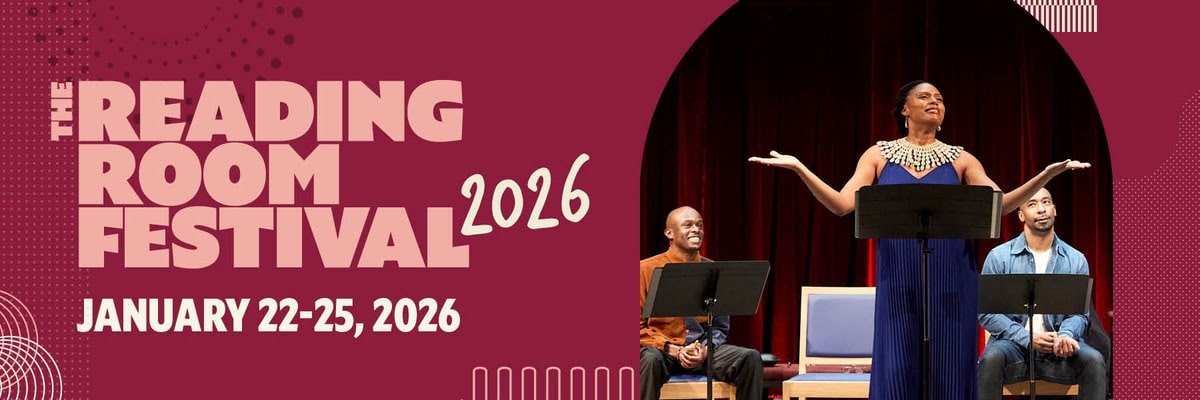
Now this isn’t a review. These productions are too new, too fresh, too in-process to review. These aren’t full productions. Readings are just what they sound like — actors, with only a few days of preparation and direction, standing in front of music stands, doing a dramatic reading of the scripts. So, this feature is more about the festival experience — and adventure. I highly recommend it for any theater lover — or adventurer.
I attended three productions, and each one was a small miracle. At one point in my life, I regularly attend the Sundance Festival and spent hours attending one movie after another, and this Folger series had that artful vibe of discovery, of being moored in with likeminded folks — I had more than one conversation with strangers/new friends about the productions, (I would even encourage the festival to keep the matinee and evening performance scheduling setup). The best vibe was just like Sundance or any artistic festival experience — it was about permitting oneself the extended, almost illicit treat of immersion in the new.
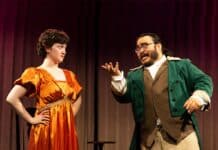
On Friday night, I attended Cymbeline: A Telenovela Melodramatic Western. I have to admit that I have never seen a production of Shakespeare’s late play, which “tells the story of an ancient British king and his three children… and continues the self-conscious interest of the other Roman plays such as Julius Caesar… in exploring how history is written and dramatized,” notes my study guide on Cymbeline from the Folger Shakespeare Library. This reading reflected the irreverence, originality, and playfulness of playwright Alberto Bonilla, who hails from Arizona and was inspired by his mother’s passion for telenovelas and his own love of Sergio Leone‘s spaghetti westerns. In this version, Cymbeline is transported from a mythic Roman-occupied ancient Britain to the American Southwest, circa 1893. The original music, sampled here and still in the works, is by Anthony de Angelis.
The goal of this bilingual (Spanish/English) adaptation was to be “a hootenanny,” in the playwright’s words, in the talkback following the reading. Bonilla added, “I think sometimes people get very precious with Shakespeare — and one of the things we had to do is not be precious about it, but fun.” Directed by Nadia Guevara, Cymbeline: A Telenovela Melodramatic Western made me want to stand up and dance and cheer for Shakespeare, something I don’t think I ever felt at one of his plays. But even more than that, it was the sense of discovery that made me optimistic. We can make the old new again in this country.
The reading of Dark Lady: A Musical Theatre Work, with book, lyrics, and music by Alexa Babakhanian and directed by Rebecca Martinez, also brought a new lens to Shakespeare. Melding a modern procedural with Shakespearean wit and mythology, The Dark Lady explores the provenance of Shakespeare’s work. Could it be that Amelia Bassano, descended from a Jewish Venetian family, and the first woman poet published in England, as well as the lover of Lord Hunsdon in the court of Elizabeth I, is the true author of Shakespeare’s plays? After centuries, does it matter who wrote the plays, or do the works stand on their own? This feminist exploration, again with a musical track, in this case infused with ballads, duets, and beatboxing, brought up questions of provenance that had the crowd buzzing during talkback and afterwards in the Quill & Crumb.
Lear, translated, adapted, and remixed by Obie Award-winning playwright Marcus Gardley and directed by Arena Stage Artistic Director Hana S. Sharif, places King Lear in the volatile 1960s in San Francisco’s Fillmore District, a center of Black art, music, and culture. This was a play reading with force and passion and betrayal and all the pain and madness of the original, but now claimed by those who have been historically marginalized in the artistic world, especially in the classic Shakespearean sphere. Ultimately, the King is unhoused on the streets of San Francisco, furious at his daughters, mad at the injustice and powerlessness he feels in the world. However, all does not end in hopelessness. We are implored to remember Lear and those who came before us, but to seek solidarity, to fight on, and lead the way. The response from the packed theater, as the winter storm bore down on us all, was a standing ovation.
As I hurried to beat the snow home, a delicious delight surged through me — at being among the theater kids, those creative, imaginative, irreverent theater folk — though attending The Reading Room Festival would be good for any clique in this high school metaphor. It was good for my soul to have people from all quarters of this country come together for a “hootenanny,” or a “dark lady” discovery, or a king who stands humbled like this Lear. I cannot wait for next year’s Reading Room series at the Folger Theatre, and most of all, for the chance one day to experience these readings in full productions.
Folger Theatre’s fourth annual Reading Room Festival took place January 22 to 24, 2026, at the Folger Theatre in the Folger Shakespeare Library, 201 East Capitol Street SE, Washington, DC.
SEE ALSO:
Folger Theatre announces full lineup for 2026 Reading Room Festival (news story, January 10, 2026)
Folger Theatre announces fourth annual Reading Room Festival (news story, December 22, 2025)