
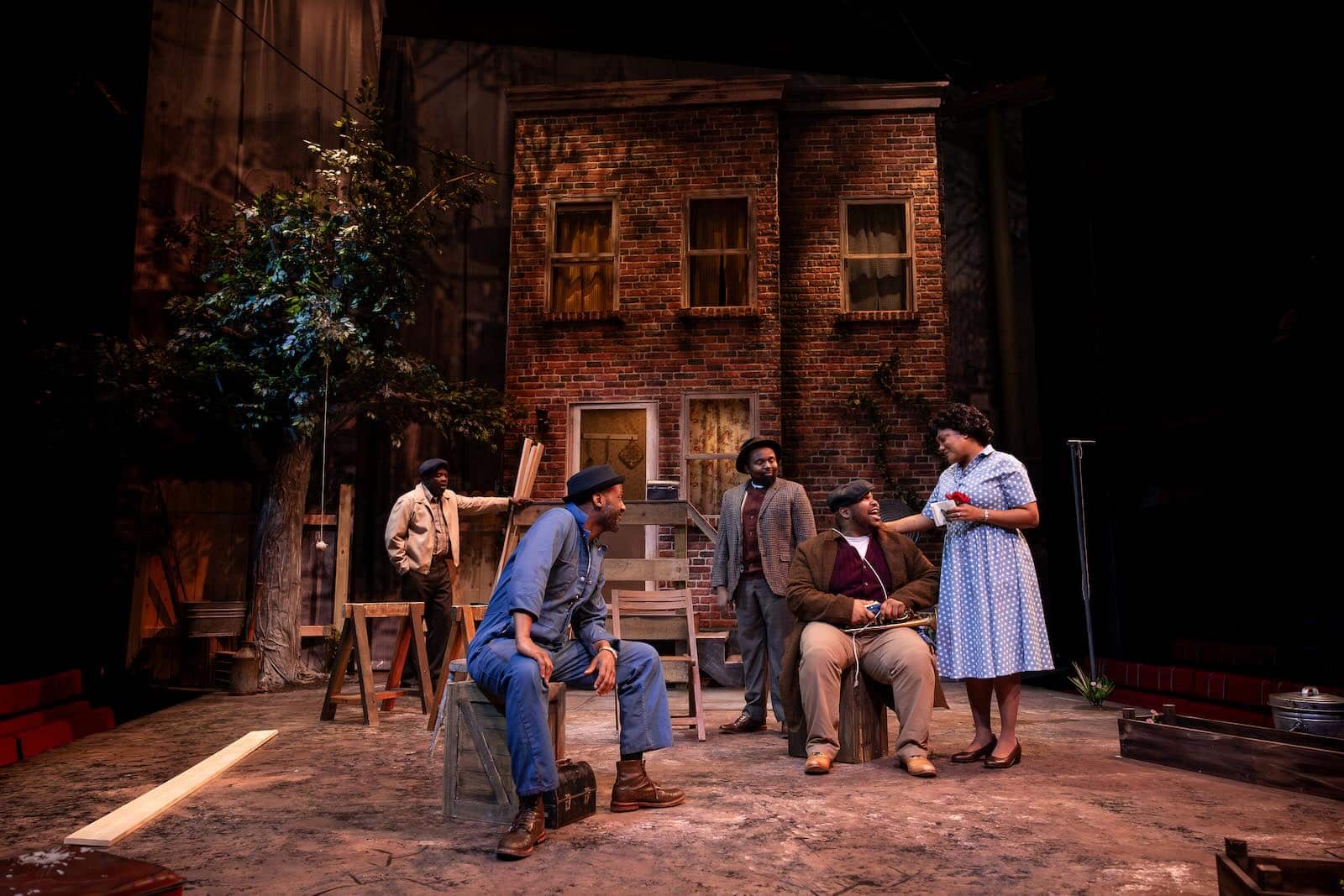
August Wilson’s Fences, presented by the Chesapeake Shakespeare Company, stands as one of the most resonant and emotionally complete productions of the August Wilson Century Cycle to grace Baltimore stages in recent memory. Directed with care and clarity by Reginald L. Douglas, this production honors Wilson’s language while allowing the performances to breathe, bruise, and ultimately bloom. It is a deeply human telling of ambition deferred, love tested, and legacy wrestled with. Often painfully, within the confines of a small backyard that feels as vast as the American experience itself.
Set in 1957 Pittsburgh, Fences centers on Troy Maxson, a former Negro League baseball player whose bitterness over lost opportunities has hardened into stubbornness and control. Now working as a garbage collector, Troy measures life by endurance rather than joy, convinced that survival itself is victory. He is married to Rose, a devoted and quietly formidable woman who has built her life around Troy’s orbit, and together they are raising Cory, a son with athletic promise and dreams Troy refuses to nurture. Hovering around them is Troy’s loyal friend Bono, his fiscally irresponsible son Lyons from a previous relationship, and a past that refuses to stay buried. The fence Troy promises to build becomes both a literal structure and a powerful metaphor. One meant to keep loved ones close, but also one that traps everyone inside it.

DeJeanette Horne delivers a commanding and deeply textured performance as Troy Maxson. From the moment he steps onstage, you feel the weight he carries, the exhaustion of a man who believes the world cheated him, and that bitterness is the only armor left. Horne’s Troy is not simply angry; he is haunted. His booming voice and blustering stories are undercut by flashes of vulnerability that make his stubbornness feel tragically earned rather than cruel for cruelty’s sake. You feel his constant push and pull: a man who wants more from life, who once dreamed big, yet is now determined to beat the world into submission by sheer force of will. Horne allows us to see Troy’s love for his family even as he repeatedly wounds them, and that complexity makes his eventual unraveling all the more devastating.
The emotional center of this production, however, belongs to Lolita Marie as Rose Maxson, whose performance is nothing short of extraordinary. Marie plays Rose not as a passive wife, but as a woman who has chosen love fully and with intention, until that love is tested beyond endurance. Her Rose is warm, steady, and quietly humorous, anchoring the household while Troy storms through it. When the truth of Troy’s betrayal comes to light, Marie delivers one of the most powerful monologues I have witnessed on a Baltimore stage. As she declares, “I planted myself in you, but the soil was hard and rocky and I was never going to bloom,” the air left the room. Her voice did not waver, but her pain rang clear and true. My eyes actually watered. It was a moment of reckoning, both for Troy and for the audience, as Rose finally claims her own worth, her own life, and her own future. Marie’s performance is poignant and stays with you.
Director Reginald L. Douglas approaches Fences with a steady hand, allowing Wilson’s language to lead while shaping a production that feels intimate and urgent. The pacing is deliberate, giving space for silence and stillness when needed, and the emotional arcs are carefully honored. Douglas understands that Fences is not about grand gestures, but about accumulation, the slow build of resentment, love, disappointment, and truth. The result is a production that feels honest and deeply lived in.
Special praise must be given to sound designer Chris Lane, whose music choices beautifully underscore the emotional landscape of the play. The sound design enhances the storytelling without overpowering it, grounding the production in its time while reinforcing the play’s emotional beats. The music felt intentional and thoughtful, adding texture and resonance to an already powerful experience.
Overall, Fences at the Chesapeake Shakespeare Company is one of the finest productions I have seen so far in Baltimore’s exploration of the August Wilson Century Cycle. It is a testament to the enduring power of Wilson’s writing and to the artists who continue to bring these stories to life with care, courage, and conviction. This production does not simply present Fences; it lives inside it. It is theater at its most honest, and it deserves to be seen.
Running Time: Two hours and 45 minutes, including one 15-minute intermission.
Fences plays through March 8, 2026, at Chesapeake Shakespeare Company, 7 South Calvert Street, Baltimore, MD. Purchase tickets ($29–$70) by calling 410-244-8570, visiting the Box Office in person, or ordering online. For directions, parking, transportation, and other plan-your-visit information, click here.
The program for Fences is online here.
This is the sixth show in The Baltimore August Wilson Celebration.