
The ancient story of Joseph — favored son of patriarch Jacob, sold into slavery by his own brothers, later to rise to power and influence in Egypt — appears in the Jewish, Christian, and Islamic scriptures and has inspired numerous artistic interpretations, from paintings to opera to ballet to literature to theater and film. Theater lovers may be most familiar with the tale through Andrew Lloyd Webber and Tim Rice’s enduringly popular Joseph and the Amazing Technicolor Dreamcoat. While Joseph: God Meant It for Good, now playing at the Museum of the Bible’s World Stage Theater, originates from the same era as Dreamcoat, don’t expect to see any Elvis-impersonating Pharaohs or catchy musical numbers.
Presented by the Academy of Arts’ Logos Theatre, and originally written by Academy of Arts founder Dr. Nicky Chavers in 1969, Joseph: God Meant It for Good predates the founding of the Academy of Arts in 1971 and has been a staple of the company’s repertoire for decades. It comes to the DC stage as the Academy of Arts celebrates its 55th anniversary and becomes, according to the show’s playbill, “the first biblical epic to be performed at [the] Museum of the Bible.”

Directed by Chavers’ daughter (and current Academy of Arts Artistic Director) Nicole Chavers Stratton, Logos’ production of Joseph is a cinematic-scale epic reminiscent of Cecil B. DeMille’s The Ten Commandments. Jesse Gould’s set design features multiple moving parts, from the rocks and palm trees of Joseph’s desert home to towering pillars covered in hieroglyphs when the action shifts to Egypt. Jeremiah Gould’s visual effects extend the starry nights and harsh red clouds of the desert landscape onto the back, left, and right walls of the theater. Olivia Singleton’s sound design blends a Middle Eastern–inflected musical score originally written by Chavers with vividly lifelike sound effects from crickets chirping to fast-approaching hoofbeats.
While the production quality and design elements justify Joseph’s billing of the play as a “biblical epic,” the story, as presented, is a family drama at its heart. True to the biblical source material, elderly patriarch Jacob (Dave Stratton) presides over a family messier than anything you’ll see on Bravo. (Twelve sons by four women! Sister wives! Handmaids!)
Joseph (Samuel Moses), the eleventh of Jacob’s twelve sons and the eldest son of Jacob’s now-deceased favorite wife, Rachel, is the golden child in this mix, bestowed by his father with the position of authority in the family, signified by an intricately patterned multicolored coat (Sylvia Jackson, costume designer). Moses plays Joseph as near-fawning in the presence of his father, grateful for his favored status, and largely oblivious to the simmering resentment that this stirs in his brothers.
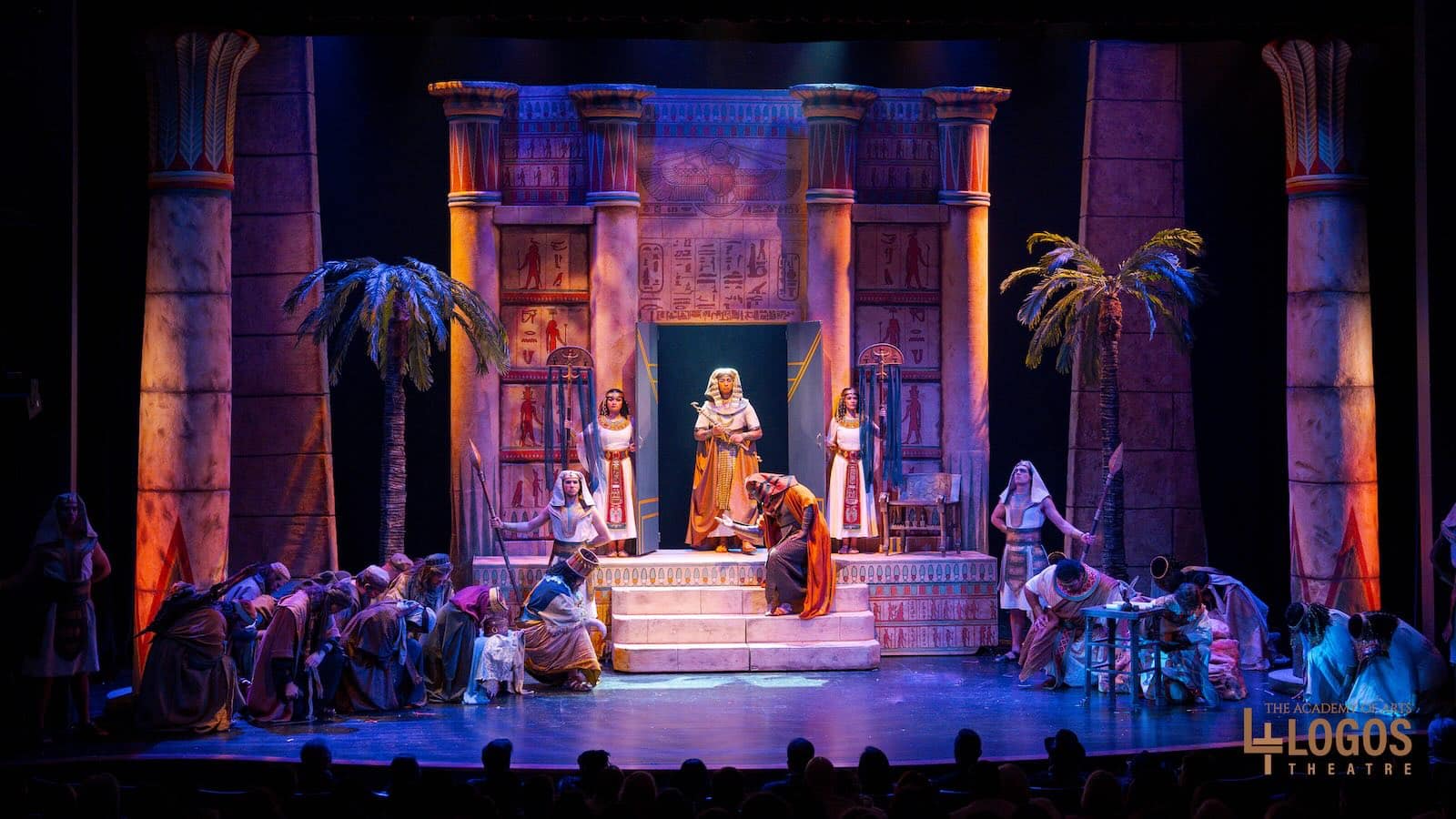
Old wounds and varying motivations bubble to the surface as the brothers are united in their hatred of Joseph but divided over how to knock him off his golden-child pedestal. Reuben (Ben Maciejack) is offended that Joseph has usurped the position of family authority that should have been his as the eldest son, while also reminding his brothers that their father will hold him (as the eldest brother) responsible should any harm come to Joseph. Simeon (Gregory Towler Jr., one of two local actors in the cast) strides across the stage with a chip on his shoulder and rage in his eyes as he shouts, “Joseph has poisoned Father against us!” and is the first to suggest killing his brother. Judah (Noah Stratton) is motivated by vengeance for his mother, Leah (Sylvia Jackson), who long after her sister Rachel’s death mourns that she and her sons are still unwanted: “As long as Joseph lives, we are all second choice.”
In a flashback narration as the play opens, Stratton’s Judah asks the audience: “Which is worse, to slay a human life, or to sell a human life?” The brothers’ decision to sell Joseph into slavery — and the repercussions of that decision — reverberate through the rest of the play.
Logos’ production uses multiple, sometimes uneven, points of view to tell the tale. Stratton as Judah alternates between a leader of the brothers and a narrator addressing the audience. Much of the dialogue and narration is spoken in vaguely Shakespearean/King James English, which adds to the play’s “ancient epic” feeling, but is not always consistently delivered. Joseph’s journey to Egypt and life as a slave is told briefly through dance, choreography, and mime with voice-over narration, keeping the focus of the play on the family drama. We don’t see much of Joseph beyond his interactions with his family, with their unexpected reunion in Egypt setting up the intrigue and emotional revelations of the second act.
Where Logos’ earlier productions at the Museum of the Bible (adaptations of three of C.S. Lewis’ Chronicles of Narnia novels, as well as of John Bunyan’s The Pilgrim’s Progress) feature biblical themes and imagery, Joseph presents the biblical characters themselves as deeply flawed human beings, with deep wounds, dark secrets, and family trauma aplenty — yet never beyond the possibility of healing.
Running Time: Two hours and 25 minutes, including one intermission.
Joseph: God Meant It for Good plays through March 22, 2026, presented by The Academy of Arts Logos Theatre, performing at the World Stage Theater on the fifth and sixth floors of the Museum of the Bible, 400 4th Street SW, Washington, DC. Tickets ($25–$79) are available online, at the Museum, or by calling (866) 430-MOTB.
The playbill for this show is online here.