How far would you go to bring guilty parties to justice? Would you lie, scheme, and deceive? Would you maybe even murder? This question has been asked for millennia and is the basis for Agatha Christie’s classic murder mystery, published on New Year’s Day in 1934, Murder on the Orient Express. A play replete with revenge, retrospection, and reckonings, Murder on the Orient Express is playing now at the Workhouse Arts Center, adapted for the stage by Ken Ludwig and directed by Adian Chapman and Natalie Turkevich.
The story follows famous detective Hercule Poirot as he works to solve another mysterious murder: Just after midnight, the Orient Express is stopped in its tracks by a snowdrift, trapping a curious set of passengers inside. When morning rolls around, the shady American “businessman” by the name of Ratchett is found murdered inside his locked compartment. It’s clear one of the train’s passengers is responsible. But who and why? Aboard the elegant express, we encounter excitement, intrigue, and suspense as Poirot uncovers countless clues and hidden truths by surveying the unique collection of characters to weed out the killer.
The Workhouse Arts Center has a habit of assembling highly talented actors who engage as an undeniable group, and this production was no exception. This success is especially impressive considering two voices are behind the show’s direction. Although they have worked together on past productions, Chapman and Turkevich don’t appear to have co-directed a show prior to this one. And yet they managed to create a clear and dynamic tone that showcases a fully realized artistic vision.
The entire ensemble relayed impressive performances both as individual characters and as a blended collective. Each performer had standout moments in this production. To name a few, John “Jack” Elmendorf as our steadfast detective, Hercule Poirot, led the majority of scenes, embodying the unquestioned confidence of the analytical psychologist, but enriched by a dash of nerdy energy that made the whole character feel renewed. Aja Goode as the thrice-divorced socialite, Helen Hubbard, commanded the stage each time she stepped out. And Suzy Alden as Princess Dragomioff contributed some of the best one-liners with a throw-away delivery that added intelligence to the grander comedy.
The dialogue never missed a beat; conversations flowed naturally, witticisms bounced around with comedically professional pace and delivery, and various accents cut through with precision. This is likely in large part due to the influence of dialect coach Zach Campion.
In particular, I found three accents to really stand out among the rest. First, Christian Wilson, as Colonel Arbuthnot, spoke with a Scottish accent so convincing that I found myself repeatedly wondering whether Christian himself was in fact Scottish. Second, Elmendorf’s Belgian accent as Poirot carefully constructed the complexly subtle combo of French and German that lends to the Belgian accent. And, finally, Jillian Blair as our murder victim, Ratchett: Despite her being alive for only the first quarter of the show, her 1930s New York gangster accent never verged on gimmicky but instead felt genuine to the era, actively placing us in the narrative world.
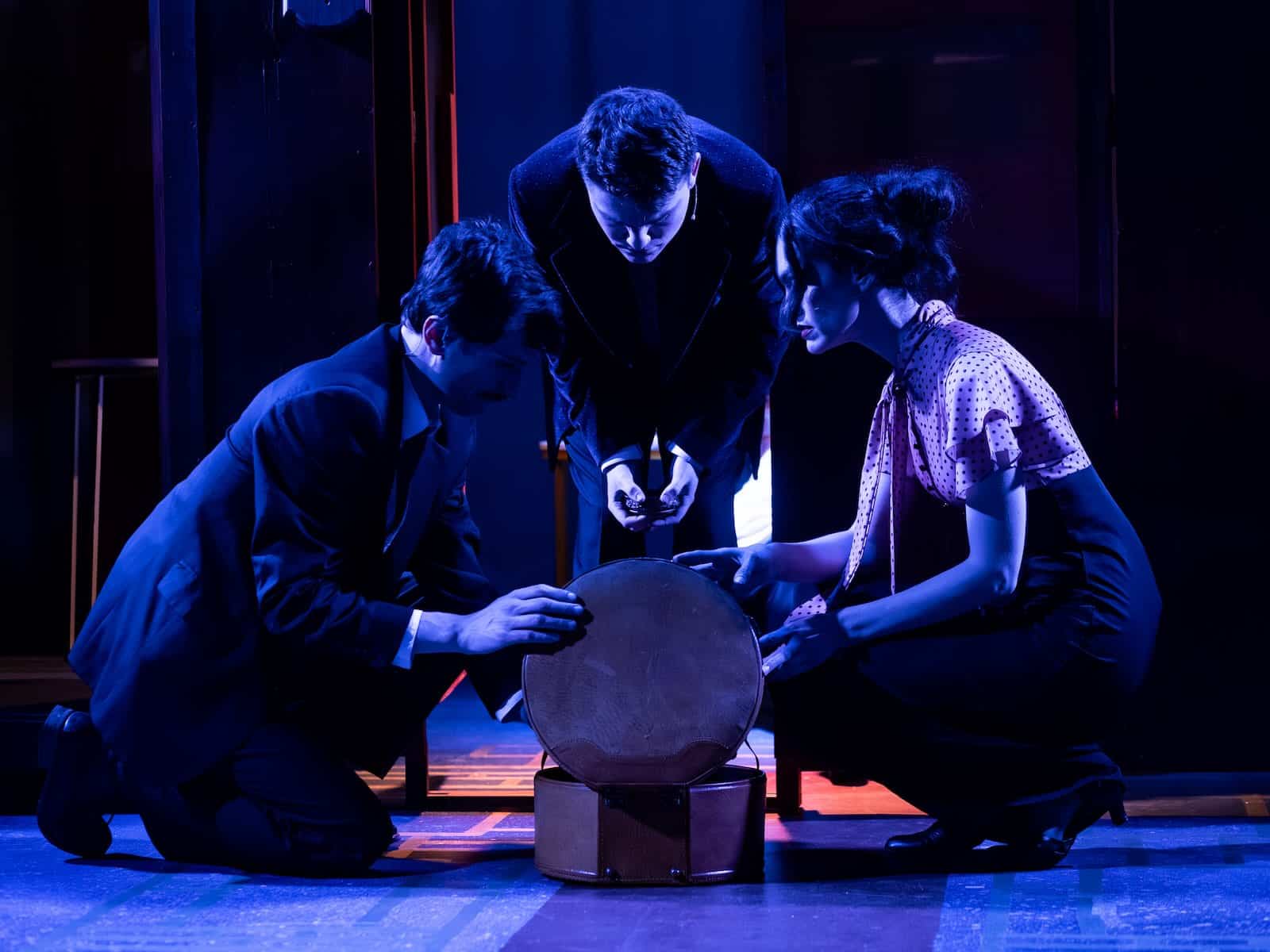
Further grounding us in 1934 on the luxurious Orient Express were the costumes, props, and sets. The costumes from costume designer Lourdes Turnblom were thoughtfully stylized from head to toe and included multiple wardrobe changes, showing the passage of time as well as the differences in characters’ demeanors (not to mention financials). The costumes appeared realistic to the era, not just in style but in fabric and practicality. So much so that I found myself distracted, wondering if the majority were sourced from antique thrifts, and if so, where can I find them, please?
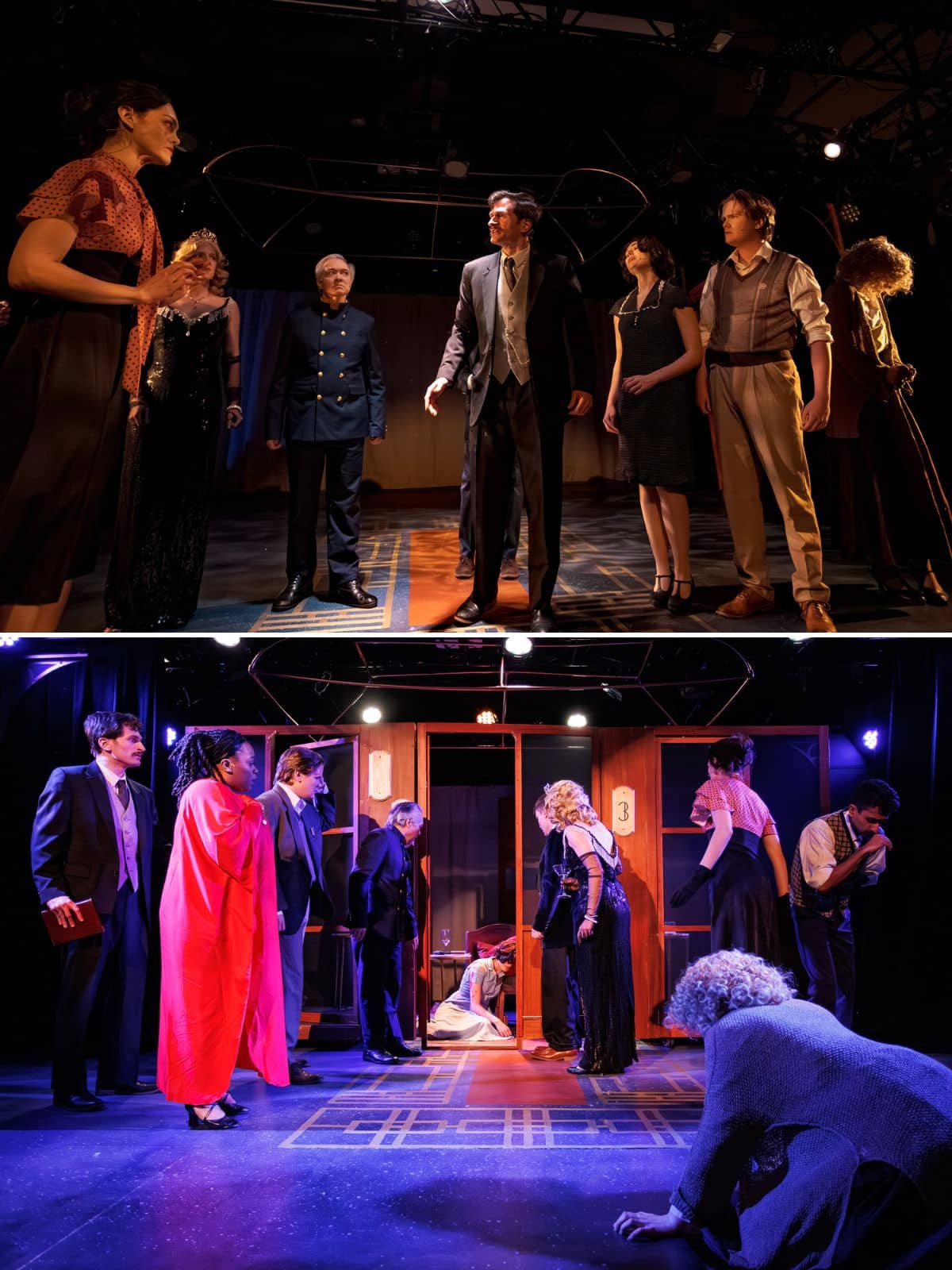
Similar to the costumes, the props from properties designer Martin Bernier were grounded in the era and did a great job filling out the world-building elements. The sets from scenic designer Ali Rocha were quite complex considering the relatively small space but were highly effective in moving the story and immersing the audience. They utilized rolling wooden walls with built-in windows and working doors to create various parts of the train including the compartments, the café, and the radio room.
Projected images also appeared on the stage backdrop to further reinforce the show’s realism, including projections of the hotel lobby before the train departed Istanbul, and later, when trapped by snowdrift somewhere in Yugoslavia, when we are transported to a snowy forest with snow falling outside the train’s windows.
Sound designer Andie Matten and sound technician Clare Pfeifer also provided grounding effects by incorporating audio such as the staticky radio transmissions and industrial-era train whistles. I also found myself smiling at the use of Radiohead’s song “Reckoner,” which was played before the show began, during intermission, and again during bows. I have to assume it’s a nod to the show’s overall theme of moral reckoning.
Lighting designer Christina Giles and lighting technician Grace Million highlighted the 1930s, too, but more through the media tropes of the time. They played with sharp contrast associated with the film noir genre by blacking out the stage and shining blue spotlights during expository monologues that heightened both the comedy and the drama of the scenes. They also created real intrigue through their lighting effects during the final “whodunnit” scene.
Everyone knows, the best part of any “whodunit” is the end when everything is explained, when we find out “whodunit” and how. This show not only delivered the engaging dialogue of the famous twist ending, but also did so in an artistic, intelligent, thoughtful, and fresh way. It’s not just the ending that this production plays with. In fact, several small details throughout are updated, such as working with only 10 characters rather than the novel’s original 17. This change affected certain plot and character points, but in a way that felt fresh for a modern audience. So, regardless of prior knowledge of the show’s themes and conclusion, the endearing characters, witty dialogue, and stunning costumes/props/sets all come together to create a truly enjoyable rendition of Agatha Christie’s Murder on the Orient Express.
Running Time: Two hours and 30 minutes, including a 10-minute intermission.
Murder on the Orient Express plays through April 12, 2026, presented by Workhouse Arts Center, performing at the W-3 Theater located at 9518 Workhouse Way, Lorton, VA. Purchase tickets ($40 for general admission, with discounts available for students, seniors, and military) at the box office, online, or by calling 703-584-2900.