The phrase “Grief is like a garden” is often heard, meaning grief must be tended to or else it will fester, and the weeds will drag us down. But if it is cared for, we can ground ourselves in nature and connect to those we’ve lost. The Secret Garden invites us to examine this saying through a beautiful parable of how love, connection, community, and environmental psychology are the medicines needed to overcome the haunting nature of generational trauma.
Based on the classic children’s novel by Frances Hodgson Burnett, published in 1911 and adapted as a musical for Broadway by Marsha Norman and Lucy Simon in 1991, The Secret Garden is charming audiences once more at the Thomas Jefferson Community Theatre, directed by Zachary Flick and conducted by Matthew Brown.

This haunting tale, with its soundtrack of dark baroque lullabies, follows the endearingly obstinate Mary Lennox (Samantha Regan, who carried the lead role respectfully) as she journeys to restore hope to a dying home. We meet our young heroine when she discovers her parents have just passed from cholera. Following their death, she is forced to leave India — the only home she’s ever known — and move to England to live with her uncle at his eerie estate, Misselthwaite Manor.
Mary’s uncle, Archibald Craven (William Essig), has spent his life under the umbrella of his hunchback deformity and the subsequent judgments — both external and internal. It was only upon meeting his beloved wife, Lily (Emily Carbone), that he was able to find peace and happiness. In the years following her death, however, Archibald has become utterly consumed by grief and grows increasingly nihilistic and isolated. In this deprived state, Archibald finds himself unable to care for Mary as he can’t even care for his own sickly son, Colin (Cecelia Gorini, a surprisingly skilled vocalist for someone so young). Instead, he leaves Colin in the primary care of his brother, Dr. Neville Craven (Jared Diallo).
Essig and Diallo, as the Craven brothers, were the anchors as well as the shining points of this show. Essig, an electrical engineer by day and musical star by night, proves that talent can truly be found anywhere! During their powerful duet “Lily’s Eyes,” both men radiate passion through poignant, pitch-perfect vocals and crescendoing dynamics. The ballad uncovers the complicated relationship between the two brothers and the complexity of their characters. Whereas Archibald fell fearful and hopeless following Lily’s death, Neville (who also harbored a secret love for his brother’s wife) has become resentful and frustrated by how his life has unfolded.
Mylo Cluff is magnetic as the lowly local boy Dickon, whose jovial nature and sense of magical realism position Mary to revive the dying garden and, in turn, the environs of the dying manor. I first saw Cluff perform as Seymour in the ARTfactory’s production of Little Shop of Horrors. And, while that performance was definitely entertaining, this role was Cluff’s glass slipper. It fit his voice perfectly, and he cradled the Celtic folk tones of songs such as “Winter’s on the Wing” beautifully.
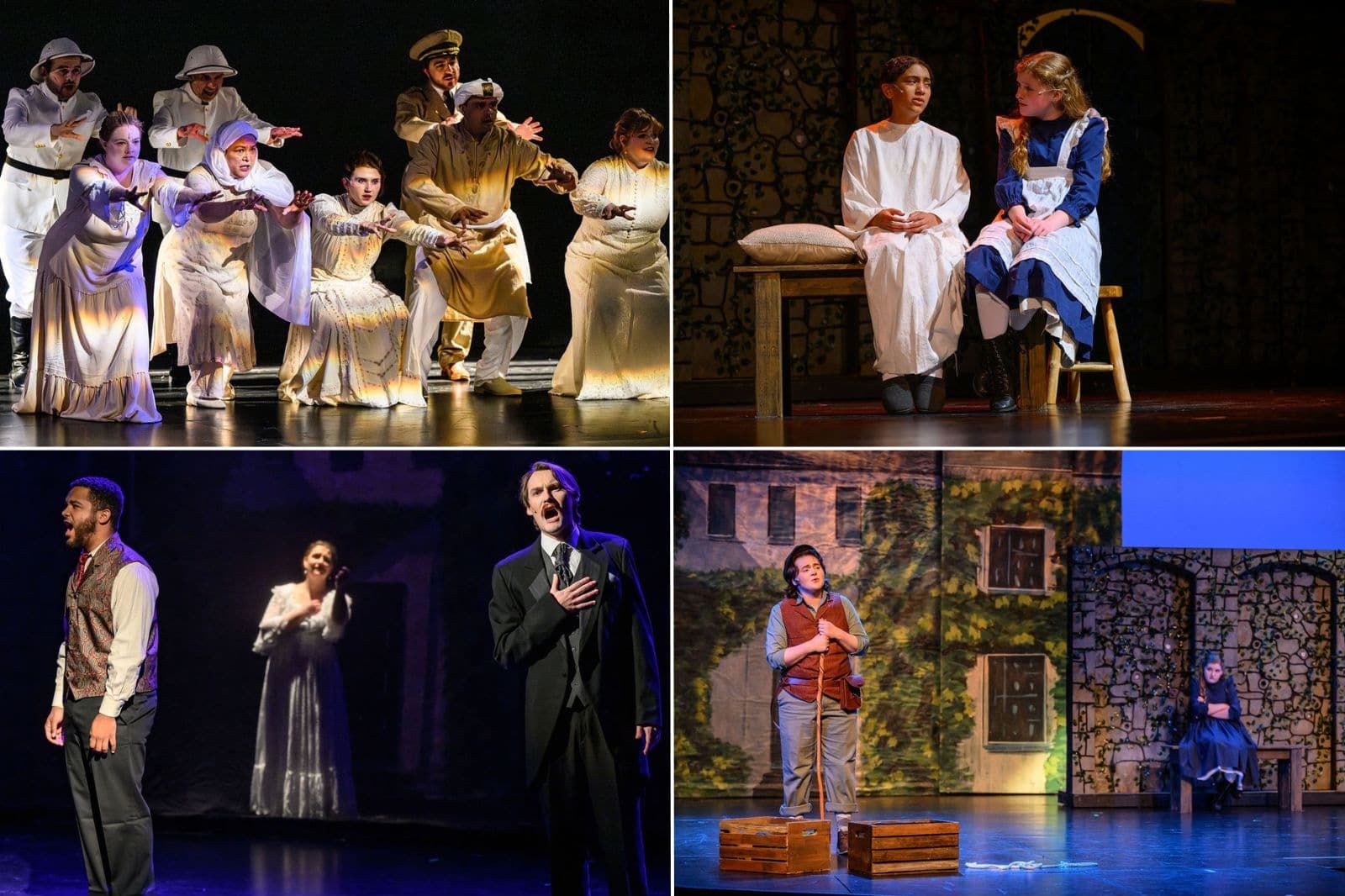
The lovely Lily (Carbone) traverses the halls of Misselthwaite Manor as a metaphorical nod to the notion that our departed loved ones are never truly gone but live on in our shared memories. She exists in all their lives as a positive presence to point them in the direction of hope and revival. She does this for her son, Colin, during “Come to My Garden,” in which she encourages the boy to leave behind the heavy fears and doubts he has inherited from his father and uncle, and come to the garden to be unburdened and greet the exciting possibilities of a new day. Carbone’s classically theatrical soprano voice was elegant and ethereal throughout the show, but in this moment, she enveloped us in the character’s warm maternal feelings and a belief in the power of love as a means of healing. She sang and we were safe.
At its core, The Secret Garden is a ghost story that threads together past and present by incorporating an ensemble cast of spirits that endow the show’s lifeblood with ethereal energy, circulating breath between what is and what isn’t. This is furthered through the choreography by Nathan Nichipor, who also served as the show’s assistant director. The ensemble group of spirits would weave through the stage, dressed head-to-toe in various shades and hues of white (courtesy of costume designer Lori Crockett) like little floating lights meant to be caught and released.
Although the choreography often felt a little awkward, the overall intention of the energy supported was clear. The spirits danced with movements that alluded to the changing mood throughout the show. They moved at points as though performing ancient summoning rituals, swaying low to the ground and spinning furiously across the stage like whirling dervishes. They would waltz during scenes of romantic recollections, and at times they even incorporated various movements from traditional Indian routines to draw us into Mary’s emotional state.
The set they danced across consisted of the manor’s exterior and the overgrown hedges that led to the secret garden. The style in which the set was painted appeared almost illustrative, perhaps a nod to the classic novel and its memorable illustrations. Set designer Skip Gresko, scenic/lead painter Sandy Kozel, and lead carpenter Shah Choudhury created a world of greenery that adapted in tandem with the characters. They also supplied a backdrop, which was used to reflect the looming presence of the spirits residing in the manor by projecting their silhouettes against the changing color backdrop.
Although there were a few opening night stumbles with lighting, mics, and steady vocals, this production of The Secret Garden is a charming evening of entertainment with layers of lessons in love. The entire show is steeped in allegory and metaphor for us to soak in. In “Come Spirit, Come Charm,” we are taught how to release negative generational trauma while still investing in the positive energy and love of past generations. And, in “Race You to the Top of the Morning,” when Archie is reading to Colin, we see how stories themselves can be healing. The Secret Garden is a healing story. It’s a reminder to garden our grief, because even in the darkest hours, hope and renewal are still alive.
Running Time: Two hours and 20 minutes, with a 15-minute intermission.
The Secret Garden plays through May 24, 2026, presented by The Arlington Players, performing in the Thomas Jefferson Community Theater at Jefferson Middle School, 125 S Old Glebe Rd., Arlington, VA. Tickets ($30 for adults, $25 for seniors or military, and $20 for students) may be purchased online.
The cast and production credits are online here.