The original West Side Story was a musical that almost never got made. Dreamed up in 1949 by Broadway choreographer Jerome Robbins, who wanted to do a dance-driven contemporary take on Shakespeare’s Romeo and Juliet, it took eight years to bring it to the stage, along the way changing its cultural focus (Irish to Puerto Rican), its locale (NYC to LA and back to NYC), and its creative team. Robbins quit more than once, and composer Leonard Bernstein sometimes got confused about what the show’s musical language should be (opera or Broadway) as he was concurrently working on Candide. Arthur Laurents struggled to write the book, and it wasn’t until a young, unknown writer was brought in that the work gained some momentum. That young writer was Stephen Sondheim. Still, there were problems raising money. The production finally opened in New York in 1957, after out-of-town trial runs, including in Washington, DC, and became a groundbreaking American musical, garnering many awards, multiple global productions, and two blockbuster movies to date.
Now, the Washington National Opera brings its own production to town, or to put it more precisely, to two towns (Baltimore and Greater Washington), with its own orchestral force of a hefty 50 pieces. But the journey to get here, though shorter, was similarly perilous and involved the WNO leaving its home of many years at the institution formerly known as The Kennedy Center, after a decidedly hostile takeover.
On opening night at the Lyric Baltimore, the audience gathered into the 2,000-seat house, and the air crackled with excitement. Ardent followers of the company mingled with first-timers. Some wondered if the show would sound “opera-ish”; others were surely asking whether an opera company could sing and dance with Jerome Robbins’ jazz flair. But when the city’s beloved Marin Alsop stepped onto the podium to conduct, the applause and cheers that greeted the former head of the Baltimore Symphony Orchestra left no doubt as to who was the star of the evening.
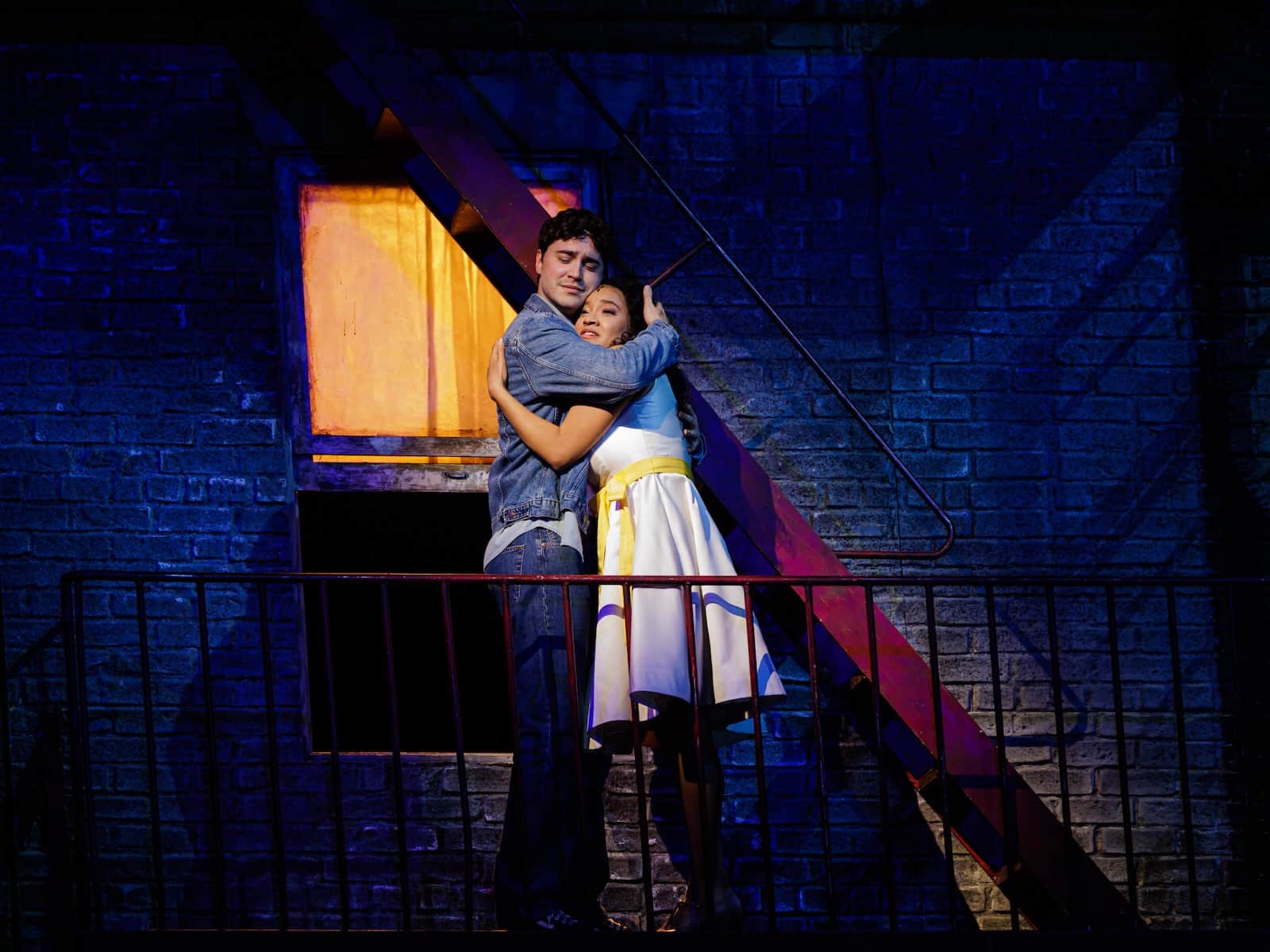
Director Francesca Zambello and her WNO team have created a show, despite all the challenges of being “on the road,” with the highest production values. Peter J. Davison designed a magnificent set with multistory building facades that transported us to New York City’s West Side, with looming iron girders, crowded dwellings, and urban playgrounds with chain-link fences. A.J. Guban has beautifully expanded on Mark McCullough’s original lighting design, painting New York’s changing skyline with light on the upstage cyc. (McCullough passed December 31 of last year. He had been a fixture at the WNO and a prized member of the creative team; he will be sorely missed.)
Zambello had determined that the show’s style would land squarely in the Broadway musical camp. Singers are mic’d (sound design by Andrew Harper), and there are character choices through chest voice and occasional growling in places, but blessedly, the sound was overall lyrical, and especially lovely from the two leads, Ryan McCartan as Tony and Shereen Pimentel as Maria. McCarton showed himself to be a most compelling performer right from his first song, “Something’s Coming,” with its augmented fourths and rhythmic drive underneath the building melodic lines. The show’s favorite “Maria” was exceptionally moving, and the duets with Pimentel were touchingly believable and vocally lovely. Surely, opera devotees could appreciate Pimental’s “legit” soprano high notes ringing as true and pure as Maria’s white dress.
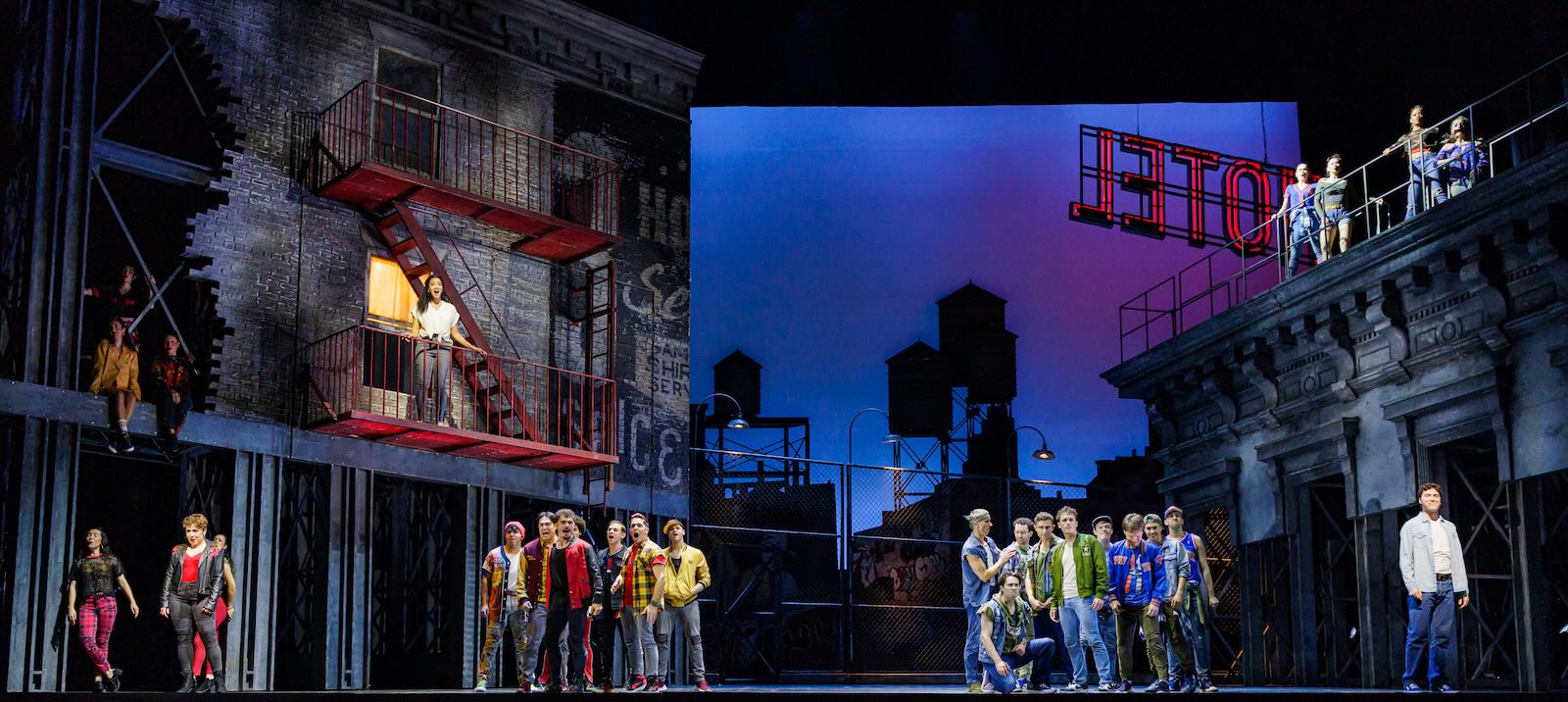
But of course, the heart of this work and what drives the story was conceived by Robbins in the dancing, and this production paid full homage to Robbins and his signature style of choreography. Zambello assembled a small army of accomplished choreographers, including Eric Sean Fogel as associate director, Joshua Begasse as choreographer, and Kiira Schmitt Carper as associate choreographer, to ensure that authentic details were incorporated into both the period’s jazz style and Puerto Rican dance forms.
The opening number introducing the rival gang members of the Jets and the Sharks, with its finger snaps and head arrests, its knee lifts to the chest, and long slides, showed us why it remains one of the most iconic numbers in the American musical canon. A nine-year-old sitting near me told me he was especially taken by “Anita and the ladies in the Puerto Rican dance number” (“America”). Amanda Castro as Anita may not have been Chita Rivera, but she was a hot dancer and delivered the goods as an actress. The high school dance and the gang rumbles were terrific and demonstrated that a talented ensemble had been gathered.
There’s also humor in this production, and the ending is powerful and gets me every time. Bernstein provided no final number. There’s just a fierce monologue by Maria, so courageous and defiant, it is shattering and brings us to confront our own prejudices, attitudes toward immigrants, and our country’s gun and other violence that goes on claiming so many lives.
Zambello and company certainly made a case that crossover music-theater forms are our shared American heritage and should be cheered by young and old alike, whatever our backgrounds or music-theater tastes. The fully staged production at The Lyric in Baltimore has closed, but head to Strathmore for a more concert-style event.
Running Time: Two hours and 40 minutes with a 25-minute intermission.
West Side Story played fully staged May 8 to 10, 2026, at Lyric Baltimore in Baltimore and plays next in concert May 14 and 15, 2026, at 7:30 p.m., presented by Washington National Opera performing at Music Center at Strathmore, 5301 Tuckerman Lane, North Bethesda, MD. Purchase tickets online.
In English with projected English titles.
CREATIVES
Stage Director: Francesca Zambello, Conductor: Marin Alsop, Associate Director: Eric Sean Fogel, Choreographer: Joshua Bergasse, Associate Chorographer: Kirra Schmidt Carper, Scenic Designer: Peter J. Davidson, Lighting Designer: A.J. Guban after Mark McCullough, Costume Designer: Jessica Jahn, Sound Designer: Andrew Harper
CAST
Ryan McCartan, Shereen Pimentel, Amanda Castro, Taylor Harley, Yurel Echezarreta, David Prottas, P. Tucker Worley, Arcadian Broad, Tristan McIntyre, Brendan Yeates, Peter Murphy, Matthew Liotine, Ethan Zeph, Madison Hertel, Emily Snouffer, Cristyn Dang, Rachel Harris, Leah Suskind, Julio Catano-Yee, Omar David Caraballo, Thomas Ortiz, Dan Follett, Waldemar Quinones-Villanueve, Edgar Cavazos, Daniella Castoria, Rachel Josefina, Maria Cristina Posada Slye, Jordyn Waldo, Erin Gonzalez, Wynn Harmon, Zachary Owen, Ahmad Kamal, Calvin McCullough, Chadwick Balen
SEE ALSO:
Washington National Opera announces new dates and venues for ‘West Side Story’ and gala (news story, February 20, 2026)