Stephen Sondheim’s Into the Woods charmed many critics when it opened in 1987, drawing audiences into an enchanted journey through familiar fairy tales and interwoven characters. The musical blends playful storytelling with darker, often Freudian undertones, including themes of flawed parenting, abandonment, and consequence. Its stories — including Jack and the Beanstalk, Cinderella, Rapunzel, and the tale of the Baker and his Wife — send each character into the woods, where their paths become increasingly entangled. After the apparent “happily ever after” of the first act, the characters return to discover that every wish carries a cost, and that everyone must eventually pay their share.
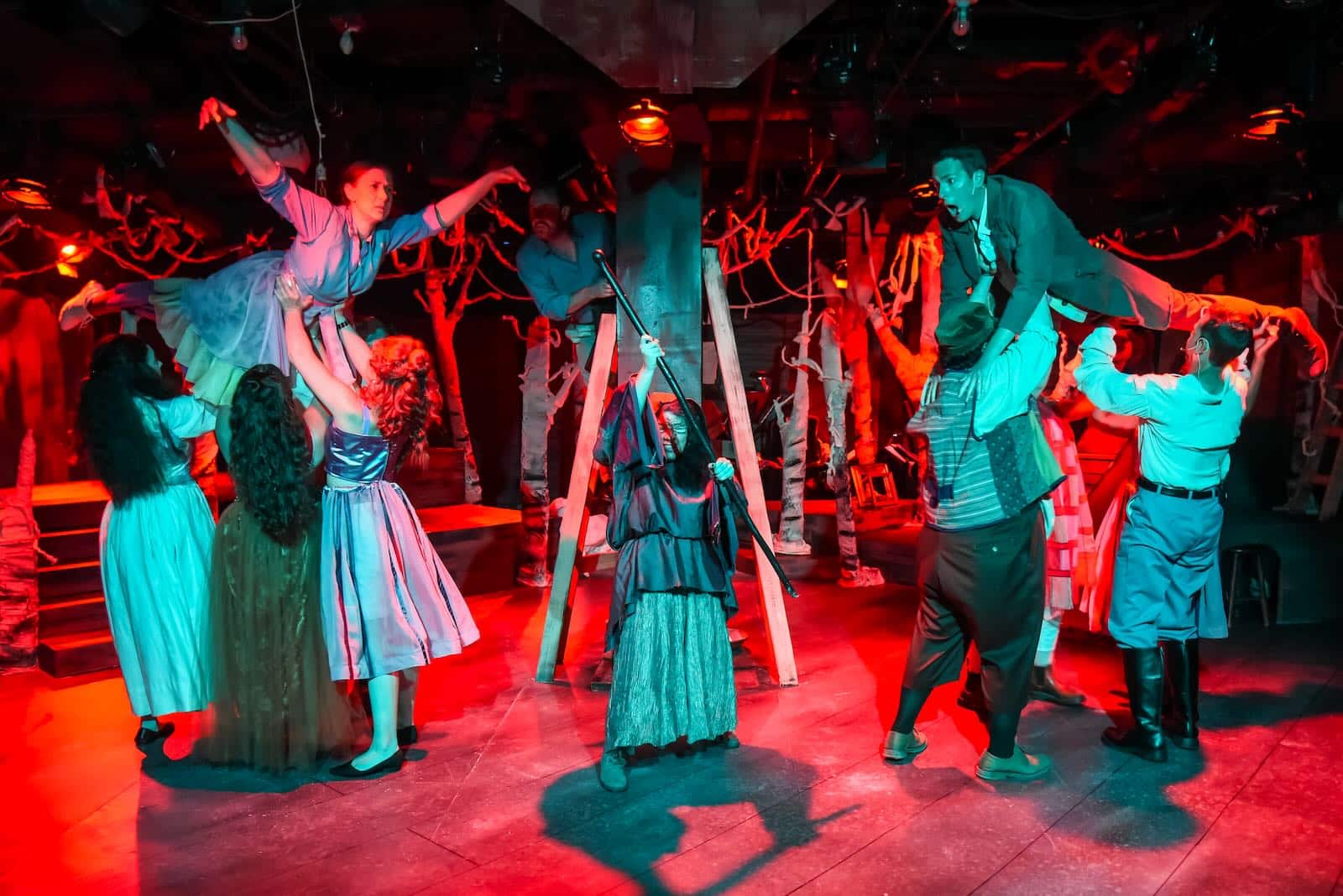
At the Maryland Ensemble Theatre, Cody James’s black box set and Shana Joslyn’s lighting design immediately pull the audience into the tangled world of the forest. Even before the house lights fade, the intimate space suggests a storybook wilderness, with wooden posts doubling as trees and a nimble arrangement of ladders, platforms, and even a slide giving the stage surprising depth. As the evening progresses, the production makes smart use of those levels, allowing the actors to move through the space with visual variety and helping the forest feel both playful and unpredictable. Furthermore, the lighting design contributes significantly to the storytelling, shifting throughout the performance to create dramatic effects and highlight the characters’ experiences.
Kyle Wolford’s sound design gave the dialogue and musical elements clarity and balance, although there were a few noticeable microphone glitches that occasionally interrupted the flow of the performance. Despite these minor technical issues, the overall sound design contributed positively to the production and enhanced the audience’s experience. As a musician and flutist, I was particularly impressed by the orchestra under the direction of Taylor Rieland. Sondheim’s music is renowned for its intricate rhythms and demanding syncopation, presenting a significant challenge for any musical theater ensemble. The orchestra not only navigated these complexities with precision and confidence but also fulfilled its most important role: supporting the performers on stage.
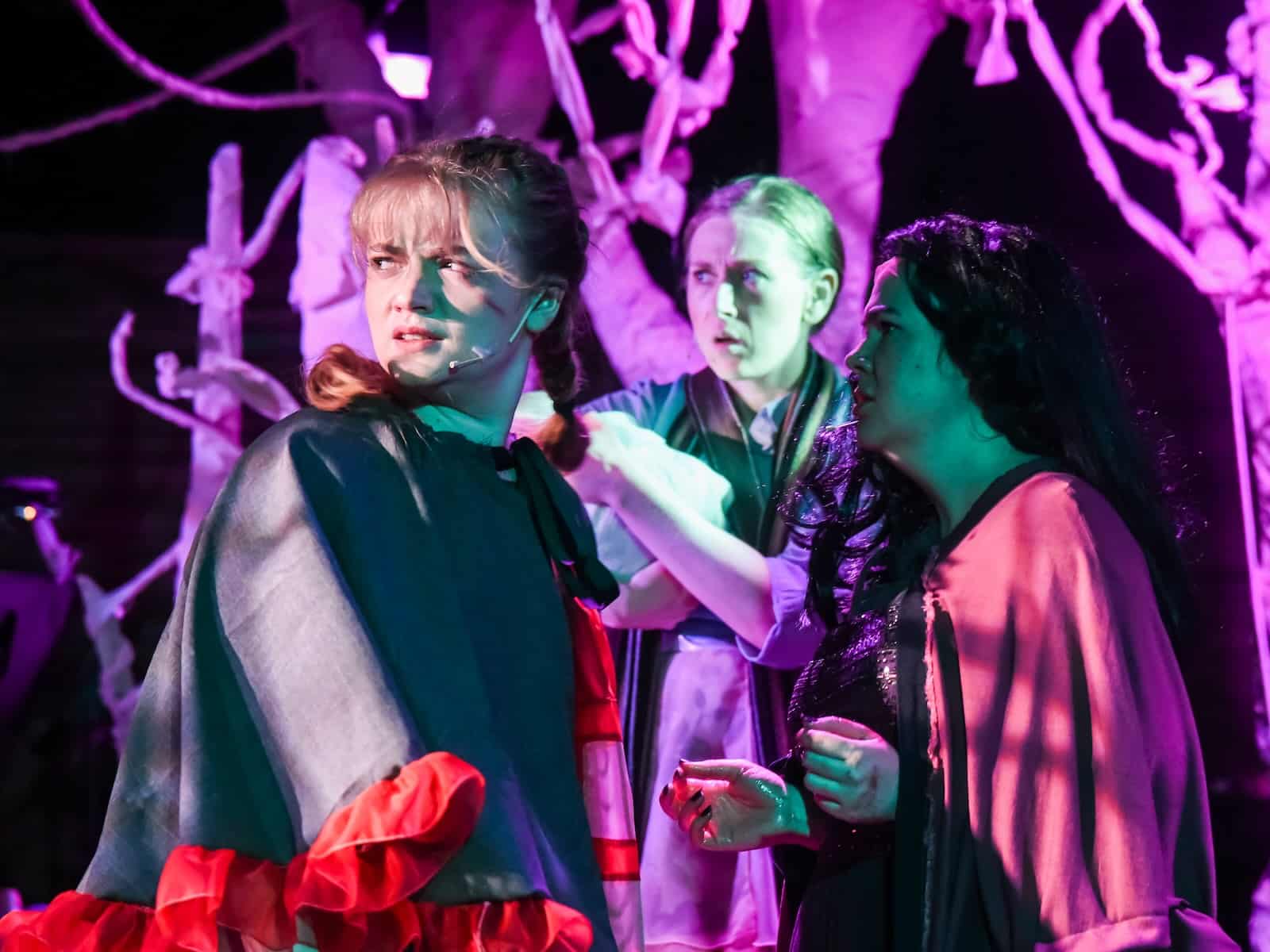
My absolute favorite cast standout was Jeremy Myers as the Baker. He provided the emotional anchor of the musical with a weary, modern “everyman” quality that balanced neurotic panic and domestic warmth. Jennifer Pagano was another standout as the Baker’s Wife. Her performance was especially effective in the scene following the Baker’s Wife’s encounter with the Prince in the woods, where she skillfully conveyed the character’s mix of excitement, regret, and self-reflection. Matt Baughman and Joe Waeyaert provided excellent comic relief as Cinderella’s Prince and Rapunzel’s Prince, fully embracing the characters’ exaggerated vanity and melodrama. Danielle Carter was equally impressive as Little Red Riding Hood, proving to be a perfect fit for the role both vocally and theatrically. She captured the character’s youthful confidence and spirited personality while delivering a strong vocal performance that made her portrayal both believable and memorable.
One artistic choice that felt less successful involved the portrayal of the Mysterious Man. Upon his first appearance, the character seemed to move with a deliberate physical stiffness or exaggerated malady that was never fully explained within the context of the production. While this may have been an intentional interpretive choice, it was unclear what it was meant to convey. Additionally, while Karli Cole‘s vocal performance as the Witch was undeniably strong, I found myself wishing she had leaned more into the character’s comedic opportunities. Sondheim’s Witch is not only a powerful and emotionally complex figure but also a source of some of the show’s sharpest humor. Even so, her vocal talent and commanding stage presence were undeniable.
I often characterize Sondheim’s Into the Woods as “worthwhile witty wordiness”; it stands as one of his most well-liked and famous works. What begins as a familiar collection of fairy tales gradually transforms into a poignant exploration of loss, responsibility, and the complexities of human desire. As dreams are granted and consequences unfold, the story reveals a sobering truth: our wishes can shape our lives in ways we never anticipate. By the final curtain, the musical’s timeless warning resonates powerfully: be careful what you wish for.
Running Time: Two hours and 45 minutes, including a 15-minute intermission..
Into the Woods plays through October 4, 2026, at Maryland Ensemble Theatre’s Robin Drummond Main Stage, 31 W Patrick Street, Frederick, MD. Tickets ($7–$36, fees included) can be purchased by phone at 301-694-4744, online, or in person at the MET box office, open Tuesday to Thursday, 12–6 p.m., Fridays 12–4 p.m., and one hour before performances. Pay-What-You-Will discounts are available to students, seniors, and military, starting at $7 per performance, while supplies last.
Into the Woods
Music and lyrics by Stephen Sondheim
Book by James Lapine
Directed by Shea-Mikal Green
Music directed by Taylor Reiland