
What is striking is how young they all were. In 1816, when they gathered at a Lake Geneva villa, Percy Shelly was 24, Mary Shelly was 19, Claire Clairmont (Mary’s half-sister) was 18, Lord Byron was 28, and his physician, John Polidori, was 21. They were filled with talent and creativity, youthful exuberance and yearnings — intellectual and sexual — and Romantic-era ideals. The relationships among them were unsurprisingly volatile. Creative Cauldron’s Monsters of the Villa Diodati, a musical play by the team of Matt Conner (who also directed the production) and Steven Gregory Smith, explores those relationships and their impact on the art created that fervid summer.
The weather was no less volatile, itself the creation of a monster. In April 1815, the gigantic eruption of Mount Tambora in what is now Indonesia — dwarfing later, better-known volcanic events like Krakatoa and Mount St. Helens — injected massive quantities of particulates and sulfur dioxide into the stratosphere, lowering global temperatures by around one degree Fahrenheit, leading to widespread crop failures and famine. It was in this “year without a summer” that the events of the play take place. (A line early in the script notwithstanding, it is highly unlikely that anyone at the villa had heard of the Mount Tambora eruption, let alone made the connection between vulcanism and climate abnormalities.)
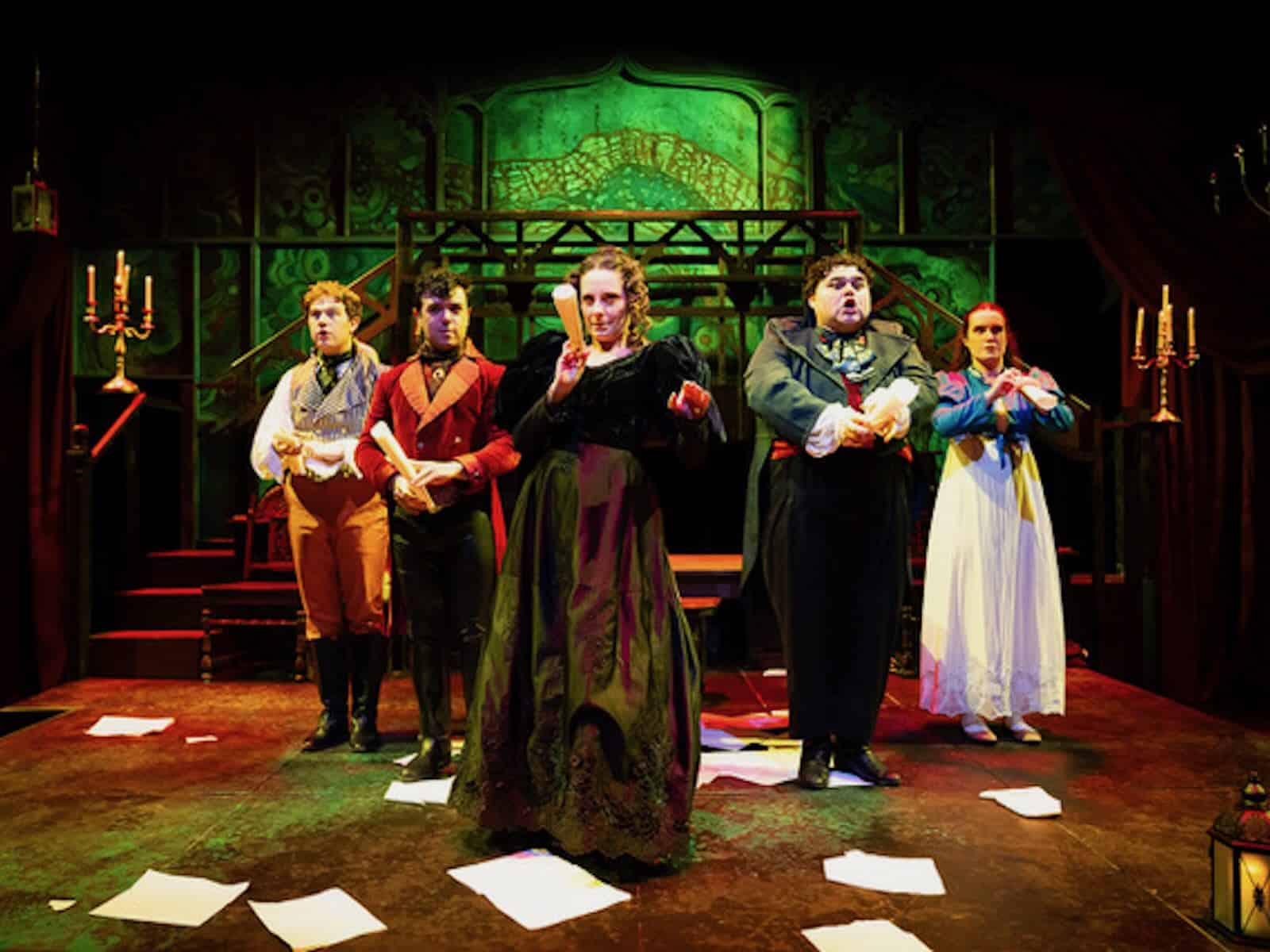
With dark and stormy days and nights, constant rain and wind, the weather was the perfect backdrop for gothic tales and romantic era sturm und drang. Lynn Joslin’s lighting design makes the most of it, with frequent thunder and lightning effects, including candelabras and chandeliers flashing on and off around and over the stage.
It was Byron’s suggestion that the group compose ghost stories to pass the time while indoors during the chronic bad weather. Portrayed by David Landstrom, Byron is a creature of pure, unregulated ego, the early 19th-century equivalent of an entitled rock star who, in a later era, would have been a darling of the tabloids. The romantics prized freedom; his is the freedom to get what he wants from those around him. Claire (Rachel Cahoon) is already pregnant with (presumably) Byron’s child before arriving at the Villa. It is Claire who makes the point that, in the thrall of romantic ideology, including its notions of free love, Shelly and Byron themselves became monsters.
There is a homoerotic subtext between the seductive Byron and Percy (Ben Ribler), which on a boat excursion — cleverly depicted through deployment of a triangular piece of fabric hung on the set to represent a sail — becomes more explicit (though Mary appears briefly to explain it never really happened). Percy is a true believer in the ideology of (at least privileged folk during) the Romantic period. We don’t get much of a sense of his poetry from the script, however.
Perhaps in part because he is the least well-known of the people involved, John Polidori (Alan Gutierrez-Urista) becomes a quite fascinating character, hopelessly in love with Mary (who keeps him squarely in friend zone) while struggling with his same-sex attraction to Byron, who treats him with cruel disdain. While taking dramatic license with the timeline of both Polidori’s writing and ultimate death, the play shows how his pioneering vampire story, The Vampyre, had its origin in his view of Byron’s character. (Ruthven, the name of the Byronic protagonist of Polidori’s story, became such a byword for gothic characters that Gilbert and Sullivan’s send-up of the gothic genre, Ruddigore, includes a character of the name.)

The center of the play is Mary (Susan Derry). Mary is solid in her sense of self and, in an atmosphere that prizes showy “genius” in the early 19th-century sense of the term, an exceptional, almost mystical creative power; she is the most groundbreaking writer of them all. Suggested in part by Percy’s interest in the effect of electrical impulses on living or dead tissue, by her knowledge of Greek mythology, and by her own dreams in the tumult of the villa’s natural and human environment, she writes Frankenstein, or The Modern Prometheus. Her story of a tragic being cobbled together and reanimated has lived through the 200+ years since and countless adaptations, while the poetry of Percy and Byron is now of interest primarily to the dwindling number of English majors.
At the beginning and end of the play, as a framing device, the Mary of 1831 reflects on the success of her monster story and the fates of the other characters. Percy, Byron, and Polidori had all died by then, but her memories of that time, and especially of Percy, remain strong, expressed in her song “Pieces of You.”
The outstanding feature of Matt Conner’s music for the show is close harmonic writing in full ensemble numbers, trios, and duets, well sung by the entire cast. One of the loveliest is “She Walks in Beauty,” with lyrics based on a Byron poem. The score also includes strong character numbers, like “What Now What Next” and “Darkness” for Byron, “Directions for John” for Polidori, and “Scotland” for Mary and Claire. Garret Jones’ musical direction is on point throughout.
The outstanding feature of Margie Jervis’s scenic design is the blizzard of pieces of paper, with writing on them, scattered on the floor of the lower playing area. Not only are we in the presence of writers, but writers in the wilds of the unleashed emotions of the Romantic era. This is their environment and an expression of their inmost selves. Upstage of the two-level set is a translucent, kaleidoscopic-like backdrop, which is illuminated from behind at various points, again suggesting the emotional tone of the era and the story. The audience configuration is three-quarter round; Conner’s blocking does a good job of playing to all parts of the seating area.
This production is a revival of a successful 2016 debut of the show at Creative Cauldron. I was unable to find any record of it being produced elsewhere in the interim. Given its high quality, interesting characters, and strong score, I hope it could gain traction in the regional theater world. Meanwhile, the strong acting, singing, and technical merits of this production merit full houses throughout Creative Cauldron’s run.
Running Time: Approximately two hours and 20 minutes, including one intermission.
Monsters of the Villa Diodati plays through November 1, 2026, at Creative Cauldron Stage, 27 E Broad St, Falls Church, VA. Performances are on Thursdays, Fridays, and Saturdays at 7:30 PM and Sundays at 2:00 PM. Refer to the specific schedule of performances and purchase tickets online. Ticket prices range from $25 for students to $40 (tier two) and $50 (tier one) for adults, with group discounts available.
Recommended for ages 13+
Cast bios are here.
Monsters of the Villa Diodati
Music and Lyrics by Matt Conner
Book and Lyrics by Stephen Gregory Smith
CAST
Lord Byron: David Landstrom
Mary Shelley: Susan Derry
Percy Shelley: Ben Ribler
John Polidori: Alan Gutierrez-Urista
Claire Clairmont: Rachel Cahoon
Female Swing: Gretchen Midgely Kaylor
Male Swing: John Henry Stamper
CREATIVE TEAM
Director: Matt Conner
Music Director: Garrett Jones
Scenic Designer: Margie Jervis
Costume Designer: Tessa Grippaudo
Lighting Designer: Lynn Joslin
Stage Manager: Nicholas Goodman