Many are the families that feel disturbed, disrupted, disgusted, and/or disgraced by an anomaly within them. A misfit. A maverick. A problem child. Black sheep happen, and family dramas ensue. Anyone who was ever that odd one out knows this better than anyone.
The Metamorphosis — a surreal novella written by Franz Kafka at the age of 29 — is perhaps the epitome of literature about such family crises. In it, Gregor Samsa — an overworked traveling salesman who lives at home with his mother, father, and sister and is their sole financial support — awakens one morning to find himself “transformed in bed into a giant insect.” In what happens after, his isolation, anguish, body dysmorphia, and alienation from his family are met by their shock, shame, horror, fleeting solitude, torment, and ultimate rejection. Gregor was the family’s meal ticket; after all, they lived off him, so when his income ends, they feel justified in crushing him.
In short, Gregor’s sudden embodiment as an insignificant insect tests his parents’ and sister’s humanity.
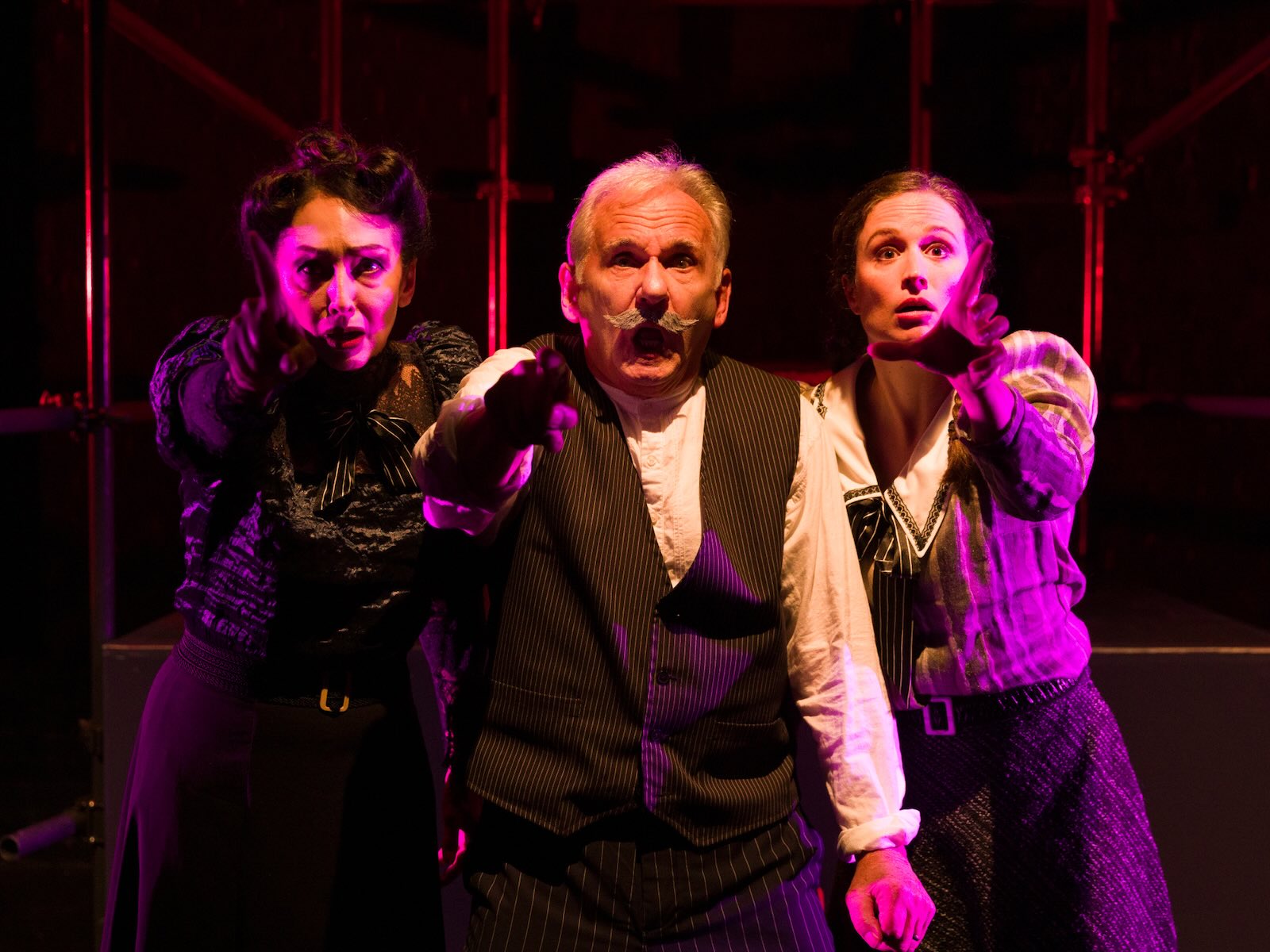
Adapted for the stage by Steven Berkhoff (as simply Metamorphosis) and directed by Robert McNamara in an excellent, expressionist Scena Theatre production, Gregor Samsa’s tragedy of existential otheredness becomes an extraordinary theater experience, exposing a traumatic family drama graphically and emblematically as realism and naturalism can’t.
The sharp script, pointed performances, and tight staging set us, the audience, up for a fascinating and shifting tension: with whose suffering do we identify and empathize: Gregor’s or his family’s? The play plays with us from moment to moment, pulling our feelings into the storytelling on one character’s behalf, then another’s. It’s disarmingly engrossing. (The show opened on Halloween, which is amusingly on the proboscis.)
The performance’s arrestingly expressionist style shows up first in the set (designed by John Traub): on a platform stands an abstract assemblage of bars resembling a cage-like jungle gym. This, we will learn, is Gregor’s bedroom, where he becomes a bug, and his insect self can climb the walls. A fluid lighting design (by Marianne Meadows) blends otherworldly blue, green, and magenta washes punctuated by white spots on the actors. And the first-rate sound design (by Brandon Cook) — with its eerie music, clock ticking, door creaking, organ, chimes, drums — syncs to the second with the onstage language and frequently propels a scene’s momentum.
In a weird opener, we meet the four Samsa family members center stage, in a line back to front, where they mime being a bug, their eight arms awry and their fingers wriggling. Their 19th-century period costumes (long skirts, vests, and such, designed by Alisa Mandel) are all in black and white, a color palette that serves their sometimes silent-movie gesticulations.
Greta, the perky, pigtailed daughter and Gregor’s fond sister, is played with an utterly charming inner ebullience by Katherine Dubois. She is most loyal to Gregor at the beginning and the last (spoiler) to abandon him.
Mrs. Samsa, Gregor and Greta’s mother, in a pompadour and neck-high lace bodice, is wonderfully played with old-fashioned airs by Nancy Flores. She is visibly torn between her own maternal feelings for Gregor (“He’s my son, my unfortunate child”) and her husband’s brusque denunciation of him (“He’s not our son anymore”).
Mr. Samsa is a classic domineering paterfamilias, no longer working and his self-esteem depleted, and a mustachioed Joe Palka plays him to frightening effect. The scenes where the authoritarian furiously torments Gregor are chilling. (Kafka suffered emotional abuse from his own oppressive father.)
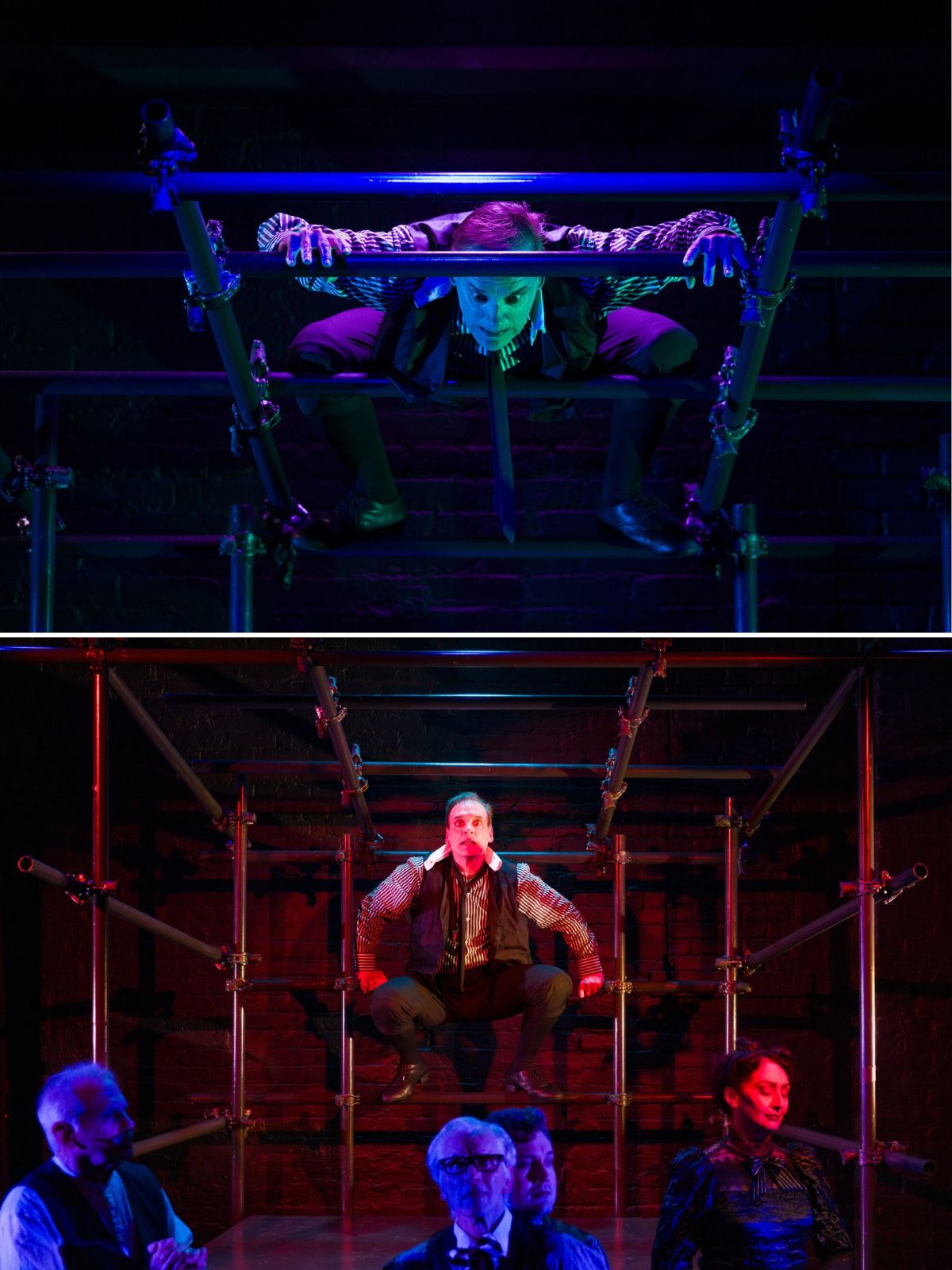
Lee Ordeman captivates as Gregor, his eyes hollowed out with kohl, his agile creature contortions creepy, his vocally distressed squeals unnerving (“I know I’m revolting,” he croaks at one point). And yet in dreamlike flashbacks, when the family recalls happier times, he exudes genuine amiability and decency.
Soon after Gregor misses his early-morning train to work (because he’s become a bug), Kim Curtis shows up as his nosy boss, interrogating Gregor’s family like a bullying snoop (while having a perplexing, passionate flirtation with Mrs. Samsa). Curtis returns in a comic turn with David Johnson as two would-be lodgers scoping out a room to rent, now that Mr. and Mrs. Samsa and Greta are trying to make up for their son’s lost earnings.
It’s a solid cast, precisely paced, and especially fun to watch as they assume stop-action poses and tableaux. The expressionism really suits the story’s in-extremis emotions and its stark up-close portrayal of patriarchy at home. Rarely is such a painfully dark personal tale told onstage with so much pleasure in its stylized execution

Running Time: Approximately one hour and 35 minutes, no intermission.
Metamorphosis plays through November 22, 2026, presented by Scena Theatre at the DC Arts Center in Adams Morgan, 2438 18th St NW, Washington, DC. Performances are at 7:30 PM on Thursdays, Fridays, and Saturdays, and at 2:30 PM on Sundays. Tickets (starting at $25, plus a fee) are available on Eventbrite here.
Discretionary Content: Body horror, dehumanization, domestic abuse, strong language
Recommended for audiences aged 14+
Metamorphosis
Written by Franz Kafka
Adapted by Steven Berkoff
Directed by Robert McNamara
CAST
Gregor: Lee Ordeman
Mr. Samsa: Joe Palka
Mrs. Samsa: Nancy Flores
Greta: Katherine Dubois
Chief Clerk/Lodger 2: Kim Curtis
Lodger: David Johnson
Lodger: Colin Davies
CREATIVE TEAM
Scenic Design: John Traub
Lighting Design: Marianne Meadows
Sound Design: Brandon Cook
Assistant Director: Anne Nottage
Stage Manager: Celeste Robertson
Fight Director: Paul Gallagher
Choreographer: Kim Curtis
Costume Design: Alisa Mandel
ADDITIONAL CREW & STAFF
Jackie Hunter (Assistant Scenic Designer), Olivia Goncalves (Assistant Scenic Designer), Stacy Whittle (PR/Marketing), Barbara Weber (Business Manager), Anne Nottage (Literary Manager), Jae Yi (Photographer), Paul Hastings, LLC (Attorney), Haines & Lagerquist LLC (Accountant), Jeff Brasfield Accounting, Inc. (Accountant), Block of Love (Media Team), Dara Brewton (PR/Marketing)