When Ro Reddick began writing Cold War Choir Practice (as she relates in her preface to the published edition), she was recalling the fear she felt as a kid during the scary 1980s Cold War era, when she was in a children’s choir and they “sang about world peace and annihilation in equal measure. We learned songs in ‘all the languages of the world’, we sang a Song for a Russian Child, we sang to save the world from itself.”
That innocent’s alarm, that fear of geopolitical armageddon, resounds in the play when we learn that the main character, a precocious ten-year-old girl named Meek, sings in a children’s choir that keeps its concerts under 28 minutes — because if the Soviet Union launches a nuclear ICBM, it would take 30 minutes to get here, and that would leave the children two minutes to hug their loved ones goodbye.
Inspired by that childhood memory of dread, Reddick created in Cold War Choir Practice an immensely inventive dark comedy with music that won the 2026 Susan Smith Blackburn Prize and scored a New York Times Critic’s Pick during its run off Broadway. Now playing in a side-splitting and jaw-dropping production at Theater Alliance — which picked Reddick’s brilliant script to inaugurate its sleek new digs in the Revada Arts Center — Cold War Choir Practice has an uncanny way of tapping into the nuclear nervousness of not only 1987 Syracuse (the play’s setting) but also the 1950s, when schoolchildren practiced ducking for cover under their desks for shelter from a bomb blast, as well as right this minute, when who knows what terror our impetuous president might trigger.
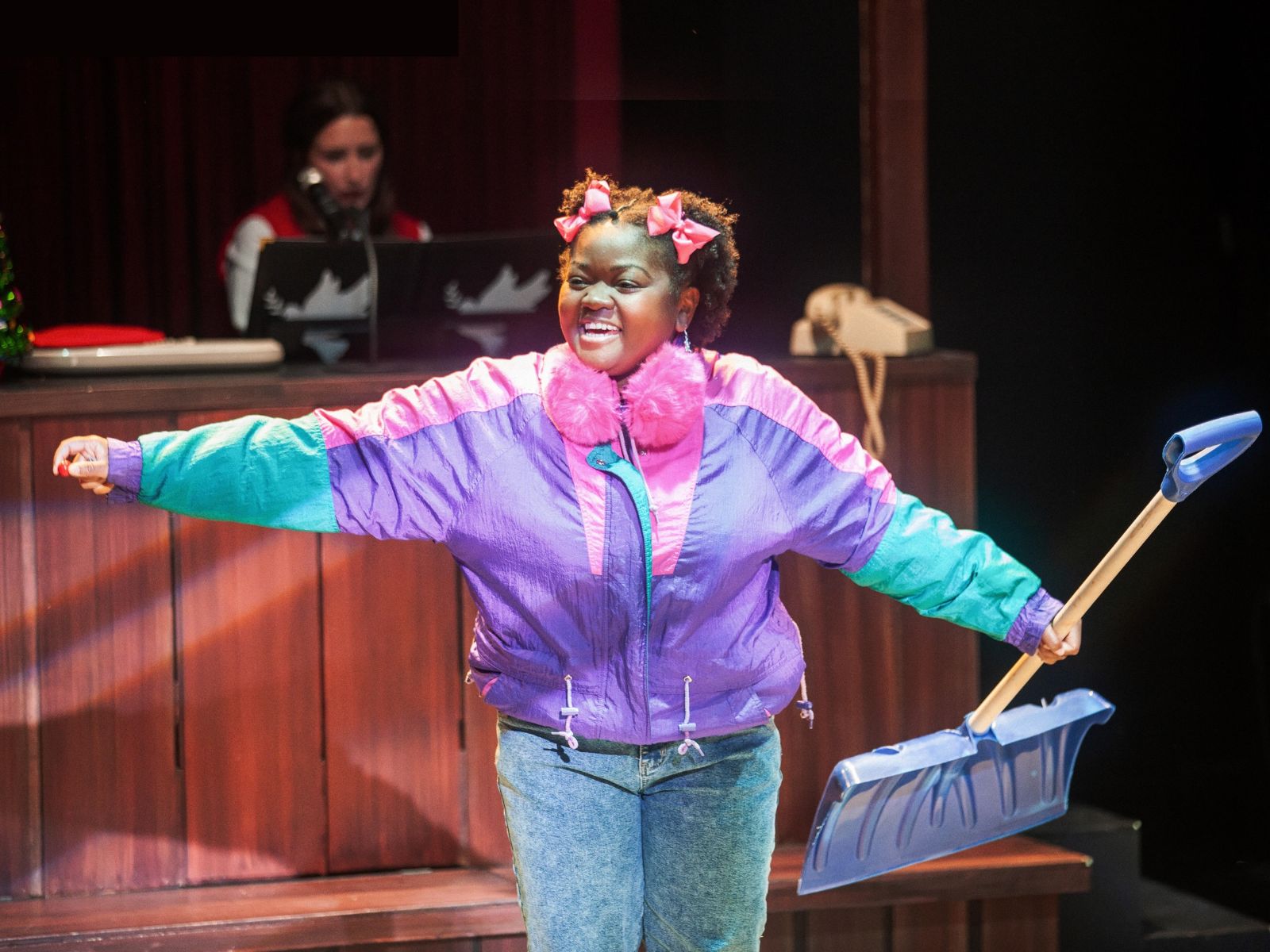
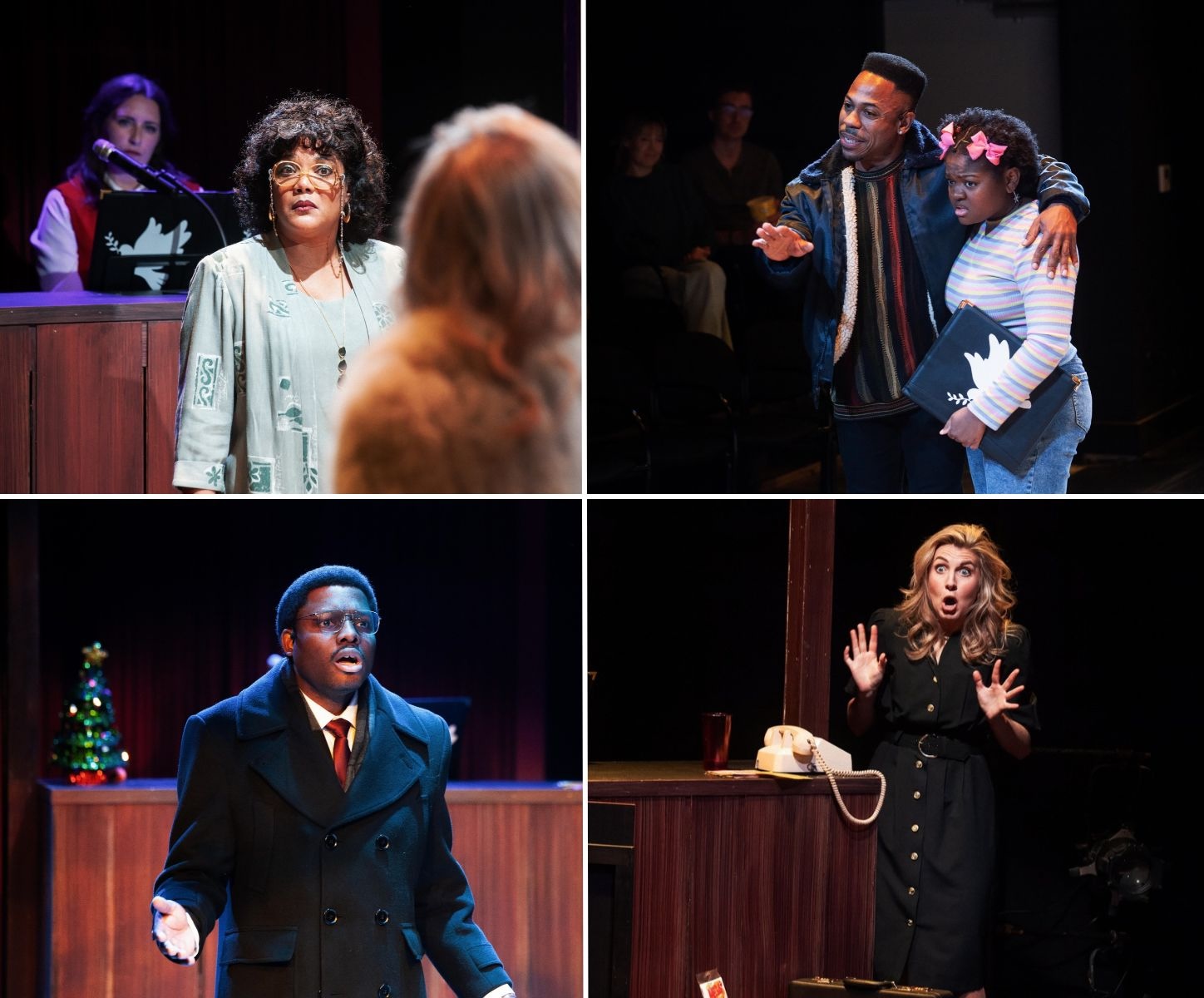
By way of setting the scene for this comically convoluted story: a bleached-wood playing surface serves as an alleyway between two opposite banks of seating, and the ceiling suggests an unfancy roller rink — lightbulbed wooden spokes radiating from a disco ball (scenic design, Jonathan Dahm Robertson). This Rolla-Rama is owned by Meek’s community-committed father, a former Black Panther named Smooch (a galvanizing Ro Boddie). They live at the rink with Puddin, Smooch’s mom (a wryly intense Lolita Marie). What with Reaganomics, they are far from well off. Daughter Meek, as played by Wynter Nicole Cook, is a marvel of smarts and gumption. Between rehearsals with the Seedlings of Peace children’s choir, she is on a mission to build her dad and grandma a fallout shelter.
Meek’s Choir Leader (Emily Erickson, who music-directs the show and plays keyboard throughout) connects each young singer for peace with a Soviet pen pal. In a cute twist, Meek communicates with hers via a Speak & Spell toy.
Reddick cleverly inserts into her play a contrasting perspective on the U.S. economy and nuclear war: Smooch’s estranged brother Clay, a Republican who works for Reagan as a national security advisor (Yao Dogbe, excellently wrapped tight). The ideological friction between Smooch and Clay is set up to erupt, and it inevitably does.
Clay comes accompanied by his spaced-out white wife, Virgie, recently rescued from a predatory, conspiratorial, capitalist-optimization cult (Emily Kester, hilariously catatonic). Costume designer Danielle Preston has great fun clothing this comic cast, notably Virgie in a socialite’s black dress, white fur, and scarlet nails. (Not coincidentally, Clay and Virgie’s names echo those of a certain ultraconservative Supreme and his white wife, who was herself in such a cult.)
Bureaucrat brother Clay also carries with him a locked briefcase containing national security state secrets, a prop that becomes the MacGuffin in a wildly imagined Russian-asset espionage plot. Virgie’s former cult wants it, Meek’s purported pen pal wants it, farce ensues.
Melding all the antics and adding melody to the annihilation-avoiding mayhem is a beautifully voiced chorus of three: Bridget Campbell, Sherri L. Edelen, and Farrell Parker. They are dressed Christmasy in red, sing amusing Reddick-written carols, dance fluidly about the stage, and shape-shift into, among others, Meek’s young choir mates and pen pal and a devious agent from the cult.
Choreographer Jeffrey L. Page keeps the players in artful motion (including when, at the roller rink, they feign skating without skates). Fight choreographer Sierra Young vividly physicalizes the brothers’ political dispute. And together, lighting designer Colin K. Bills and sound designer Nick Tha 1da pull off an effect worthy of a content warning.
If Wynter Nicole Cook’s terrific Meek is the play’s protagonist, director Tom Story is the production’s hero. What his vision has wrought in bringing to life Reddick’s dramatically surreal yet emotionally authentic script warrants awe. The acting style is fast-paced and ebullient. The actors find loads of humor in lines that, while droll on the page, do not read as laugh-out-loud. The off-kilter plot points click. Most of all, Story has shepherded to the stage a show that speaks like shared comfort to what has become a fact of our human condition: the nearby fear that nuclear extinction may be but a button push away.
But laughter, it turns out, is the best anti-anxiety med yet. For a don’t-miss dose, catch Cold War Choir Practice.
Running Time: Approximately 90 minutes with no intermission.
Cold War Choir Practice plays through December 13, 2026, presented by Theater Alliance, performing at the Revada Arts Center, 340 Maple Drive SW, Washington, DC. Purchase tickets ($50 for general admission) online, by email (boxoffice@theateralliance.org), or by calling (202) 241-2539. Theater Alliance also offers name-your-own-price tickets starting at $13 and available for online purchase.
View the downloadable digital program here.
Cold War Choir Practice
Written by Ro Reddick
Directed by Tom Story
CAST
Meek: Wynter Nicole Cook
Smooch: Ro Boddie
Puddin: Lolita Marie
Clay: Yao Dogbe
Virgie: Emily Kester
Choir Leader: Emily Erickson
Choir, Speak + Spell: Bridget Campbell
Choir, Very Good Friend: Sherri L. Edelen
Choir, Familiar Face: Farrell Parker
CREATIVE TEAM
Music Director: Emily Erickson
Choreographer: Jeffrey L. Page
Asst. Director: Renea S. Brown
Fight Choreographer: Sierra Young
Language/Dialect Coach: Katie McDonald
Scenic Designer: Jonathan Dahm Robertson
Costume Designer: Danielle Preston
Lighting Designer: Colin K. Bills
Sound Designer: Nick Tha 1da
Asst. Scenic/Props Designer: Bridgette Tran
PRODUCTION
Production Stage Manager: Regina Vitale
Asst. Stage Manager: Jake Vollmar
Lighting Supervisor: Erin Sanders
Audio Supervisor: Allison Pearson
Asst. Audio Supervisor: Will Stutzman
Wardrobe Supervisor: Saba Tshibaka
SONGS
Music and lyrics by Ro Reddick
“Happy Tidings”
“Milkshake for Peace”
“Lay Down Your Arms”
“Cult Theme”
“Gorbachev Motif/Speak + Spell Melody”
“The Farmer and the Businessman”
“Cult Theme – TV with Tag”
“Speak + Spell”
“Star Wars”
“S+S Soviet Theme”
“Cult Theme – Bathroom”
“Adult Skate Night”
“The Inside of Something (‘All You Need’)”
“Virgie & The Bomb”
“Lay Down Your Arms (Reprise)”
“One America”
“A Star of Peace”