Written ca. 1595, Shakespeare’s Richard II is the first in his series of four history plays (followed by Henry IV, Part I, and Part II, and Henry V) that traces the deposing of the last Plantagenet king in 1399, and the rise of the House of Lancaster to the British throne, with the coronation of Henry IV (Richard’s cousin Henry Bolingbroke, Duke of Hereford), who, after a period of banishment, challenged the eponymous monarch’s Divine Right and led a rebellion against his wasteful spending, excessive taxation to finance his wars (in Ireland and elsewhere), and arbitrary seizure of the money, possessions, and properties of his recently deceased uncle, John of Gaunt (Henry’s father).
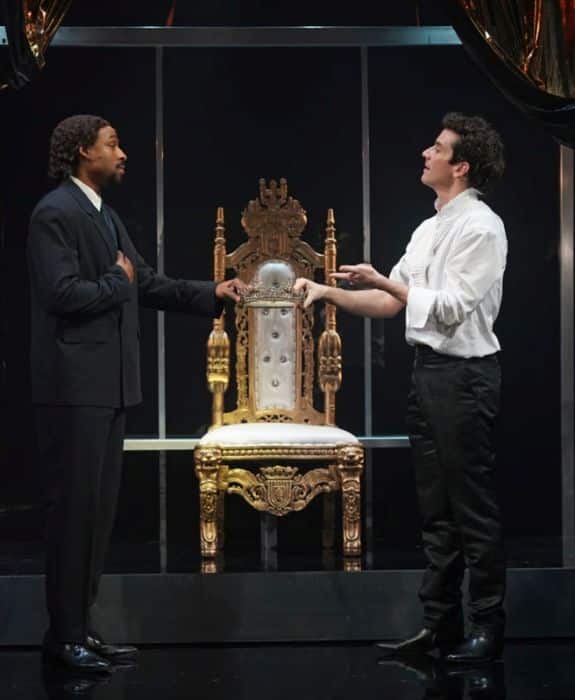
Now playing a limited Off-Broadway engagement at Astor Place Theatre, the current production of Richard II, adapted and directed by Craig Baldwin, and presented by Red Bull Theater (a company with a mission of revitalizing rarely seen classic plays with a modern sensibility for today’s audiences), is reset in 1980s America and offers an anomalous mash-up of then and now, which, for me, was more distracting and gimmicky than elucidating.
The stark post-modern staging features a rotating box of glass and metal, rectilinear benches, and neon lights (minimalist set by Arnulfo Maldonado), an array of 20th-century wigs and makeup (by Bobbie Zlotnik), business suits and military uniforms, casual and disco attire, and towels wrapped around waists in a steam room and a skimpy bikini worn while reclining on a sun lounge in a garden, gratuitously exposing flesh (costumes by Rodrigo Muñoz) and barely indicating the change of locales, in contrast with the serious themes of fatal discord and betrayal, Richard’s heartless banishments of his challengers to maintain his absolute power, elevated notions of sovereignty and pride, as seen in his lavish antique-style gilded throne and bejeweled crown and manifesting as disrespect and detachment from his subjects and country, and the rich Shakespearean verse that says it all with eloquence and insight, and renders the current updates unnecessary.

There are Richard’s snarky looks, vocal intonations, and interjections, flagrant spending and excess with his inner circle of chosen friends, counselors, and sycophants, disco scenes of suggestive dancing, drug use, and flashy attire, and intimate kissing with his cousin Aumerle (which is ignored by the Queen), indicative of the mannerisms and speech patterns, conspicuous consumption, and sexual abandon of the young generations of the late 20th century (with voice and speech coaching by Andrew Wade and Rick Sordelet serving as intimacy coordinator). And there are numerous at-odds characters laughably throwing down their gloves to challenge each other to a gun duel (fight direction by Sordelet; props by Jackson Berkley), brutal terrorist-style executions of Richard’s supporters and Bolinbroke’s enemies, portable phones buzzing and motion picture cameras recording, and the recurrent sound of the 1983 Eurythmics’ hit “Sweet Dreams” that bespeaks ambition and hopelessness in a synth-pop style (sound by Bradon Wolcott), which clash with Shakespeare’s iconic poetic language as much as the characters clash with each other.
Michael Urie stars as Richard II, masterfully adept at delivering the original words, meter, and meaning of Shakespeare, embodying the changing emotions and bearing of the King – enhanced with dramatic shifts in lighting (by Jeanette Oi-Suk Yew) – and switching on a dime from one century to another, with initial humor and indulgence, and ultimately with the pain of defeat and introspection in losing his regal power and identity, as he looks back and ruminates from his prison cell and tells “sad stories of the death of kings.” Also turning in stellar performances with skillful locution are Grantham Coleman as his opponent Bolingbroke, a less flowery counterpoint to Richard, accused of treason but seeking justice and amassing a huge following among the people, his fellow nobles, and the military, and Ron Canada doubling as the aging Gaunt, who appeals to the King for a shorter period of exile for his son, lashes out in anger and curses him, and dies in his wheelchair, prompting Richard to usurp everything he owns, and as the Bishop of Carlisle, who is loyal to Richard and foresees that the “blood of English shall manure the ground” under the reign of Henry IV.
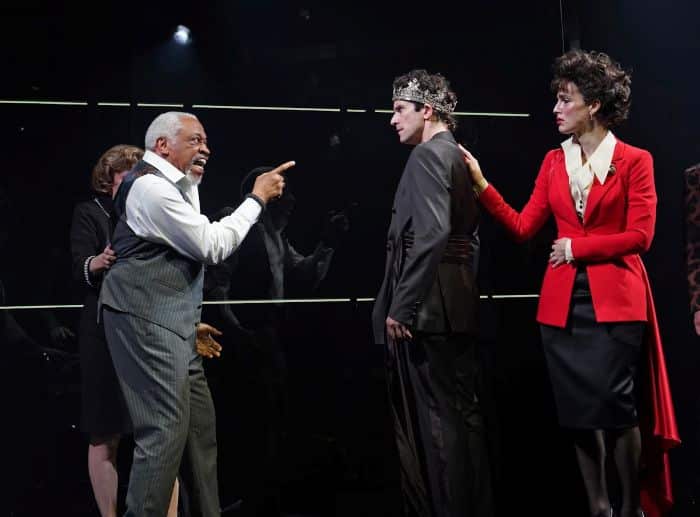
Rounding out the cast are David Mattar Merten as Aumerle, Lux Pascal as the Queen, Sarin Monae West, Ryan Spahn, and James Seol as Richard’s friends at court, Bushy, Bagol, and Green (with each doubling in additional minor roles), Kathryn Meisle as the Duke of York, Emily Swallow as Northumberland, and Daniel Stewart Sherman as both Mowbray and Scroop, whose dress, deportment, and delivery lean more towards the 1980s than the actual era in English history.
If you’re a purist who believes that classics are classic for a reason, most notably for the universal human themes that everyone can recognize and relate to their own times, without having to rework the timeless brilliance of Shakespeare, you might bristle at this anachronistic version of Richard II, which, though often amusing, is lacking in historical cohesion and authenticity. But if you want to see a new take on an eternal theme of entitled rulers who disregard the public good for their own gain, ego, and amusement (sound familiar?), this post-modern production delivers The Bard’s overriding ethical message to a current audience that might not otherwise attend.
Running Time: Approximately two hours and 30 minutes, including an intermission.
Richard II plays through Sunday, December 21, 2025, at Red Bull Theater, performing at the Astor Place Theatre, 434 Lafayette Street, NYC. For tickets (priced at $49-300, including fees), go online.