Theaters around DC and the country are leaning hard into Golden Age musicals. At the moment, Fiddler on the Roof is dancing on tables at Signature Theatre, and Hello Dolly! is strutting the stage at Olney Theatre Center, while Damn Yankees recently hit its last run out of the park at Arena Stage. Now added to that deck, the classic 1950 musical on stage at the Shakespeare Theatre Company’s Harman Hall, Guys and Dolls, turns the DMV’s Golden Age musical trifecta into a superfecta.
And Guys and Dolls hits the jackpot — to belabor the gambling metaphors. I wouldn’t by any stretch call it the “perfect” musical, but it’s a darn good one, packed with classic songs, high-energy dance numbers, leggy chorus girls, and tough-but-lovable gangsters on the make. It may require a measure of suspended disbelief to chuckle at some misogynistic characters, lines, and lyrics in the Joe Swerling/Abe Burrows book and Frank Loesser lyrics. But it works winningly if you let the production take you back to a time when women were dolls and men were guys, and everyone wanted a happy ending, even if “the course of true love never did run smooth.”
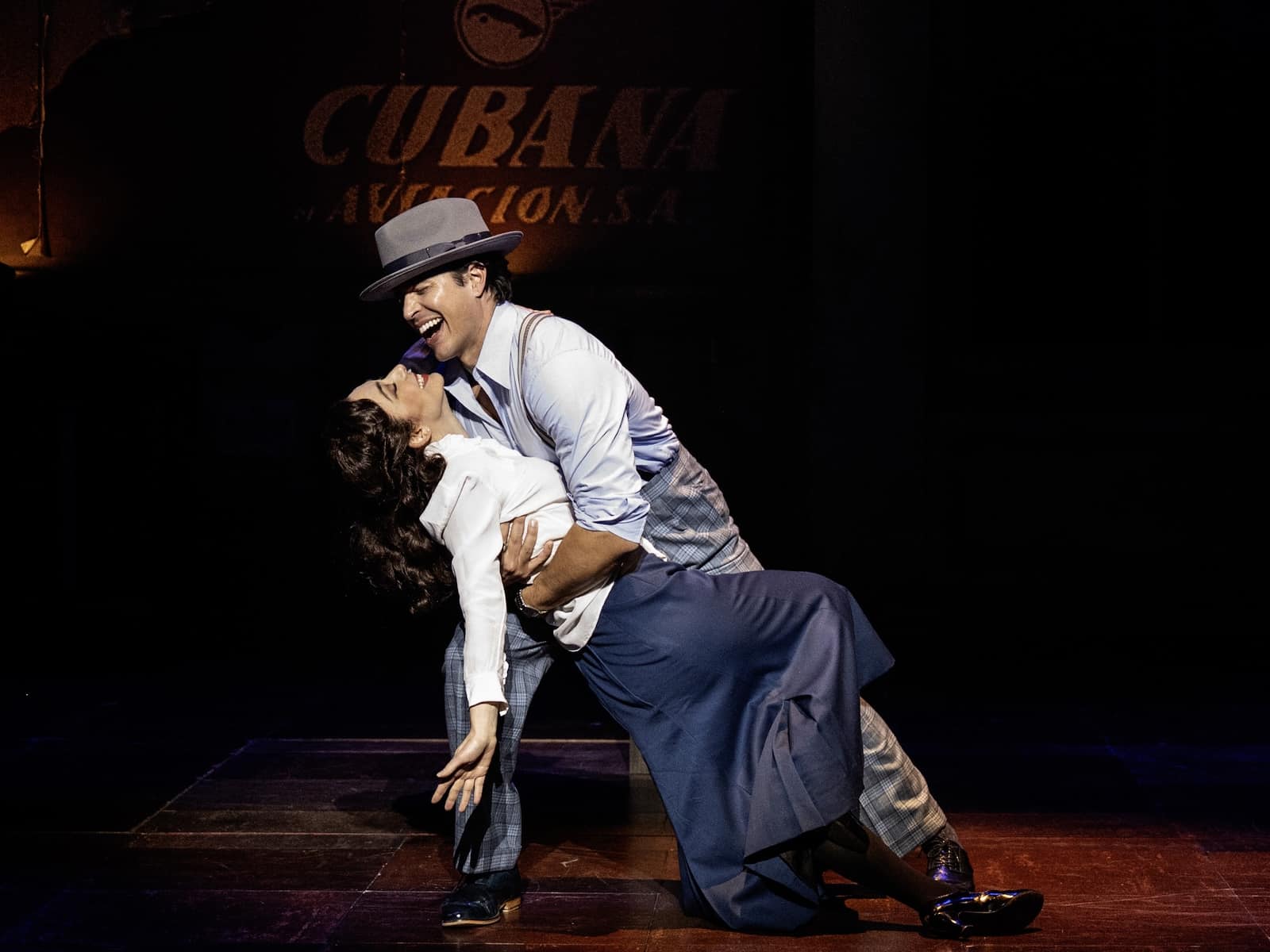
Washington Opera Artistic Director Francesca Zambello elevates this popular show with its hummable hits — “A Bushel and a Peck,” “Luck Be a Lady,” and “Sit Down, You’re Rockin’ the Boat” — to near-perfect apotheosis. If you don’t go home humming and smiling, who dealt you dirty?
Guys and Dolls takes its inspiration from early-20th-century author Damon Runyon, a sports reporter, newspaper columnist, and short-story writer. Runyon had a fascination with folks who populated the seedier side of the city — the drunks, bums, gamblers, and ladies of ill repute. And his colorful tales of the underworld brought these rough-and-tumble characters to life using Runyon’s unmistakable diction: high-falutin language that eschews contractions, interspersed with the street slang of the day. “Doll,” used throughout the show, is obviously a pretty, young woman, and though the term infantilizes, here in context it’s a compliment. In certain circles 75 years ago, doll was as ubiquitous for women as bro might be today for men, and the rest of us. The colorful language of gambling, from shooting craps, to a marker (an IOU), to money slang from dough to lettuce to Gs (big money), to Yiddishisms like no-goodnik and nu, the language in song and conversation sings with various levels of the classic mid-century New York accent.
As Sarah Brown, the straight-arrow ingenue of Save-a-Soul Mission, the radiant Julie Benko is the perfect mark for a high-stakes bet between gambling rivals Nathan Detroit and Sky Masterson, because in mid-century New York, what else would a gambling man do but bet he could whisk a doll off to Cuba’s casinos? Ringleader and wannabe swindler Nathan, played by the wily yet lovable Rob Colletti, runs “the oldest established permanent floating crap game in New York,” a line that when sung sounds poetic. Jacob Dickey as high-roller Sky Masterson deals out equal parts charm and bravado, an alpha male who loves the chase as much as the prize. And his prize isn’t only the dough he’s certain he’ll win by wooing upright missionary Sarah Brown, but the doll herself.
As Nathan’s love interest, the perpetually engaged burlesque dancer Miss Adelaide is perfectly portrayed by Hayley Podschun; her nasally, squeaky soprano is exquisitely “poifect” for a “poyson [who] could develop a cold,” as she sings in her Act 1 lament. Todd Scofield’s Lt. Brannigan blusters with gruff incompetence as the cop tailing this illegal dice game all over town, like a Keystone Cops movie chase. Holly Twyford’s General Cartwright captures staunch reserve as the head of the missionary outfit set on saving souls in this down-and-out corner of Times Square on the edge of Hell’s Kitchen. And among a standout cast, Kyle Taylor Parker shines vibrantly as the saccharine Nicely Nicely, as he displays his sincere smile and his silky smooth dance chops.
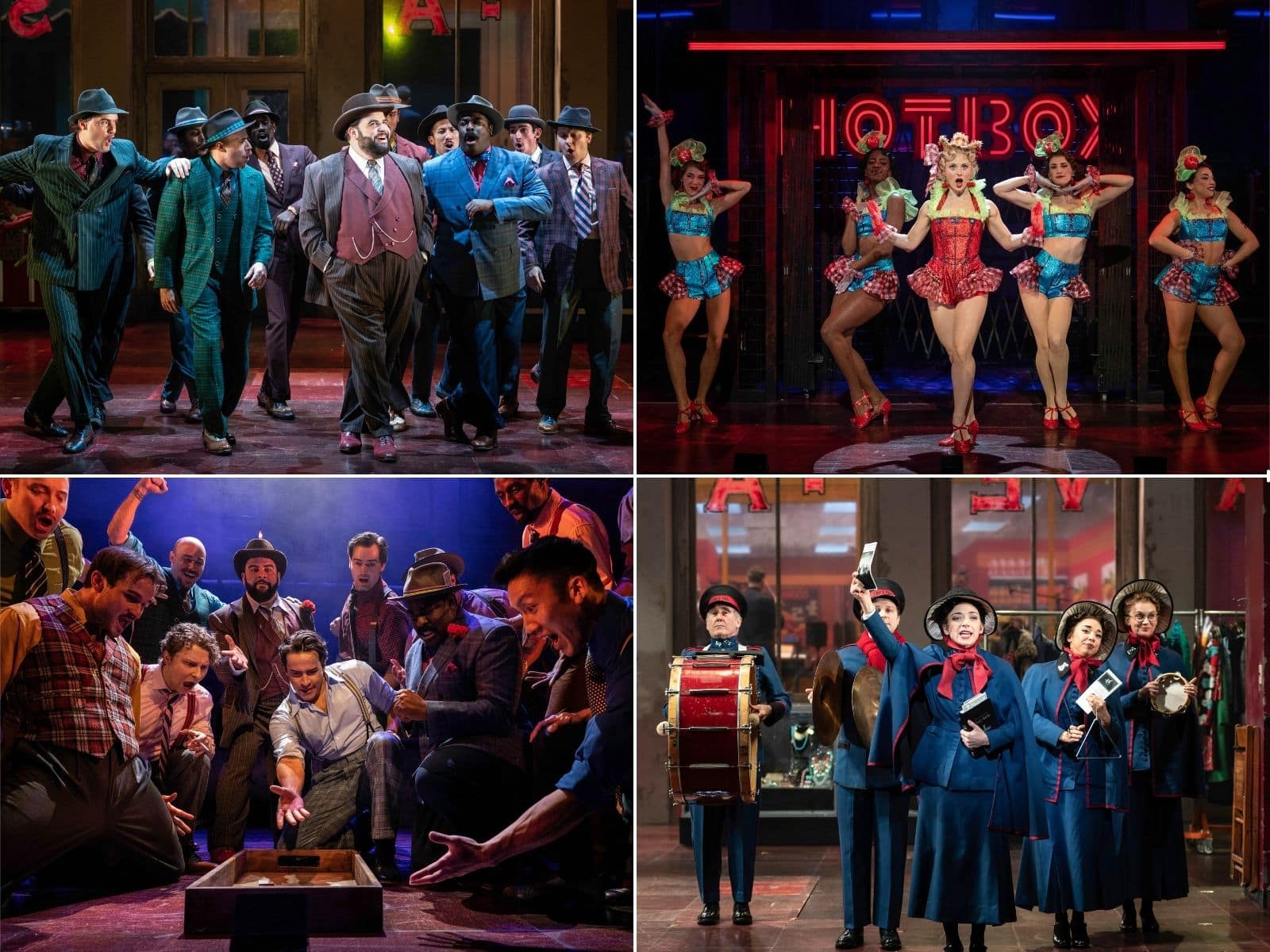
Guys and Dolls is nothing without its winning triple-threat chorus of singers/dancers/actors, each imbuing their roles with specificity without upstaging the principals. Supported by the excellent orchestra, they deliver each choral number with the full-bodied sound of a Broadway cast. Kudos to James Lowe for his musical direction and double kudos to choreographer Joshua Bergasse, who brings out the best in the dancers, particularly in the show-stopping “Lady Luck” number, which he filled with classic 1950s jazz postures and turns, letting these gambling men pull out the stops with hijinks – soaring split leaps, off-kilter pirouettes, handsprings, flips, and other astonishments. And then there are the Hot Box Girls, a leggy quartet who back up Adelaide with a perfect mix of sex appeal and corniness in Act 1’s “A Bushel and a Peck,” and Act 2’s Gypsy-like refined striptease – all performed with a wink and a laugh.
Set designer Walt Spangler has found a perfect solution for the now-defunct storefront mission setting. Save-a-Soul Mission has been re-envisioned as a cluttered Salvation Army-like thrift store with racks of used coats and dresses, shelves of beat-up suitcases, and other detritus, along with fold-up wooden chairs for soul-saving meetings. When the bare-bones design, with visible vent work and dingy flooring and walls, transforms to the sewer for a crap game, the audience gives the Shakespeare theater set its ubiquitous applause moment.
Costume designer Constance Hoffman keeps the soul savers’ well-tailored uniforms a traditional royal blue with a touch of red trim. She leans into color when dressing the gamblers in modified Zoot suits of green shades, bright blues, tans, burgundies, enhanced with pink shirts, purple coats, and fedoras all around. Nicely Nicely keeps a lucky playing card tucked into his hatband, one of many small details that enhance this production. The Hot Box Girls look the part: pristine and sexy in perfectly coiffed wigs, rhinestone-studded fishnets, LaDuca heels, and outfits that go from coy to outlandish.
This Guys and Dolls production — both elegant and earthy — pays homage to mid-20th-century mores, fashions, and social status. In fact, with its culturally diverse cast that looks like Washington or New York today, you can almost believe the 1950s were a kinder, gentler era. Of course, we know better as we have seen movements for civil, women’s, gay, immigrant, and a multitude of other rights and freedoms change our nation for the better since then.
At the top of the show, Shakespeare Theatre Company artistic director Simon Godwin stated that Guys and Dolls was about “change and redemption.” As the plot unfolds with the consistency of a Shakespearean comedy, we take a journey from a place of mundanity to the chaos of the sewer gambling den – for Shakespeare, that would have been a forest or a shipwreck – before all is set right at the fortuitous conclusion. And then there’s that battle for hard-won love à la Katherine and Petruchio from Taming of the Shrew. Watching Sarah Brown turn an icy shoulder to Sky Masterson’s motive-filled advances offers a tinge of the scrappy Shakespearean arguments between couples. And Masterson’s macho belief that he can win over even the toughest doll also harkens back to that era when men supposedly ruled the roost. Zambello’s approach to this classic acknowledges with rose-colored shades the joy these storybook musicals provide. Maybe the world Loesser, Burrows, and Swerling painted feels a little old-hat in an era where conspicuous consumption, digital relationships, and 24/7 news cycles dominate. But, just as Shakespeare always provides moments of wonderment, joy, and resolution, musical theater, too, particularly classics like this one, allows us time to delight in the belief that, at last on stage, anything is possible, even an unexpected romance where a high-class doll falls for a high-stakes gambler. Happily-ever-after feels as perfect in Shakespeare’s time as it does in Guys and Dolls.
Running Time: Approximately two hours and 30 minutes with one 15-minute intermission.
Guys and Dolls plays through January 8, 2026, in Shakespeare Theatre Company’s Harman Hall, 610 F St NW, Washington, DC. Tickets (starting at $39) can be purchased online, by calling the Box Office at 202-547-1122, or through TodayTix. \
The Asides program is online here.
Guys and Dolls
Based on a Story and Characters of Damon Runyon
Music and Lyrics by Frank Loesser
Book by Jo Swerling and Abe Burrows
Choreographed by Joshua Bergasse
Directed by Francesca Zambello
SEE ALSO:
Shakespeare Theatre Company announces casting for ‘Guys and Dolls’ (news story, September 18, 2025)