“Nobody loves me but my mother. And she could be jivin’, too,” goes a famous song by the blues legend B. B. King. King’s lyric describes the emotional space in which The Delta King Blues, a new musical about early Blues musician Robert Johnson, begins. Born in 1911 and active musically until his death in 1938, Johnson established the musical template that was adopted by B. B. King and other musicians.
Delta King Blues Composer Damien Geter has said, “Robert Johnson is the American Beethoven. He is the most important American musician to have ever lived. Everything that we know about the blues and rock and roll and all of the branches that come off of that tree stem from Robert Johnson.”
The Delta King’s Blues is neither a historical biography nor a hagiography in which Johnson, an ordinary human being, is “idealized” and treated as a saint. Instead, it is the thoughtful exploration and recounting of the legend and myth surrounding this forefather of American music. It is a presentation of the story people told about how Robert Johnson sold his soul to the Devil in order to become an incomparable musician. It is a Faustian tale and as such inhabits familiar operatic territory.
The score and libretto of The Delta King’s Blues make an exquisite jewel of a piece. (IN Series publicity materials refer to it as a chamber opera.) For the most part, Director Alicia Washington’s evocative staging makes a supportive setting for it. The production is gorgeously decorated by the design team of Rakell Foye (costume designer), Nadia Kuffar (assistant costume designer), Joshua Sticklin (set designer), and Paul Callahan (lighting designer).
If Geter’s music is a luscious stew in which unfamiliar and sharp ingredients occasionally surface, then Librettist Jarrod Lee’s words are mounds of cornbread that allow us to soak up this meal without missing a drop.
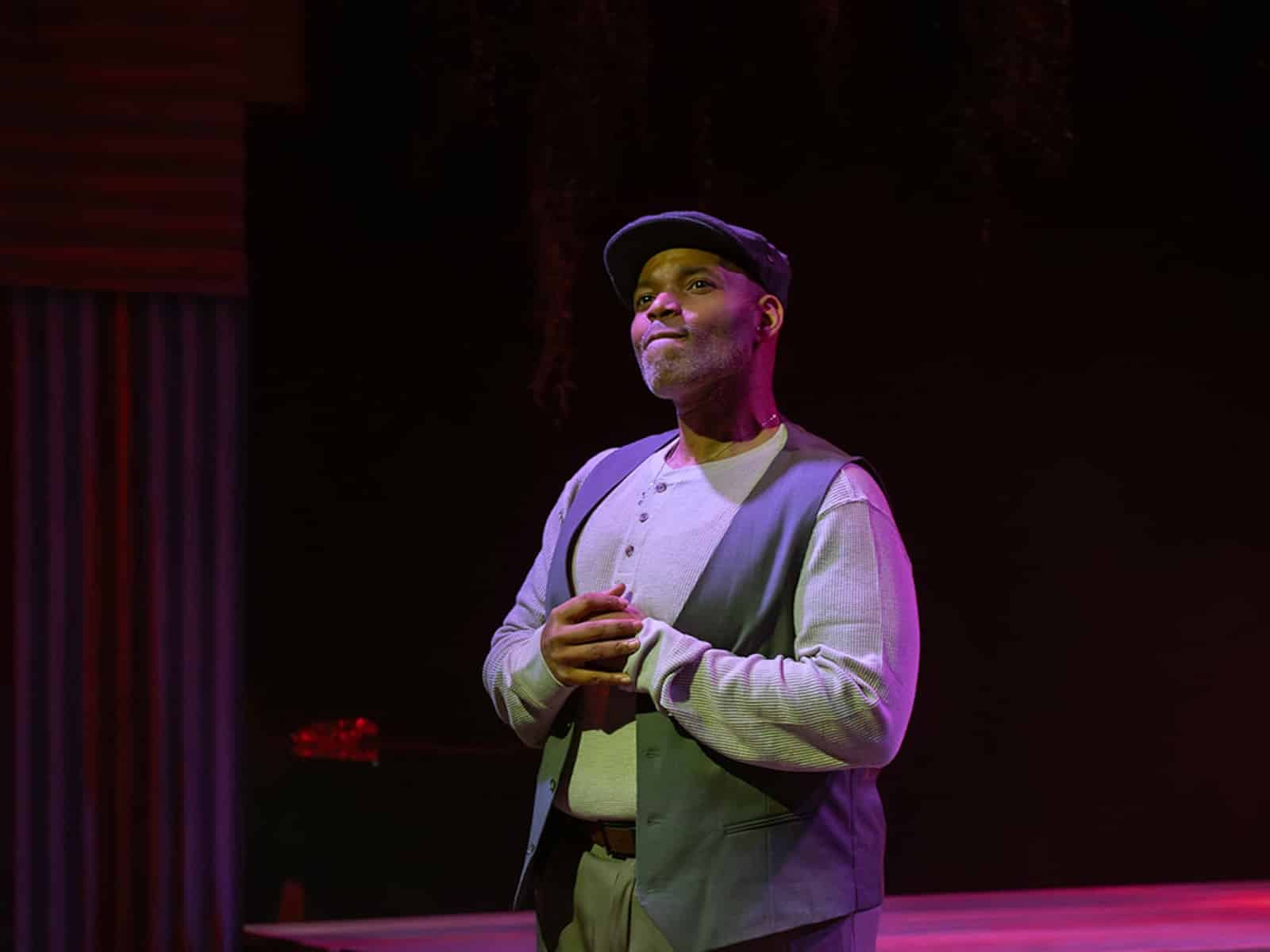
The opera begins with Robert Johnson, a grown man, sprawled on his mother’s grave. Its single white cross is painfully modest and suggests much that remains unsaid. Albert R. Lee’s tenor voice (as Robert Johnson) pierces through the dense harmonies of the instrumental ensemble, establishing a presence of someone not ready to give up on life.
Lee’s lyrics throughout the piece are clean, straightforward, and revealing when needed.
Lee’s Robert Johnson reveals an isolation made larger by his mother’s death: “I want to live in a place where they miss me when I’m gone. And they welcome me when I return.”
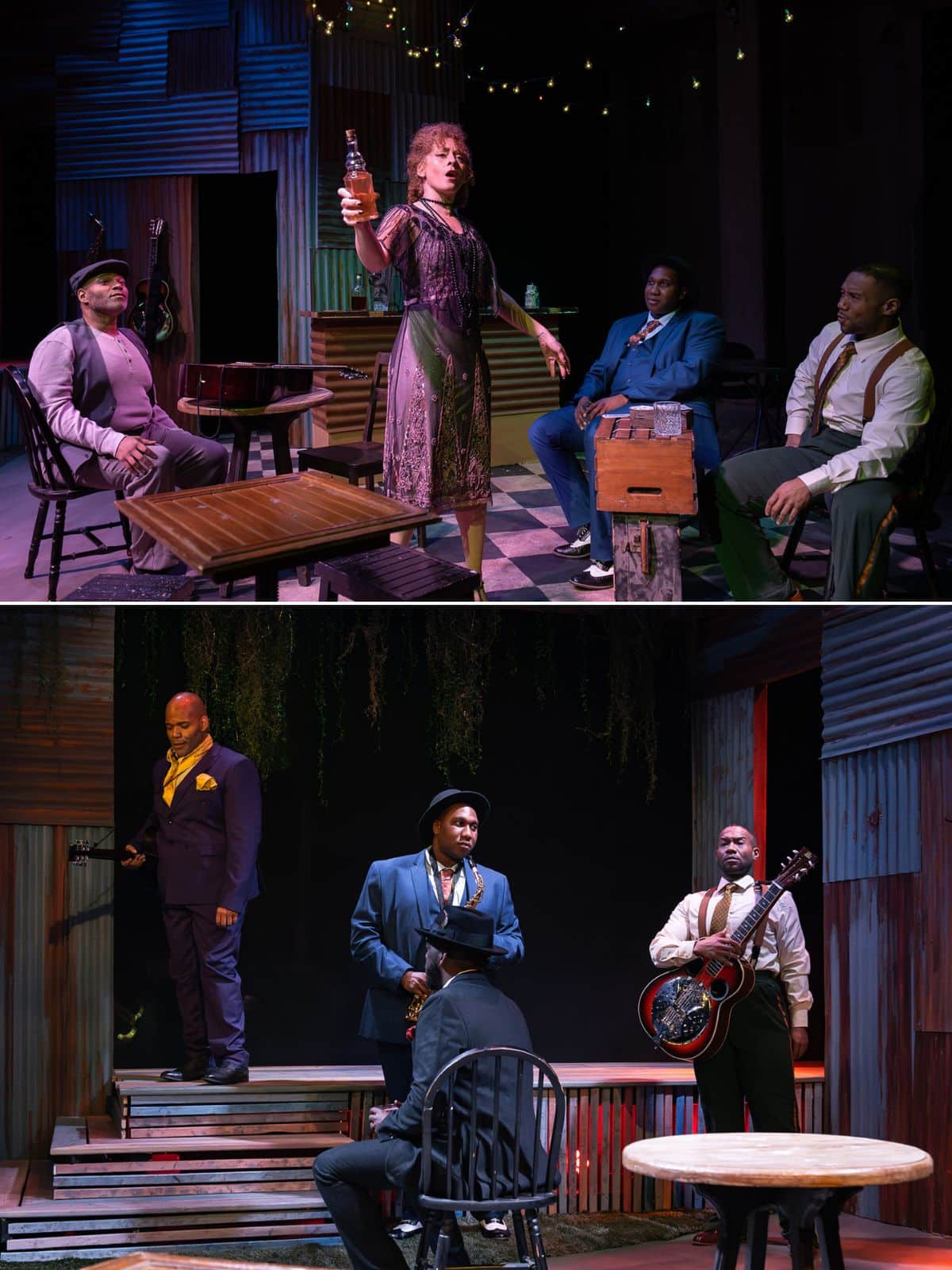
Lee’s Devil does not leer or drool. Above all else, he is honest, fair, and stylish. He looks good, and he knows it. This Devil intimately and gently confides his concerns (as far as you need to know them) and addresses your desires. Christian Simmons embodies the Devil impeccably. “I don’t want your money. I want your soul. That little light. That little glittering thing.”
Geter’s music is often full of lush harmonies that move the plot forward, interrupted periodically by discordant strains. The sound was dense and enveloping, with a direction that carried the audience along. I got some of the same feelings from this work that I got from listening to some of Franz Waxman’s classic work, like the music for A Place in the Sun.
Under conductor Darren Lin’s taut guidance, the instrumental ensemble’s performance was smoothly executed and emphatically delivered.
Washington’s staging leans into the piece’s eerie, dreamlike aspects. Her actor/singers move through the stage as though they are a photograph that has come to life, but are confined by the silvery-dusty light reflected off the metal walls of the bar they inhabit. Despite the set being very close to the audience, the fourth wall is firmly in place here.
The choice to have the performers handle real instruments and then to mime playing them was a risky one, and it is only partly effective. But it is effective for the protagonist. Albert R. Lee fervently embodies both the energy that Johnson puts into his guitar and the rhythms and sounds that come out of it in response to his efforts, and he embodies them as graphically as you might expect to see Strauss’ Salome or Saint-Saëns’ Delilah embody their intentions.
For most of its length, the staging of The Delta King’s Blues suspends us in a satisfying and mystifying dream. The very last moment of the show, though, confused me. The barkeep, played by Melissa Wimbish, sings “Last call!” in an ordinary but ominous echo of what we’ve heard her sing before. Then she and the musicians begin to gather casually on the bar’s stage. The musicians get themselves into position to begin another song when the music stops and the lights abruptly go out. The audience is suddenly pulled out of its reverie and left to wonder what happened. This staging leaves the audience hanging — perhaps on the precipice that precedes the monumental fame Johnson will acquire well after his death. But it is not certain. After giving in to the dreamy atmosphere that had come before, I wanted more.
Running Time: 60 minutes.
The Delta King’s Blues plays through December 14, 2025, presented by IN Series, performing at Pop-Up Theater, 340 Maple Drive (IN Series’ new venue in Southwest DC). Tickets for DC performances are sold out. The Delta King’s Blues also plays December 19 to 21, 2025, at 2460 SPACE, 2460 St Paul Street, Baltimore, MD. Tickets range from $25 to $35 in Baltimore and can be purchased online or by calling 410-752-8558.
The cast and creative team bios are online here.
The Delta King’s Blues
Music by Damien Geter
Libretto by Jarrod Lee
Directed by Alicia Washington
CAST
Albert R. Lee (Robert), Christian Simmons (Devil), Melissa Wimbish (Virginia), Marvin Wayne (Willy), Anthony Ballard (Son)
PRODUCTION TEAM
Stage Director: Set Design: Josh Sticklin; Lighting Design: Paul Cannahan; Costume Design: Rakell Foye; Assistant Costume Designer: Nadia Kufflar; Stage Manager and Lighting Operator: Mikayla Talbert; Technical Directors: Jonathan Dahl Robertson and Jos Lucas; Production managers: Samba Pathak and Isabela Tapia
INSTRUMENTALISTS
Michael Barranco, Tom Clippinger, Karen Cueva, Michael Chong, Dave Doescher, Mira Frisch, Victor Holmes, Doug O’Connor, Marcus Pyle, Ben Thomas, with special music guest Memphis Gold
Conductors: Darren Lin and Timothy Nelson, Rehearsal and Show Pianist: Dana Scott
SEE ALSO:
IN Series to salute ‘the most important American musician who ever lived’ (interview with Composer Damien Geter and Librettist Jarrod Lee by Gregory Ford, November 11, 2025)