As the show begins, the stage is bathed in red light. War is imminent. A rabble shouting about grain rations runs throughout the theater. Wielding parasols representing shields and spears, the Roman army, led by Caia Marcius, attacks Corioles, the stronghold of Rome’s longtime enemy, the Volscians, led by her hated but deeply respected counterpart, Tullus Aufidius. Caia Marcius bravely dashes ahead of her troops, emerging bloodied but victorious. Such is the striking beginning of director Jae K. Gee’s adaptation of Shakespeare’s Coriolanus at Silver Spring Stage.
Coriolanus is famously Shakespeare’s most political play, dealing in matters of class conflict and politics as a blood sport. The title character is typically portrayed as an egotistical, arrogant figure, steeped in the aristocratic martial virtues and honor culture of 5th-century BCE Rome while contemptuous of the common people, somewhat as Charles DeGaulle was said to love France while hating Frenchmen.
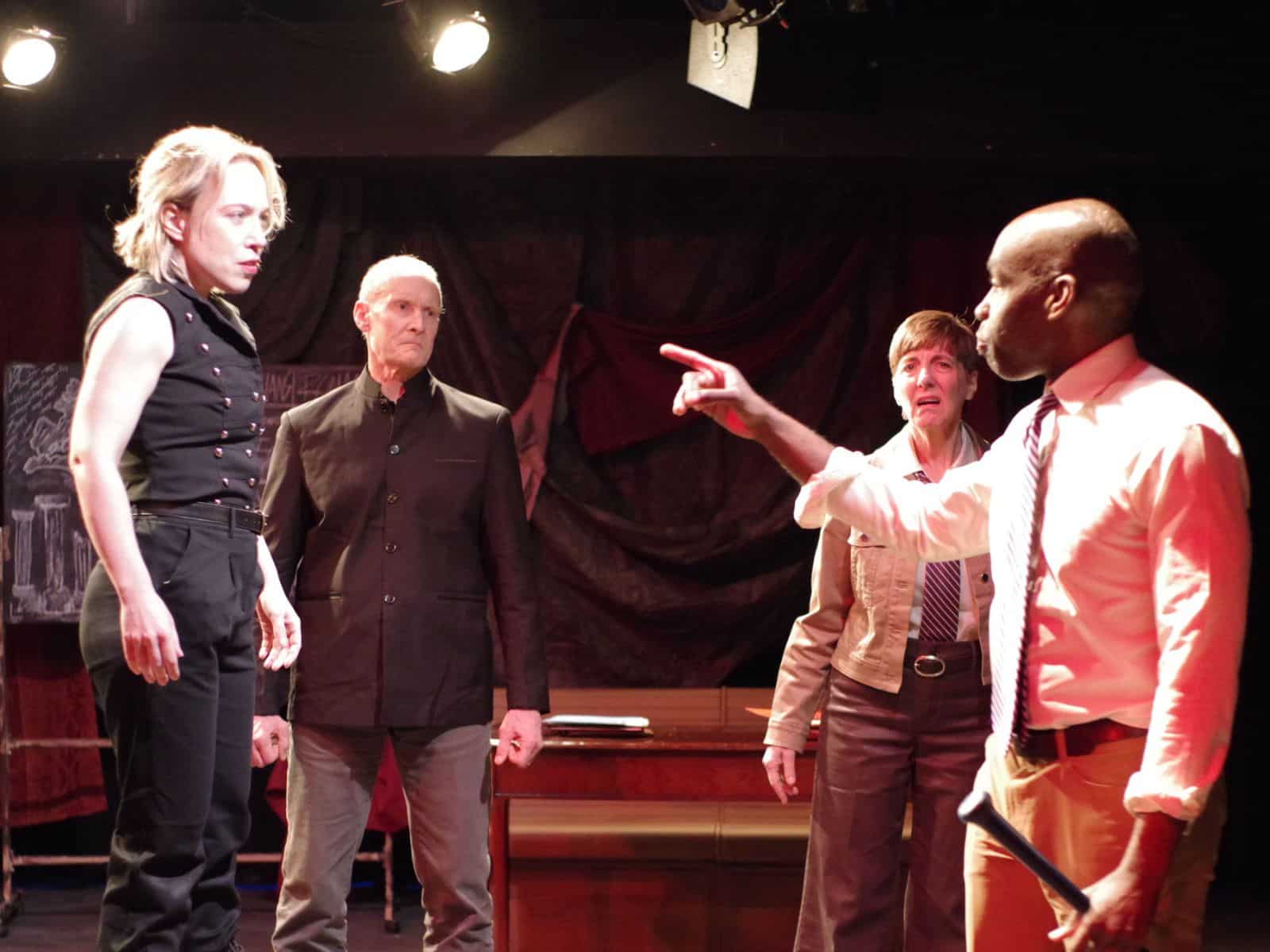
Gee takes the play in a different direction. Her Coriolanus, she says in her director’s note, “centers queer and female voices to examine how power is performed through gender.” This she accomplishes primarily by casting women (Brianna Goode and Erin Nealer, respectively) in the key roles of Caia Marcius (given the honorific “Coriolanus” for her role in the war) and Aufidius. This is not a totally unique idea. There was a 2026 Theater for a New Audience production in New York that cast a woman as Aufidius, for example. A Portland, Oregon–area theater did an all-female cast version of the play in 2016.
What matters is that the casting and Gee’s concept of the characters work well, particularly illuminating the relationship between Coriolanus and Aufidius in ways that traditional casting may not. The two share the intimacy of close combat. They have met on the battlefield five times, with Coriolanus having the edge but Aufidius surviving to fight another day.
In the second half, after Coriolanus has defected to the Volscian side, they share what can fairly be called a Heated Rivalry moment, making explicit the already evident homoerotic subtext in their lines in the scene. There being no implicit gendered hierarchy between them adds credibility to the relationship. Their mutual passion adds a dimension to Aufidius’ ultimate decision to kill Coriolanus, after seeing Coriolanus yield to her wife’s and mother’s pleas to make a peace that spares Rome from a Volscian victory. In this production, it is a decision as much personal as political.
Her mother, Volumnia (Rebecca Grutz), is the picture of “old Roman” militaristic virtues, for whom her daughter’s wounds are a badge of honor. Unlike Lady Macbeth, she does not need to “unsex” herself to glory in bloody deeds. While not villainous like Livia in I, Claudius, she is a matronly force of nature whom Coriolanus cannot resist. Coriolanus’ wife, Virgilia (Tara Scully), is proper and very softly feminine in demeanor, a kind of ancient Roman tradwife. Coriolanus’ relationship to Virgilia, while affectionate and protective, lacks the intimacy of her relationship with Aufidius. On the whole, the dynamic of a male Coriolanus with these characters — a son’s helpless devotion to his mother, a Roman husband’s duty to his wife — may better explain Coriolanus’ fatal decision to do what they ask.
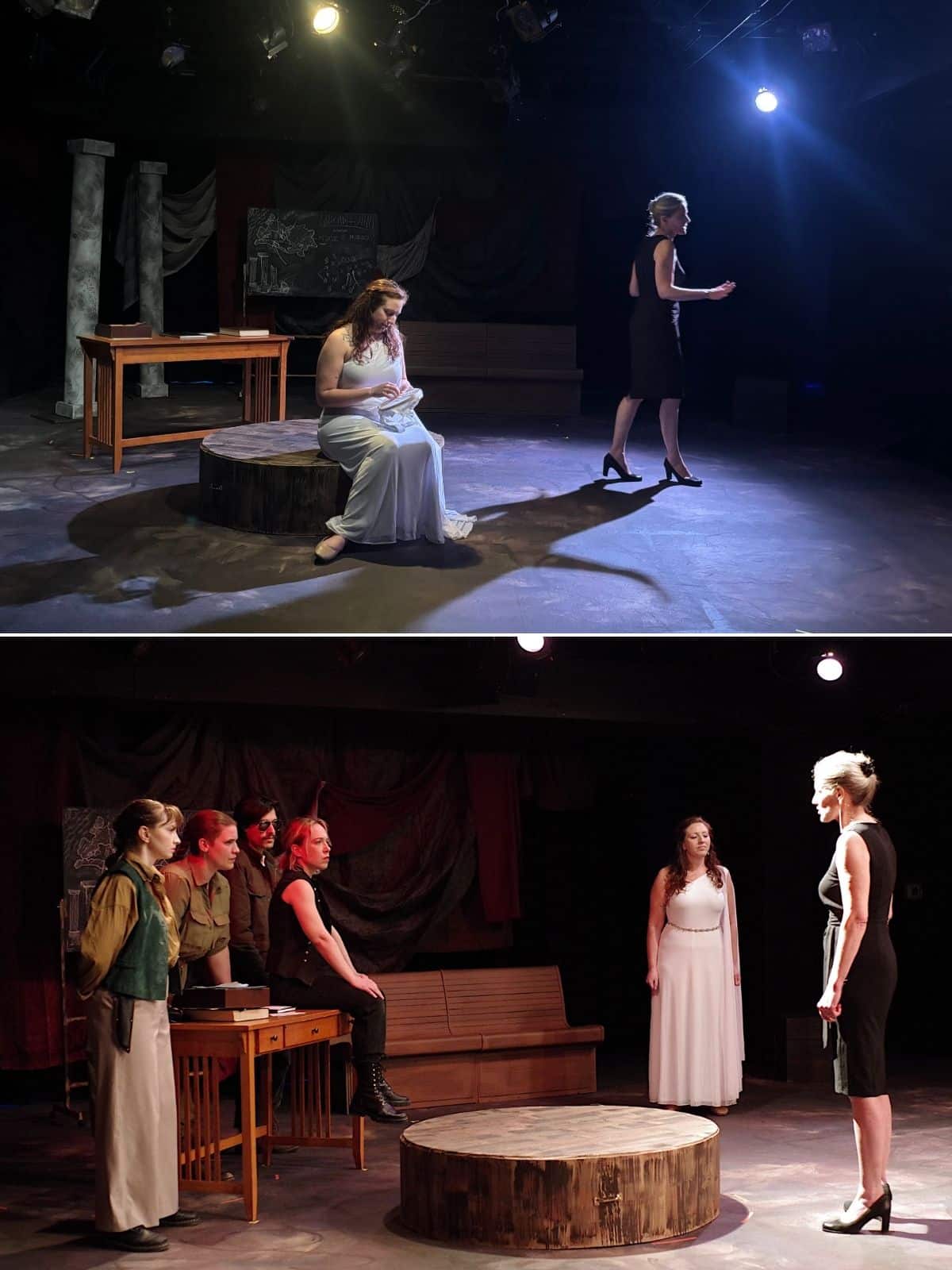
There is another scene where I found casting a woman in the lead role to be illuminating. In the first half, Coriolanus is asked to show her battle scars to the public, as a way of legitimating her claim to political authority. Coriolanus is very reluctant to do so. In a traditionally cast production, this is often played as an example of the character’s arrogance, resisting contact with the unwashed of the city. In Goode’s interpretation — she nervously crosses her arms over her body — her reluctance reads more as discomfort with appearing vulnerable, performing a political ritual for which she is ill-equipped.
In a production focusing as this one does on the main character as Goode plays her, the political content of play, and the sharpness of its interrogation of class conflict, are somewhat muted. The patricians Menenius (Alan Gomez Bisnes) and Cominius (Michael McClary) support Coriolanus’ candidacy for Consul, though it is clear that they would prefer, so to speak, an Eisenhower rather than a MacArthur to preserve the privileges of the upper class.
The tribunes Junius Brutus (Margaret Condon) and Sicinius Velutus (Kenneth A. Edwards) are a pair of manipulative faux-populist politicians of a type recognizable in any age. At times comic in their conspiratorial maneuvers, they are ultimately sinister and dangerous to the Roman state. They easily bend the volatile emotions of the plebeians to their political advantage, leading to the forced exile of Coriolanus from Rome and her bitter decision to make common cause with Rome’s enemy. Coriolanus’ pride is a force driving her decisions, even when it leads to consequences she must know are destructive.
The ensemble is versatile as plebeians, soldiers, and in a variety of smaller roles. They often speak as individuals, not simply members of a chorus.
Gee’s direction is impeccable: the characters and their relationships are clear, the pace is excellent, the stage pictures make sense and are never static, and the scene changes are smooth. The technical side of the production is likewise laudable. The fight choreography (Kiefer Cure) is precise and believably violent. Molly Jane Brennan’s lighting design — virtually all in reds and a light yellow — effectively sets the emotional tone of scenes. Scenes of contention and war were predominantly red, for example, while domestic scenes between Coriolanus and Virgilia were in the milder yellow hue.
Kiefer Cure’s music often had the sound and function of a film score, while Connor Lugo-Harris’ sound design was particularly notable filling in crowd noise during scenes involving the plebeians. Consistent with the stated time of the play — “a timeless world inspired by Rome — the set (Kate Zuckerman) has suggestions of the Roman world (e.g., some upstage columns) but otherwise is not time- or place-specific.
Jillian Skara’s costumes were a highlight of the production, nicely individualizing the characters. Coriolanus is in a sleek black outfit, manifesting power. Aufidius is in military fatigues. Virgilia is in a virginal, flowing white dress. Volumnia is in a professional, tight black dress and heels, suggesting a bit of a Roman devil wearing Prada. Adrian (Elijah Rakha-Sheketoff), an aide to Aufidius, has the look (in hair as well as costume) of 1970s cool. Sicinius wears a sports coat and tie and, for some reason not clear to me, typically carries a green baseball bat. The plebeians are often dressed in jeans and checkered shirts. There was never the problem that can exist in some Shakespeare productions I’ve seen of telling one character visually from another.This Coriolanus was as fine a marriage of concept and execution as I have seen in some time, and I heartily recommend it to audiences over the show’s remaining run as well as to Watch judges, who I hope will give the production the strong consideration it deserves.
Running Time: Approximately two hours and 20 minutes, including one intermission.
Coriolanus plays through April 12, 2026 (understudy shows are March 20 and 21), at Silver Spring Stage, 10145 Colesville Road, Silver Spring, MD. Purchase tickets ($28; $25 for students and seniors) at the door, online, or by contacting the Box Office at boxoffice@ssstage.org or 301-593-6036.
Coriolanus
By William Shakespeare
Adapted and directed by Jae K. Gee
CAST
Caia Marcus Coriolanus: Brianna Goode (Courtney Sumlin u/s)
Tullus Aufidius: Erin Nealer
Volumnia: Rebecca Grutz (Helen Cheng Mao u/s)
Menenius Agrippa: Alan Gonzalez Bisnes (Bryan McNamara u/s)
Cominius: Michael McClary
Virgilla: Tara Scully
Sicinius Velutus: Kenneth Edwards
Junius Brutus: Margaret Condon
Titus Lartius: Bryan McNamara (Daniel Riker u/s)
Nicanor: Ariana Kretz
Adrian: Elijah Rakha-Sheketoff
Citizen Ensemble: Helen Cheng Mao, Daniel Riker, Olivia Cholewczynski