Imagine a cluttered workshop. Imagine two quirky workers. Imagine an immense space filled with fascinating shapes. Imagine the beautiful geometry of lines and planes and angles interacting with light and motion.
If I were to suggest that one might see this show simply for the poetry of the shadows and feel well rewarded, and you were the type of reader who understood what I meant by that and purchased tickets posthaste, you would be precisely the sort of audience that is perfect for seeing Alex and Olmsted’s newest performance piece, Really Quite a Lot of Mechanisms. My editors, I believe, might be unhappy with a review that stopped there. If you are that person, use the ticket link right now. In fact, for your convenience, here it is.

Really Quite a Lot of Mechanisms begins with music, a shadow puppet series against a scrim, and no words. This show is almost exclusively visual storytelling, though there is sound of significance, and significant sounds.
When Alex and Olmsted — Alex Vernon and Sarah Olmsted Thomas — greet us (using words) and deliver an introduction to simple machines, the sequence is less about the machines and more about the audience. Alex and Olmsted’s faces convey pride, encouragement, caution, disappointment, expectation … these are impressively expressive performers. There are no more spoken words for the remainder of the show. I doubt you’ll miss them.
Aesthetic: patinated workshop, familiar, but also puzzling. The effect is akin to being dropped into an untidy but fully functional antique toolbox. What is this for? How will they use that? Observe the set, which is nothing like a backdrop. It is arranged strategically, layered in three dimensions, with vintage items that are sometimes what they are and sometimes something else entirely. The attention paid to visual detail is astounding. Each item seems chosen for function, form, aesthetic integrity, and the sounds that it makes when it is being handled. I am a little distracted by the shine on a few of the objects — my brain wants them to be dented, rusty, scuffed, or distressed — but there are several perhaps deliberately shiny things on the set. I tell my brain to settle down.
The story (and there is one) follows our two quirky characters in what is established as their ordinary day, days, weeks — we’re not necessarily sure what kind of time frame we’re seeing — where they demonstrate, operate, even build mechanisms. It all seems very abstract until suddenly it is quite pointed.
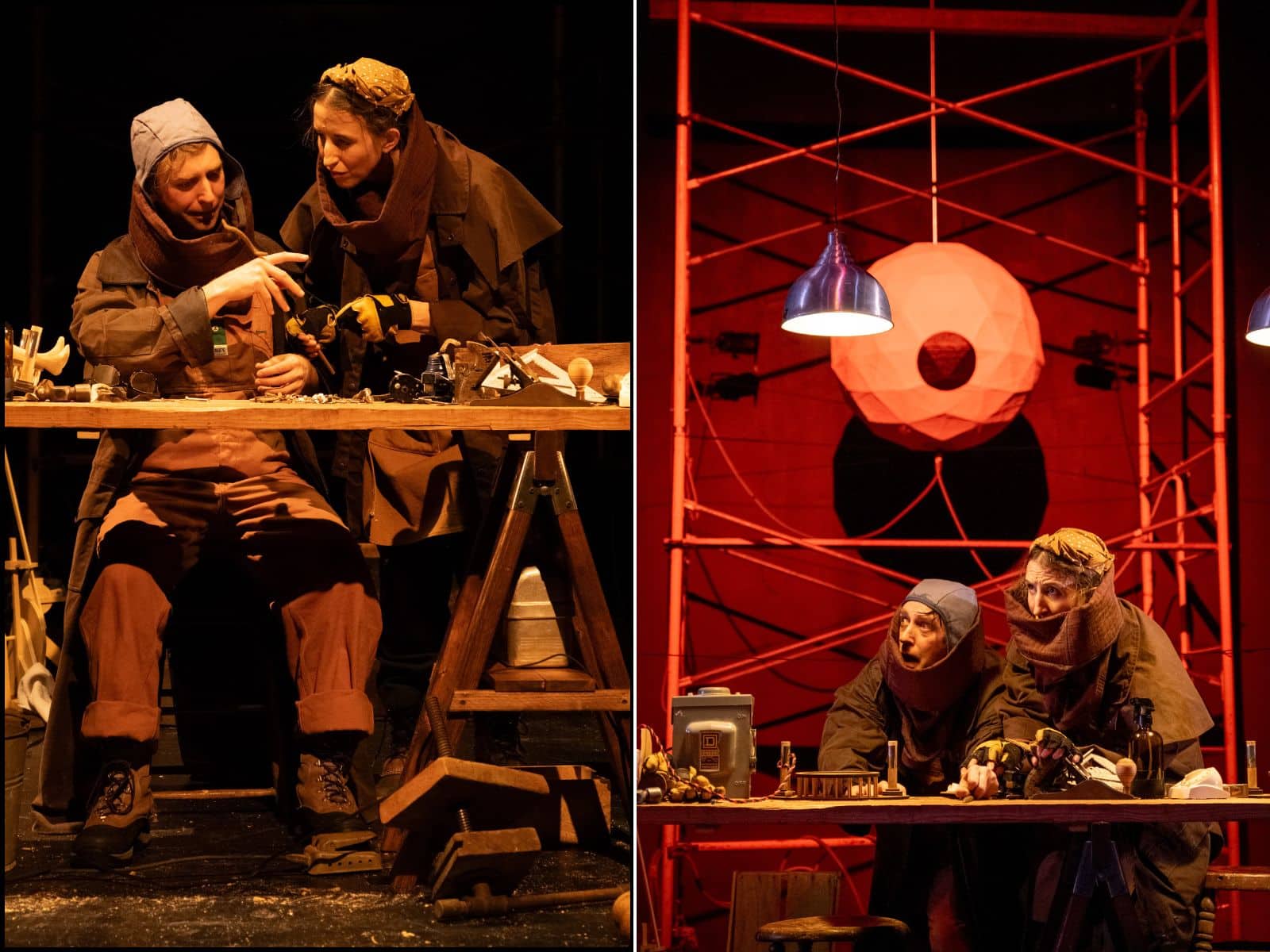
Maybe don’t bother trying to figure out “what’s going on here” while you watch. You risk depriving yourself of the joy of unfolding. Just observe and marvel — there’s so much. The expressiveness of the characters, the fascinating devices, the height and breadth of the space, the majestic lighting, the carefully curated music, the gradual rise of emotion, the involvement of more than just two of your senses — this is truly an immersive piece of work, very nearly an installation. Much of it is unsettling and strange. Some of it is familiar and reassuring. Classic clown techniques are packed into this very full 70-minute show. There are also references, homages, or continuations to the works of Jim Henson, previous Alex and Olmsted shows, Charlie Chaplin, and a 1971 Moody Blues album. The artists delve deeply and widely.
The effect of the lighting design by John McAfee is impossible to overstate. The interaction of items on the set, lighting color, intensity, timing, motion, and the structure of the building itself are magical and magnificent. Board operator Nicholas Boone’s impeccable execution of technical elements not managed onstage is organically seamless.
Alex and Olmsted have proved themselves over the years to be high-caliber conceptual creators and technicians working in an oft-misunderstood genre. Certain baggage comes with the word “puppet,” at least here in the U.S. The work of Alex and Olmsted goes far, far beyond Captain Kangaroo, Avenue Q, Pinocchio, and The Muppets. Their previous works have been marvelously different from one another in topic and assembly, always with a lofty level of artistic integrity. In a show that is somehow more different than any of its predecessors, and also very like them, Really Quite a Lot of Mechanisms is an intricate, evocative tour-de-force of construction, joinery, scope, and theatricism. Though it has hallmarks of a completely finished piece, I suspect A&O, inherent tinkerers, will tinker with it somewhat. Do avail yourself of the opportunity to see this show in its nascence, so you can enjoy the effects of its evolution at a later time.
Running Time: 70 minutes, with no intermission.
Alex and Olmsted’s Really Quite a Lot of Mechanisms plays through March 29, 2026, presented by Alex and Olmsted performing at Baltimore Theatre Project, 45 West Preston Street, Baltimore, MD. Purchase tickets (general admission, $25; seniors, artists, and students, $15) online, by phone (410-752-8558), or at the door, though I wouldn’t risk that last option. This show deserves to sell out every performance, and I hope it does.
No printed program is offered. The program is online here.
Street parking is available nearby, and sometimes free.
Final Factoid: I love the theater in Theatre Project. The seats are a delight, the rake perfection, and the sightlines unimpeded. It is, however, challenging for the mobility-impaired to access. There are exterior elevators for those who need them. Calling ahead seems prudent.
Alex and Olmsted’s Really Quite a Lot of Mechanisms
Devised by Alex and Olmsted
Lighting Design by John McAfee
Featuring Alex Vernon and Sarah Olmsted Thomas
Board Operation by Nicholas Boone