
Alexandre Dumas’ epic 1844 novel The Count of Monte Cristo, about the betrayal, retribution, and redemption of a falsely accused and wrongfully imprisoned man, provided the inspiration – along with Charles Fechter’s 1868 five-act play based on it – for the world-premiere musical adaptation Monte Cristo by Peter Kellogg (book and lyrics) and Stephen Weiner (music), presented by The York Theatre at The Theater at St. Jean’s and developed as a part of its New2NY series. With a cast of eleven, all but three playing multiple roles, 25 original songs, a narrative that takes place in many different locations, from Elba to Marseille, the Chateau d’If prison to the island of Monte Cristo, Rome, and Paris, spanning more than two decades during the end and aftermath of the Napoleonic era, and a running time of more than two hours, one might assume that the sweeping story would be difficult to follow. But Kellogg’s writing is clear, Peter Flynn’s direction is fluid, and the actors’ performances fully embrace and distinguish their individual characters, making it both engaging and readily intelligible, with or without a prior knowledge of Dumas’ even more dense original and the significant changes made here in the second act and conclusion. And along with the expressive new music, there are also touches of humor added throughout the show to lighten the heavy themes of unmitigated envy, political corruption and injustice, and moral reckoning that still resonate today.

The historic tale follows the journey of sailor Edmund Dantes, returning home in a commanding position on his ship after the death of its captain, to marry his love Mercedes and to deliver a letter, as requested, from the exiled Napoleon, which, unbeknownst to him, is considered treasonous. Upon his arrival, though the ship’s owner Morrell is a loyal and ardent advocate for Edmund and intends to make him the new captain, his conniving former friends – Danglars, a resentful junior officer who expected the promotion, and Fernand, Mercedes’ jealous cousin who is also in love with her – plot his downfall to further their own interests, and Villefort, the public prosecutor who, although he knows that the apolitical Edmund did not intentionally commit an act of treason, unjustly sentences him to life in prison to save a member of his own family, for whom the letter was intended.
In the gloomy cell to which he’s been confined, Edmund meets another prisoner, the Abbé Faria, a highly intellectual Italian priest who educates him, considers him a son, bequeaths him the sizable fortune he’s hidden on the eponymous island, and ultimately enables his flight from jail and his new life as the wealthy and wise Count of Monte Cristo, determined to wreak his revenge on those who wronged him, assuming a number of guises, and enlisting the aid of the drunken innkeeper Caderousse – who overheard the nefarious plot of Danglars and Fernand and reported it (but to no avail) – to execute his plans (against the initial objections of his domineering wife Carconte, until she is lured in by Edmund’s lucrative promise). What follows is a series of carefully orchestrated encounters with Edmund’s targeted enemies and reimagined plot twists involving his rescued new love Haydee (daughter of a murdered Greek vizier also betrayed by Fernand), his former fiancée Mercedes (long married to Fernand but still in love with Edmund), her son Albert, and Danglars’ unsure daughter Eugénie, who is engaged to Albert but feels, and then acts on, a secret attraction to another. Will the protagonist succeed in his driving quest for justice and retribution, or will the power of love and mercy, and a happy ending for this musical retelling, prevail?
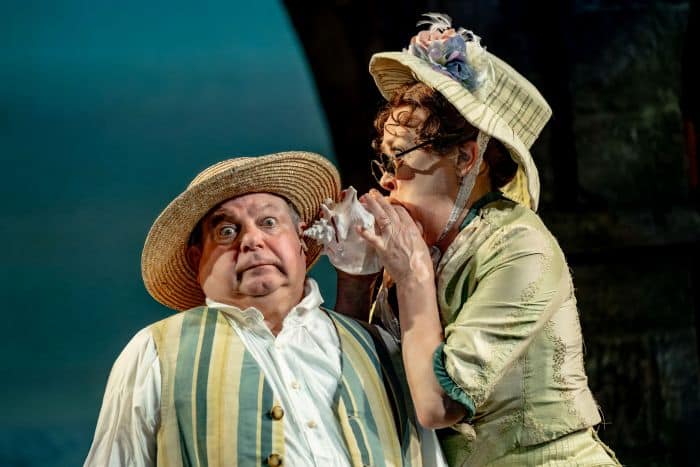
A consistently top-notch cast is led by Adam Jacobs as the severely maltreated, transformed, and avenging Edmund and Sierra Boggess as Mercedes, who never stopped loving him but, upon his imprisonment, quickly wed her cousin, with featured performances by Daniel Yearwood as the duplicitous Fernand, James Judy as the conniving Danglars, the always outstanding Norm Lewis as the conflicted Villefort, haunted by what he’s done and unable to sleep, Danny Rutigliano as the hilariously sardonic Caderousse and Abbé, and Karen Ziemba as the nagging Carconte (and, in a brief appearance, as the murderous Lucrezia Borgia).
Together they capture the personalities, their evolution, and inter-relationships, reveal the characters’ thoughts, emotions, and motivations, and bring their masterful voices to the melodious score, ranging from Edmund and Mercedes’ romantic duet “You Guide Me Home,” Mercedes’ longing in “This Stupid Heart of Mine,” Edmund’s plaintive “Is Anyone There?,” and Villefort’s soul-searching and regretful “A Great and Noble Man,” to Abbé’s comical “You Sent Me This,” and Carconte’s mocking “That Stupid Man of Mine,” accompanied by a seven-piece band (Kerrick Sasaki on viola, Bobbie Lee Crow III on cello, Joseph Wallace on bass, Noah Vece and Mackenzie Conroy on reeds, Jay Mack on drums/percussion, and Music Director David Hancock Turner, who also provided the rich orchestrations, on keyboard). Rounding out the excellent company are Eliseo Roman as Morrell, Jadon Lopez as Albert, Kate Fitzgerald as Eugénie, and the golden-throated Stephanie Jae Park as Haydee (whose song “Haydee’s Story” is yet another vocal highlight of the show).
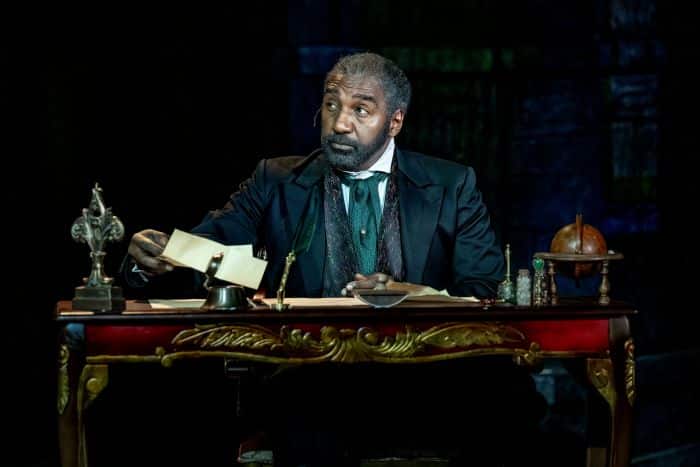
An equally accomplished artistic design transports us to the 19th century and the changing locations in Europe, with a stationary set (by Anne Mundell) made of historicizing stone architecture and arches, iron fencing and doors, steps up to another draped room, and antique-style furnishings that efficiently move in and out for the different scenes and allow for the easy mobility of the cast, with background projections (by Shawn Duan) that identify the lands, cities, seascapes, and interiors where the story takes place. Period-style props (by Polly Solomon) include the crucial letter, swords, and guns, and costumes (by Siena Zoë Allen and Amanda Roberge), with hair and make-up (by Caitlin Molloy), define the characters and their situations, from the sailor’s uniforms, the innkeepers’ modest attire, and the prisoners’ filthy rags and beards to the lavish suits, gowns, jewels, and coiffures of the figures’ increasingly wealthy status and their attendance at the Count’s masquerade ball (with choreography by Marcos Santana and additional choreography by Betty Weinberger). The action, places, and moods are enhanced with apropos lighting (by Alan C. Edwards) and sound (by Joanna Lynne Staub), for a thoroughly compelling theatrical experience.
The York’s full-stage premiere of Monte Cristo is engrossing, entertaining, and enlightening, raising significant issues that are as timely now as they were in the Napoleonic age, in its examination of jealousy and injustice, political power and socio-economic standing, retribution and reckoning, and choosing love and mercy over anger for a truly happy and victorious life.
Running Time: Approximately two hours and 15 minutes, including an intermission.
Monte Cristo plays through Sunday, April 5, 2026, at the York Theatre, performing at The Theater at St. Jean’s St, 150 East 76th Street, NYC. For tickets (priced at $29-79, including fees), go online, or find discount tickets at TodayTix.