On April 3, 1964, after a series of arrests for a charity scam, drug possession, and obscenity charges, stand-up comic Lenny Bruce (1925-66), known for his satirical socio-political commentary and no-holds-barred language, was arrested after leaving the stage of the Café Au Go Go in Greenwich Village, along with club owner Howard Solomon, by undercover detectives in the audience, for what was, at the time, deemed an obscene performance. The infamous six-month trial – prosecuted by Manhattan Assistant District Attorney Richard Kuh and decided by a three-judge panel (without a jury), with Martin Garbus serving as Bruce’s defense attorney – resulted in the comedian’s conviction on November 4, a four-month sentence, his immediate appeal, release on bail, and death from a narcotics overdose before the appeal was decided (and for which he was posthumously pardoned by NY Governor George Pataki on December 23, 2003, 37 years after his death).
Cause Célèbre Productions’ world premiere presentation of The People Versus Lenny Bruce by Susan Charlotte offers an examination of the comedian’s NYC trial and, with it, our First Amendment right to freedom of speech. Now playing a limited engagement at NYC’s Theatre Row, following a staged reading at the New York Society for Ethical Culture, the work is part of a trilogy, All The Courts A Stage, based on the cases of Garbus (with Last Chance Café, about voter suppression, and Unlucky Gal/The Story of Jane Doe, on sexual abuse, slated to follow this production), all of which remain extremely relevant, as our long-established liberties have come under increasing attack by the current administration.
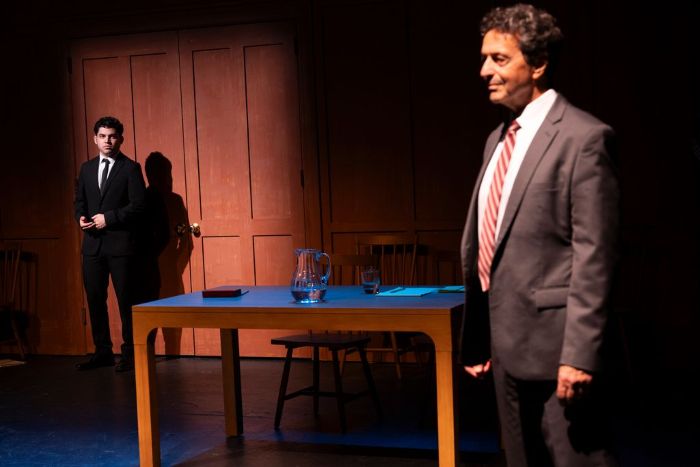
Directed by Antony Marsellis, the one-act theatrical adaptation of the real-life events, combining thought-provoking drama and sardonic humor, is set in the NYC courtroom in 1964, and framed in the device of the present-day Garbus serving as narrator, interweaving his recollections and imaginings of the trial and his client in first-person direct address to the audience, with actual excerpts and enactments by some of the key characters in the case – the lawyers, witnesses for both the prosecution and defense, and the targeted Bruce, who was found guilty of obscenity by a two-to-one vote, despite the expert testimony of his supporters and the clear inaccuracies of his accusers.
An engaging cast of seven relays the story, the conflicting attitudes, and the opposing personalities, led by Stephen Schnetzer as Garbus, both the dedicated attorney, who presents his case and expresses his love and concern for Bruce, and the reflective narrator, who introduces the characters and the scenes, and shares his thoughts and the significance of the trial, then and now. In the titular role of Lenny Bruce, Johnny Anthony turns in a stellar performance, capturing his demeanor, voice, and the stylings of his stand-up routines, visibly and vocally reacting to the contradictory testimonies and cross-examinations, interrupting Garbus with questions he wants him to ask, points he thinks he should make, and legal precedents he believes should be referenced (even when irrelevant), as the lengthy trial progressively takes its toll on him. And Ian Lithgow as the stern prosecutor Richard Kuh is determined to prove the obscenity charges levelled against the defendant, repeatedly stating the vulgarities he used in his act, with an air of poker-faced professionalism, and the disputed allegations that he touched his crotch (until Kuh, himself, is called out for unconsciously stroking the pen he’s using to take notes, in one of the show’s funniest and best delivered sight gags).
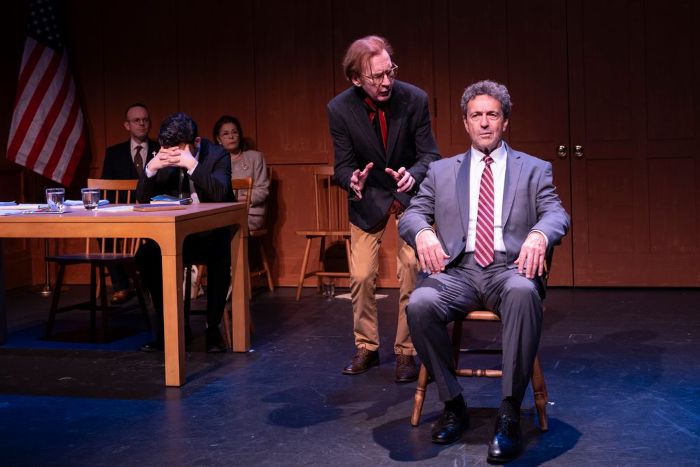
The witnesses for the defense are represented by Roberta Wallach as journalist, syndicated columnist, and TV personality Dorothy Kilgallen, whose testimony is highly intelligent and articulate, and who remains cool and unruffled in the face of Kuh’s interrogation; Timothy Doyle as satirical cartoonist and writer Jules Feiffer, who, like Kilgallen, provides an earnest voice of reason and support for the nature of Bruce’s art as new personal theater and socio-political commentary; and Jonathan Spivey as the Reverend Forrest Johnson, a man of the cloth who attended the show at the Café Au Go Go, found Bruce profoundly insightful in his observations about religion, inoffensive in the profanities that he also admits to using, and unequivocally certain that he never once touched his crotch.
Rounding out the riveting cast is Dan Grimaldi as License Inspector and former CIA agent Herbert Ruhe, a loud and brazen witness for the prosecution who went undercover to Bruce’s performance, wrote down all the expletives he spoke – without citing their context in his jokes – grossly mispronounced the Yiddish words he used (after being corrected multiple times), falsely accused him of making masturbatory gestures on stage, and, after the conclusion of the trial, acknowledged that the arrest was a set-up, with the admission that, “We aimed for Bruce. We picked him out of all the performers. I know he was not obscene, yet in a way I feel he had to be convicted.” (Please note that this is not a spoiler; it appears on the production’s postcard and promotional material). It’s a statement that should have resulted in an instant declaration of a mistrial and a reversal of the guilty verdict, and provides a compelling impetus for the play.
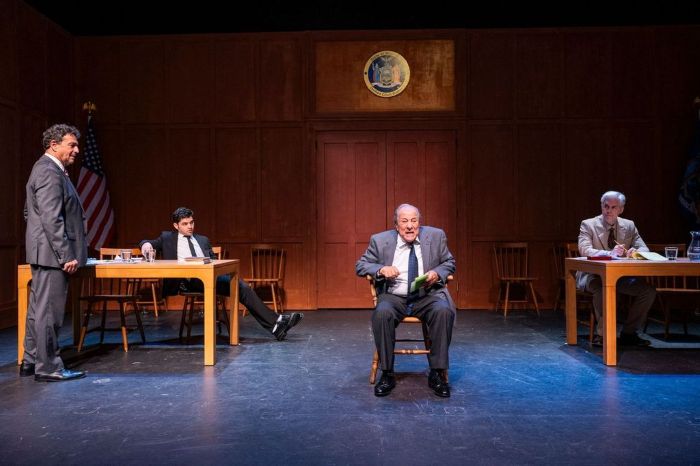
The expressive performances are supported by a courtroom set (by Josh Iacovelli) with light-toned wood paneling, central doors, a seal of the New York State Court System above, and wooden tables and chairs for the defense, prosecution, and witnesses; suits that evoke the fashion of the era (with Olga Turka serving as wardrobe consultant); and lighting (by Matt Berman) that shifts with the scenes and shines a spotlight on the stand-up segments delivered by Bruce.
Following select performances, advocates of free speech will discuss the play and its relevance today. The schedule of the post-show discussions, moderated by the playwright, is as follows: comedian Lisa Lampanelli on Thursday, May 7, Friday, May 15, Saturday, May 23, Friday, May 29, Friday, June 5, Thursday, June 11, Friday, June 19, and Saturday, June 27; defense attorney Martin Garbus, on whom the trilogy is based, on Wednesday, May 20; and Michael J. Osgood, Deputy Chief of the NYPD, on Thursday, June 11.
One more reminder about the current import of The People Versus Lenny Bruce: After eleven years of The Late Show being hosted by Stephen Colbert (a sharp-witted critic of the state of our country and its leadership), it was cancelled by CBS. During its final two weeks, Colbert was joined by fellow late-night hosts Jimmy Fallon, Jimmy Kimmel, Seth Meyers, John Oliver, and David Letterman (just as Bruce was supported by an array of fellow writers and performers at his trial). The last night of the popular talk-show will air on Thursday, May 21, at 11:35 pm, so be sure to set your clock – back to 1964.
Running Time: Approximately one hour and 50 minutes, without intermission.
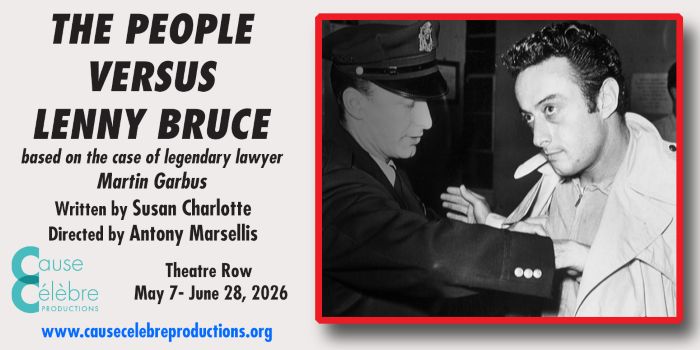
The People Versus Lenny Bruce plays through Sunday, June 28, 2026, at Theatre Row, Theatre Four, 410 West 42nd Street, NYC. For tickets (priced at $65-155, including fees), call (646) 366-9340, or go online.