
The rug-pull that reframes The Motion, Christopher Chen’s philosophical sci-fi provocation at Arena Stage, arrives half an hour in and not a moment too soon.
In the show’s table-setting opening section, a crimson-blazer-wearing Nancy Robinette tells the audience we are to be the judges in a debate organized by “Intelligence Cubed” to determine whether medical testing on animals should be banned. The motion that opens The Motion is no more specific than that — it reads, in full, “Ban Animal Testing Now” — but we’re invited to signal our belief that such testing should continue or stop by raising the green side or the red side of the placards beneath our seats. We’ll be asked to vote again, Robinette’s moderator tells us, after the pair of duos arguing for and against the petition have completed three rounds of scholarly argument. The team that appears to have changed the most minds will be declared the winner.

Thus the contest begins. Those arguing to spare the animals, the avuncular Dr. Alan James (Barzin Akhavan) and the Immanuel Kant-citing Prof. Lily Chan (Peregrine Teng Heard), plead the philosophical case that because we cannot be certain the creatures used in medical studies are not suffering, it is incumbent upon humans as morally evolved creatures to avoid causing lesser species pain or fear. On the pro-testing side, the rhetorically nimble Dr. Sarah Matthis (Nikkole Salter) and hotheaded Prof. Neel Bharara (Nehal Joshi) counter with pragmatic arguments that while animal studies should be as humane as possible, the potential benefits to us outweigh any consequences to the unlucky rabbits and vermin. (Playing to the crowd, Bharara points out that the restaurants many of us dined in before coming to the theater kill mice by far more violent means than those used in medical labs, and that we’re grateful when they do.)
As in so many political debates, it becomes evident that the two sides don’t even agree on precisely what they disagree about. And as in so many political debates, their hypotheticals sag into personal attacks, each contingent seeking to expose hypocrisy in their opponents.
These are strong actors advancing cogent arguments. It’s all utterly believable. Substantive. Familiar. But boring. Who wants to spend a night out watching live-action C-SPAN?
Mercifully, there’s a blackout, and when the lights come back up, the four debaters can no longer see us. They’re alarmed to discover they can read one another’s thoughts, but their individual memories are growing blurrier by the moment. From the ceiling of the Fichandler Stage, a new, more creature-comfortable set has descended, the far-apart podiums of the debate stage replaced by a cozy kitchen table and a sideboard stocked with wine. (Tim Mackabee designed the set.) This is how you build consensus, and this is where Arena Artistic Director Hana S. Sharif’s production begins to find its groove.
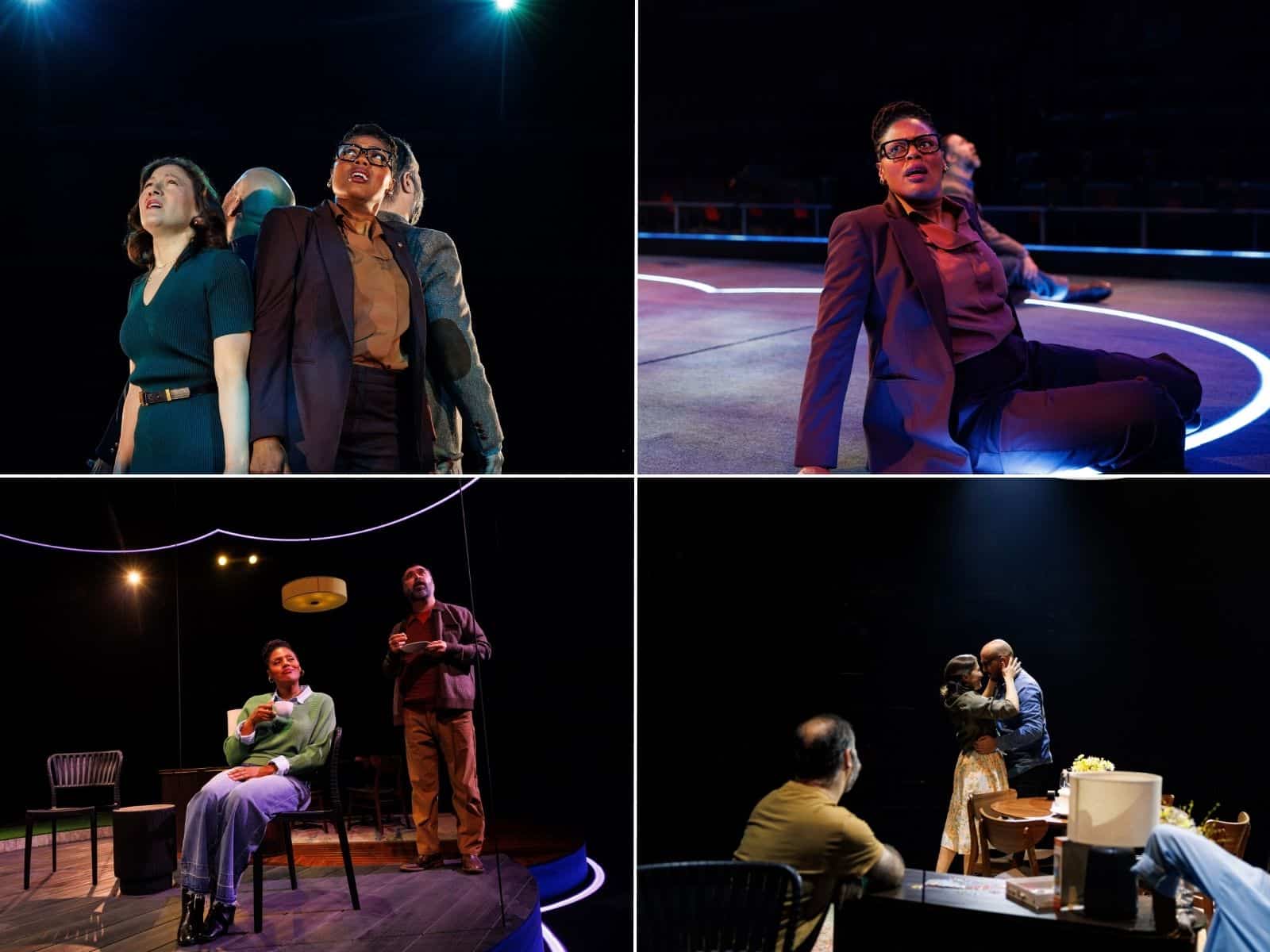
These four experts quickly deduce that they themselves are subjects of an experiment being conducted — quite humanely, it must be said — by some superior intelligence. Lily and Neel, neither of whom can recall for certain whether they were single before being bottled in this bardo, find something more profound than mere flirtation growing between them. As they surrender to the comforts of their cage, they find it’s not just gilded but expansive: The test subjects can go outside. They can visit a farmer’s market on weekends, cultivate a vegetable garden, and socialize with other “pods” of human guinea pigs. Admiring a sunset they know to be illusory, onetime opponents Alan and Sarah admit their unseen captors “did a good job.” And even allowing for the fact that years of joy may seem to pass more quickly than moments of sorrow, the foursome finds soon enough that they can hazard only a guess as to how many weeks or years they’ve spent living comfortably in this five-star zoo.
So: A ticket to Eden, at the cost of their old identities. It’s the sort of jam the bridge crew of the Starship Enterprise used to find themselves in on a weekly basis. But you don’t need to know your Star Trek to predict that several of the scenarios about the rights of animals discussed in the abstract in The Motion’s early moments shall now recur with the lives, or at least the humanity, of four human beings we’ve come to care for in the balance. It’s a consequence of the rigidity of Chen’s grand design, rather than any failing of performance or direction, that these four characters, empathetic though they are, still register more as chess pieces than individual characters.
Spoilers aren’t usually a problem theater critics have to reckon with, but Chen’s play is new enough (its world premiere was at Berkeley, California’s Shotgun Players last September) and strange enough to require delicate handling. I wrote a Village Voice piece on this subject in 2013, the year after the world premiere of Anne Washburn’s Mr. Burns, a Post-Electric Play at Woolly Mammoth Theatre Company made me wonder why the compulsion I felt to protect that radical play’s formal secrets was, for the most part, not shared by other critics. (I’ve been careful not to disclose anything Arena hasn’t already made a part of The Motion’s marketing campaign.)
Certainly, The Motion aspires to be the sort of mindbending experience more common to Woolly than to Arena. The way Chen ultimately resolves the riddle after belatedly winning our emotional investment struck me as more gimmicky and schematic than revelatory or satisfying, but that’s just my messy, unquantifiable humanity talking. Trap me in a jar or plug me into the Matrix and it’ll be the first thing to go.
Running Time: Approximately one hour and 45 minutes without an intermission.
The Motion plays through June 14, 2026, in the Fichandler Stage at Arena Stage at the Mead Center for American Theater, 1101 Sixth St SW, Washington, DC. For tickets (starting at $49), go online, call the box office at 202-488-3300, email info@arenastage.org, or visit TodayTix.
Arena Stage’s many savings programs include “pay your age” tickets for those aged 35 and under; military, first responder, and educator discounts; student discounts; and “Southwest Nights” for those living and working in the District’s Southwest neighborhood. To learn more, visit arenastage.org/savings-programs.
View The Motion program. View The Motion Learning Guide.
SEE ALSO:
Arena Stage announces cast and creative team for ‘The Motion’ (news story, April 11, 2026)