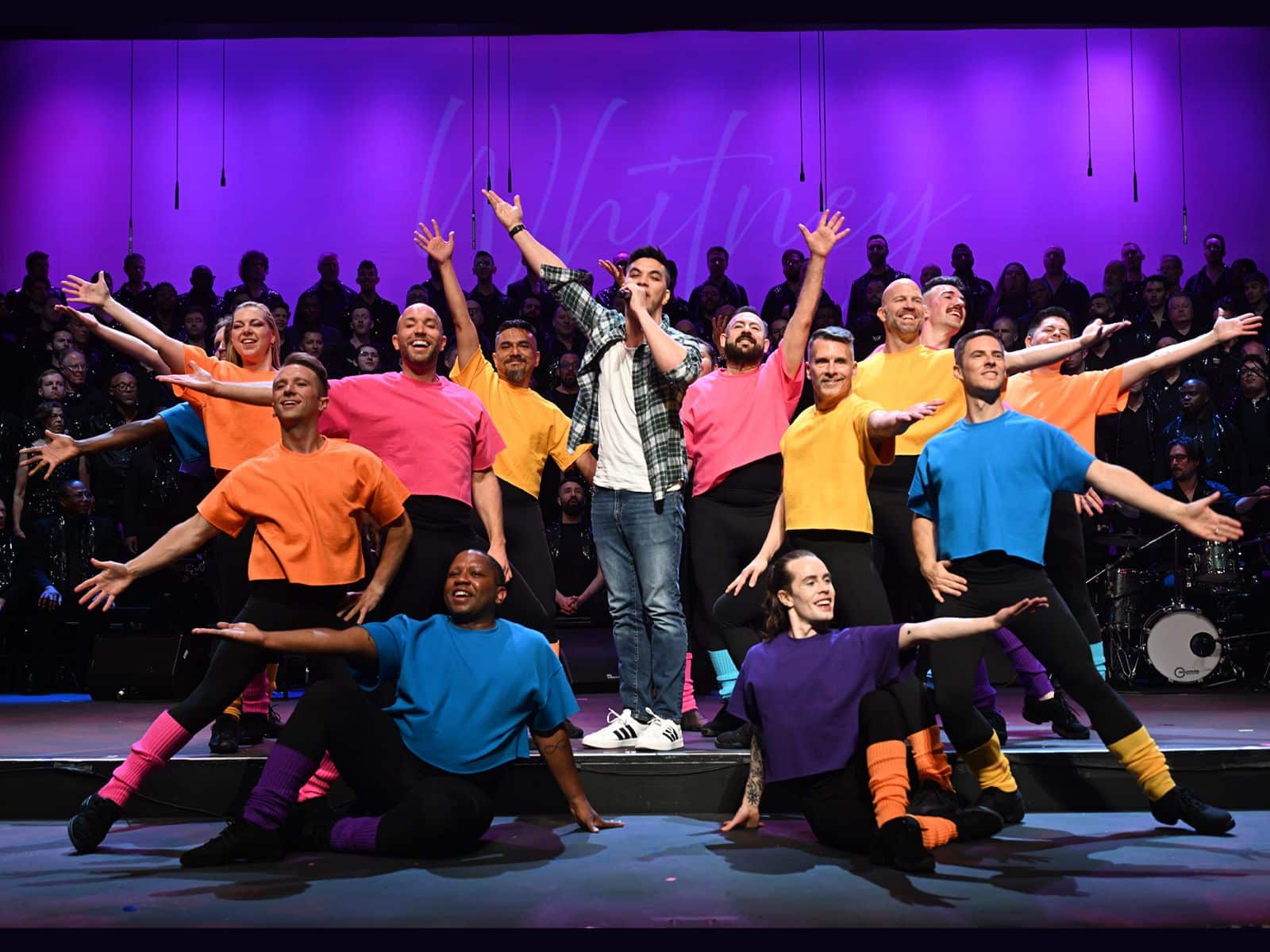
June is both Pride Month and African American Music Appreciation Month (Black Music Month), and Soul Divas, a concert by the Gay Men’s Chorus of Washington, DC (GMCW), kills two birds with one stone by offering a tribute to iconic soul stars from Diana Ross to Aretha Franklin to Whitney Houston. Conducted by Thea Kano and C. Paul Heins, Soul Divas is more than just a concert or musical performance; it is a story, one that includes choreographed dances by Carlos Barillo, Craig Cipollini, James Ellzy, Jeffrey Hollands, and Matt Zagorski. With assists from the Rock Creek Singers, GenOUT Youth Chorus, Potomac Fever, and Seasons of Love, the concert works to memorialize coming of age, identity, resilience, belonging, and the never-ending fight for social justice, from women’s rights to feminism, with personal anecdotes from speakers such as Thomas Reiker and Benn May and flamboyant, colorful costumes by Jeffrey Hollands. In true diva fashion, the honored artists needed nothing but their first names illuminated in the background (Solomon Haileselassie, lighting design) to usher in each segment, because after all, while many have been inspired by our legends and greats, their magic can’t be replicated.
And yet, despite this and the homage to Black women, a demographic that is often erased and ignored, it’s hard not to notice that even in a concert so heavily inspired by Black culture and artists, there’s a significant lack of representation of Black men in the chorus.
Additionally, it’s almost a disservice to perform at the Lincoln Theatre on U Street, a neighborhood historically known as “Black Broadway,” and not mention the modern social justice movement #DontMuteDC, a grassroots, political movement that’s fighting against the gentrification and cultural erasure of the birthplace of Go-Go music. The District has the honor and prestige of being the first major U.S. city to have a predominantly Black population, hence the moniker “Chocolate City,” and yet, this rich history, while mentioned in a recounting of Roberta Flack’s early career (told onstage by GMCW member Sean Robinson), appears to take a backseat to more personal anecdotes, primarily of white men working to understand their own identities, which at times felt like a discounting of the complicated, multifaceted identities of the women whose songs were being performed. For example, one story spotlit Tina Turner and how her music helped the performer feel more comfortable and seen as a young, queer white boy, but it never mentioned that Turner herself was a complex person who suffered from a music industry that gave her praise and accolades but also turned her domestic abuse into a running joke.
While it’s not inherently negative to experience validation, pride, and a sense of self from others, this notion can be a double-edged sword for Black women, as we are often praised and revered for our strength, resilience, and ability to make others feel safe. (Cue the trend on social media of white women telling their kids to look for Black women if they get lost or need help.) In return, this often contributes to our harm from medical racism to the Black maternal health crisis, and disproportionately higher risks of depression.
Now, this is not to say that Soul Divas missed the mark, because after all, it’s hard to cover everything in a two-hour time span. But, for many of the artists celebrated in this concert, their dually marginalized identities as Black and female were intrinsically linked to their music. Therefore, while song and dance do transcend color lines, as well as cultural and racial barriers, in an era where people like Black culture but don’t necessarily like Black people, the art can’t be separated from the artist.
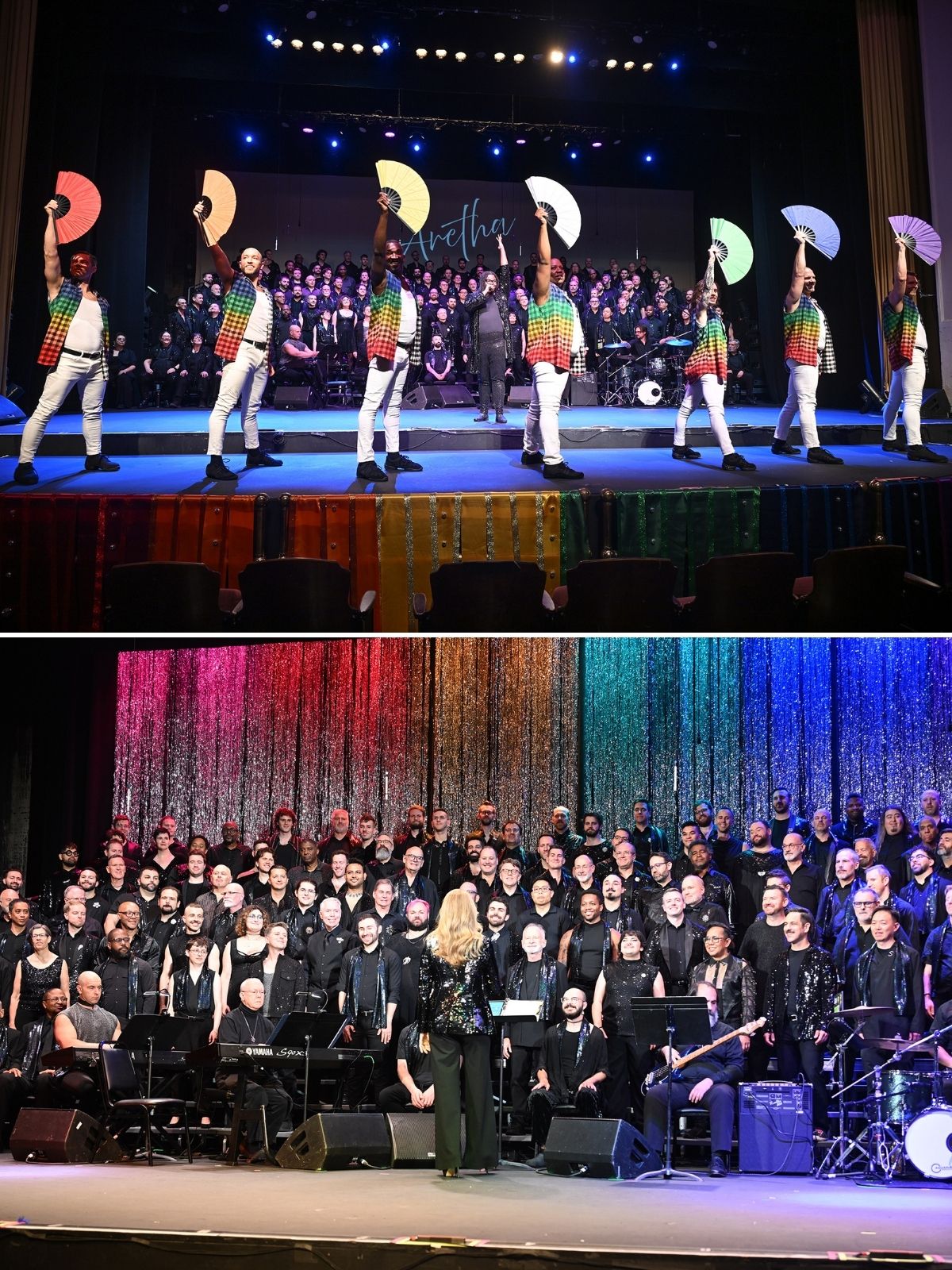
Because a lot of this concert focused on the emotional journeys of the performers in the GMCW, it glossed over the fact that the Black female artists who were featured also lived multiple identities, experienced heartache, and were publicly humiliated in their own lifetimes. This inadvertently reinforced the tendency for Black people to be remembered as performers, but not as fleshed-out, multi-faceted, and complicated humans.
There were several standout moments in the concert, however. Drew Thatcher and Gregory Atkins, the soloists performing “Think/Respect,” gave phenomenal, memorable performances. Tina Turner’s song “Private Dancer,” which could have easily featured female dancers, focused on an intimate dance, skillfully performed by two men (Craig Cipollini and Matthew Zagorski). And the choice to include a poem by Maya Angelou was a lovely twist in the list of “divas” showcased at the concert.
The opening song, “I’m Coming Out,” by Diana Ross, now an LGBTQ+ anthem, was written by Nile Rodgers after he was inspired by drag queens he saw at a club in New York City. Although drag performance is often associated with white men, both queer and cisheterosexual, William Dorsey Swann, dubbed the “Queen of Drag,” was a Black man born into slavery in 1858. In fact, Swann is credited with organizing some of the earliest documented drag balls in Washington, DC. This lesser-known history is a direct contrast to dominant narratives, ones that portray social problems as single issues, when the fight for LGBTQ+ rights and queer resistance is inherently intertwined with racial and gender injustice. And while these phenomena can stand alone, the likes of our divas, including but not limited to Tina Turner, Roberta Flack, Dionne Warwick, and Maya Angelou, made it clear in their creative artistry and work that they didn’t live single-issue lives, but instead inhabited overlapping identities that transcended societal norms and boundaries.
As such, when the curtains closed, and I stepped back out onto what used to be an African American hub, “the heart of Black culture in America,” I found myself wondering — what’s a soul diva without the soul? The music created and performed by the “Soul Divas” featured in this concert belongs to everyone. But the concert would have done well to showcase more of the complicated lives lived by the divas who created the music.
Running Time: 90 minutes, no intermission.
Soul Divas played June 6 and 7, 2026, presented by Gay Men’s Chorus of Washington, DC, performing at the Lincoln Theatre, 1215 U Street NW, Washington, DC. You can support the Gay Men’s Chorus of Washington, DC by visiting gmcw.org.
The Soul Divas playbill is online here, and the setlist is below.
SOUL DIVAS SONG LIST
GAY MEN’S CHORUS OF WASHINGTON, DC AND 17TH STREET DANCE
“I’m Coming Out”
Music and lyrics by Bernard Edwards and Nile Rodgers
Arranged by David Maddux
“A Deeper Love”
Music and lyrics by David Cole and Robert Clvilles
Arranged by Ronté Pierce
Soloist: Jaylan Monroe
GAY MEN’S CHORUS OF WASHINGTON, DC
“Think/Respect”
Music and lyrics by Aretha Franklin, Ted White, and Otis Redding
Arranged by Steve Milloy
Soloists: Drew Thatcher and Gregory Atkins
Speaker: Thomas Reiker
“I Say a Little Prayer”
Music and lyrics by Burt Bacharach and Hal David
Arranged by Tim Sarsany
ROCK CREEK SINGERS
Speaker: Sean Robinson
“Killing Me Softly With His Song”
Music and lyrics by Charles Fox and Norman Gimbel
Arranged by Jetse Bremer
GAY MEN’S CHORUS OF WASHINGTON, DC
Speaker: Benn May
“What’s Love Got to Do With It”
Music and lyrics by Tery Britten and Graham Lyle
Arranged by David Maddux
Soloist: Michael Makardish
GAY MEN’S CHORUS OF WASHINGTON, DC AND 17TH STREET DANCE
“Private Dancer”
Music and lyrics by Mark Knopfler
Soloist: Kevin Thomason
Dancers: Craig Cipollini and Matthew Zagorski
“Proud Mary”
Music and lyrics by J.C. Fogerty
Arranged by Tim Sarsany
Speaker: Paul Shannon
GENOUT YOUTH CHORUS
Speaker: Malena Mulder
“United in Purpose”
Music by Rollo Dilworth
Text by Maya Angelou
GAY MEN’S CHORUS OF WASHINGTON, DC AND 17TH STREET DANCE
“No More Tears (Enough is Enough)”
Music and lyrics by Bruce Roberts and Paul Jabara
Arranged by David Maddux
Soloist: Ben Goldsberry
POTOMAC FEVER
“Midnight Train to Georgia”
Music and lyrics by Jim Weatherly
Arranged by Deke Sharon
Soloist: Cooper Westbrook
GAY MEN’S CHORUS OF WASHINGTON, DC AND 17TH STREET DANCE
“Lady Marmalade”
Music and lyrics by Robert Crew and Kenny Nolan
Arranged by Chad Weirick
Soloist: Michael Dumlao
Speakers: Thea Kano and Justin Fyala
SEASONS OF LOVE
“New Attitude”
Music and lyrics by Sharon Robinson, Jon Gilutin, and Bunny Hull
Arranged by Ronté Pierce
Soloist: Chris Murphy
“Sweet Love”
Gary Bias, Louis A. Johnson, and Anita Baker
Arranged by Ronté Pierce
Soloist: Eyal Lurie Pardes
GAY MEN’S CHORUS OF WASHINGTON, DC AND 17TH STREET DANCE
“How Will I Know”
Music and lyrics by Geoge Merrill, Narada Michael Walden, and Shannon Rubicam
Arranged by David Maddux
Soloist: James McMaster
GAY MEN’S CHORUS OF WASHINGTON, DC
“The Best”
Music and lyrics by Holly Knight and Mike Chappman
Arranged by Robert Strauss
Soloist: Jarrod Bennett