“The defendants have been found guilty of presenting an indecent, obscene, and immoral play, exhibition and drama. Although the theatrical profession is not as exalted as the other literary arts, this judgment still signals that the People of New York State are entitled to morally upright, wholesome American drama.”
So says Judge John McIntyre in the verdict of People of the State of New York vs. God of Vengeance in 1923. The ruling found producer Harry Weinberger and the cast of God of Vengeance — a Broadway play mounted in the same year — guilty of obscenity. The play in question is the subject of Pulitzer Prize–winner Paula Vogel’s 2015 play, Indecent, now playing at 1st Stage in Tysons, Virginia.
But what sort of play could produce this response? Was it the fact that God of Vengeance is set in a brothel? The on-stage desecration of a Torah scroll? Was it the first-ever kiss between two women on a Broadway stage that shook New York audiences to the point of an obscenity trial? Or, was it the theatrical act itself that proved so powerful as to sway its audiences from more indoctrinated systems of belief? After all, what other art form is so capable of lifting spirits as it is soliciting riots? Vogel’s deeply moving play encapsulates such controversies and contradictions by fictionally recounting the history of this groundbreaking play by Polish-Jewish writer Sholem Asch.
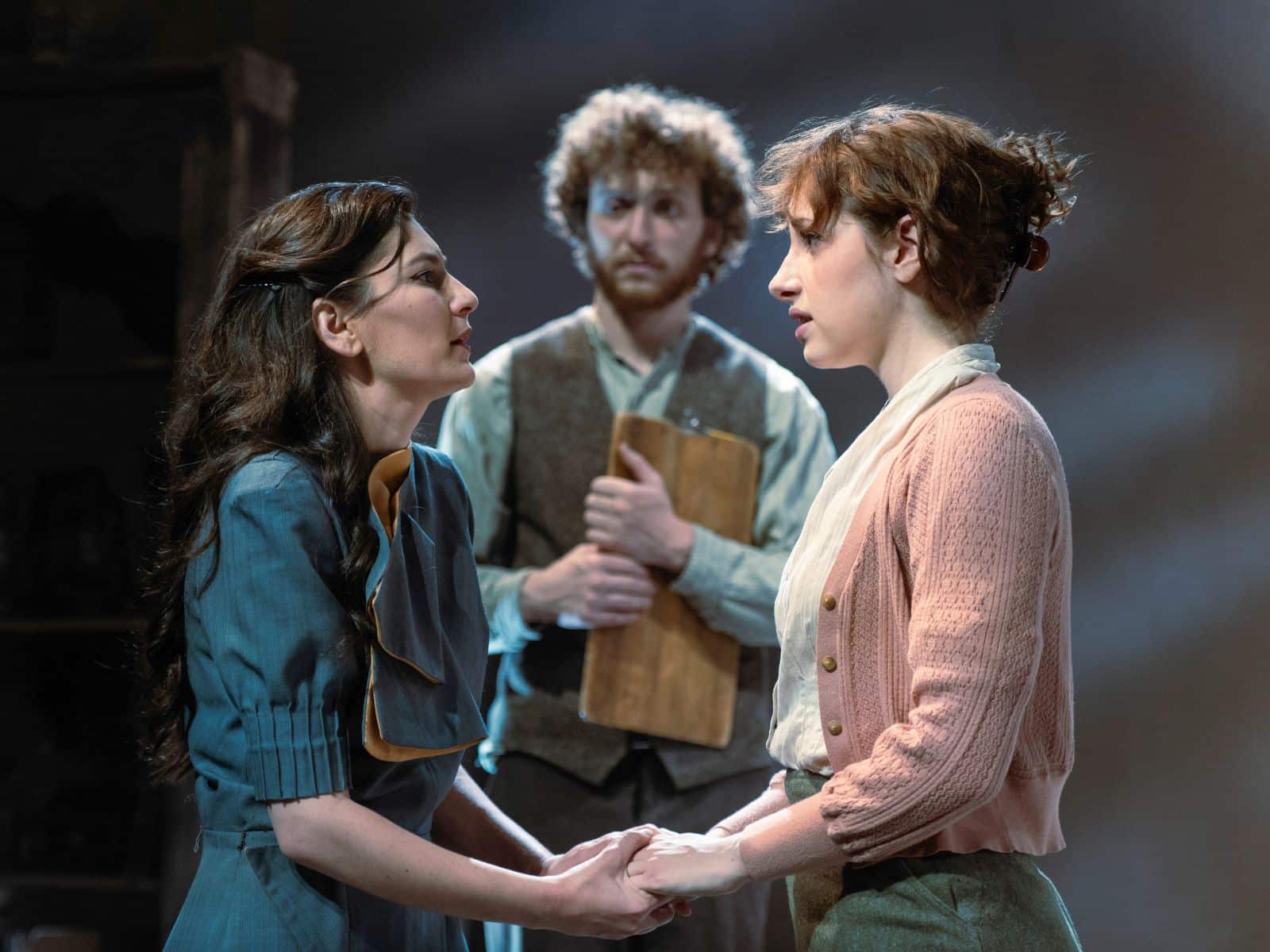
Directed by Alex Levy, 1st Stage’s intimate production of Indecent begins with a nondescript figure rising from the ashes. He shakes the dust out of his coat and introduces himself as Lemml (Ethan J. Miller). Lemml has a story he wants to tell us “…about a play. A play that changed his life.” Except he can’t remember how it ends. “No matter,” he reminds himself, “I can remember how it begins.”
In Warsaw, 1906, the newly married Asch shares a scandalous new manuscript with his wife. A tale about human depravity and the fight for respectability, it’s about a Jewish brothel owner whose daughter falls in love with one of his workers. Asch’s wife is enthralled, but his male friends and colleagues are less so. Nevertheless, the play opened in Berlin in 1908, in St. Petersburg in 1911, Constantinople in 1914, and Bratislava in 1918. By 1921, God of Vengeance was running in Yiddish at The Bowery Theatre in New York. In 1922, it reopened in English and moved to Broadway’s Apollo Theatre within just a few months — though the performance ran for only 133 performances thanks to the aforementioned obscenity charges. While all this is taking place in and just outside of Manhattan, Vogel reminds us that anti-Jewish massacres are simultaneously devastating Eastern Europe. With a setting described as “Warsaw, 1906, to Bridgeport, Connecticut, 1950s, and everywhere in between,” Indecent draws to mind the fallacies of “It won’t happen here.”
Beyond Lemml — our narrator and stage manager du jour — the troupe of performers in this play-within-a-play includes Vera Parnicki (Nicole Halmos) and Otto Godowsky (Zach Brewster-Geisz), who play the fathers, the mothers, the sages, and the wise fools. The younger but still seasoned members of the troupe are played by Halina Cygansky (Lauren Hart) and Mendel Schultz (Stephen Russell Murray). Finally, there are the ingenues Chana Mandelbaum (Lily Burka) and Avram Zederbaum (Ben Ribler). Each cast member plays many roles, but their synergy as an ensemble quickly demonstrates the strength of collectivity in times of great strife.
Hart and Burka stand apart from the cast as Manke and Rifkele, the lesbian love interests in Asch’s original play, as well as the various actresses who play these roles. Hart brings seductive yet tender energy — Burka, intelligence, and skillful precision — to each iteration.
God of Vengeance, it is said, hinges on the “rain scene” — an evocative and humanizing declaration of the love these women share. “Every night during the rain scene, the entire troupe lines up in the wings to watch,” says Lemml. What happens then, to the play and to these women, when this moment is cut for fear of scandalizing the American public?
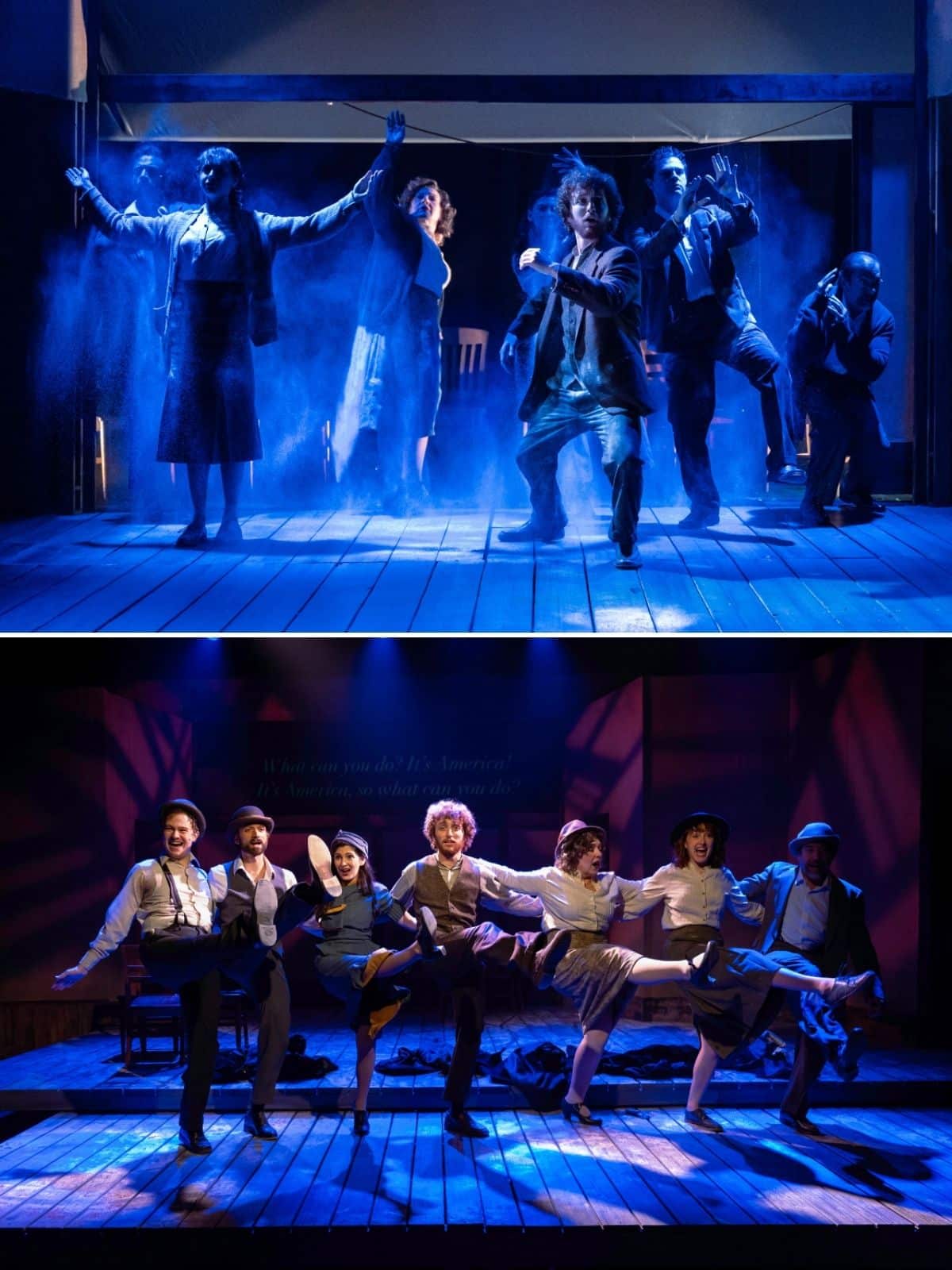
Ribler primarily operates as the God of Vengeance playwright, Asch, among other featured characters — including a quippy homage to Eugene O’Neill, who, even in a drunken stupor, delivers some of the play’s most astute observations about theater. Murray and Halmos impressively switch between their various roles, while also enriching the production with comic warmth. Finally, while Brewster-Geisz might not garner too much attention in the play’s first 90 minutes, it is his penultimate scene — where he steps into the shoes of the now much older Asch — that commemorates the quiet anguish of 20th-century Jewish history.
Costumed simply but insightfully by Rakell Foye and Maria Bissex, each character is dressed to suit their respective roles within a larger Jewish immigration story. Scenic designer Kathryn Kawecki places the action on a modest wooden stage bedecked with minimal furniture, frequently relying on chairs and suitcases to construct the interior landscape. William K. D’Eugenio’s lighting design plays with shadows and passageways, as easily depicting the steaminess of a Berlin cabaret as the ethereality of a midnight rainstorm. All transitions are rightfully speedy as Vogel packs a lot into 95 minutes. But Indecent operates almost as if it were a dream. Neither rushed nor overly intense, this production flickers between moments — it “blinks in time,” the overhead projections tell us — with compelling ease and dexterity.
If 1st Stage wants us to learn anything from this production of Indecent, it lives in Lemml’s first lines: a play has the power to change a life. Indecent concludes with one final staging of Asch’s play — in 1943 in the Łódź Ghetto in Poland, where an attic has been turned into a stage. The troupe’s humble and earnest staging of the “rain scene” is a reminder of how theater continues to connect and inspire us — when all else fails, hope might still be waiting in the wings.
Running Time: One hour and 35 minutes, no intermission.
Indecent is extended through June 28, 2026, at 1st Stage, 1524 Spring Hill Road, Tysons, VA. General admission tickets are $55, with a limited availability at $40 and $25, and student, educator, and military tickets are $15. Tickets can be purchased online or by calling (703) 854-1856.
The playbill for Indecent is online here.
SEE ALSO:
1st Stage announces cast and creative team for ‘Indecent’ (news story, May 18, 2026)