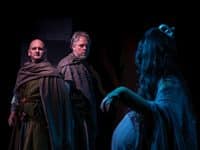
It was hard to be alive in the Middle Ages. There were the incessant wars, famines, floods, and other natural disasters. And then, there was the bubonic plague, which was likely to come for one of your neighbors if not for you. It was a scary time to be alive, a feeling not unfamiliar to us today. But in the delightfully exuberant and inventive Adrift: A Medieval Wayward Folly, Happenstance Theater company lifts the veil of fear by reminding us that, like our medieval forebears, we have ways of dealing with the demons that confront us. We can laugh at them, and we can use our imaginations to envision other worlds and other, less destructive, ways of being. As the endearing Fool (Mark Jaster) says to a young woman apparently dying of the plague (in what may be a fever dream framing the entire production), “Now is all we have … but don’t forget to play!”
Adrift is full of various kinds of play, from physical comedy to music to puppetry and dance, and full of striking visual imagery that lingers in the mind. Inspired by the apocalyptic paintings of early Renaissance artist Hieronymous Bosch (he of the giant strawberries and flaming hellmouths) and the more sober landscapes of his fellow Dutchman Pieter Bruegel, by medieval occultism, and the allegorical figures of tarot, the production comprises a series of independent vignettes that explore motifs common to our medieval ancestors and us. Among these are the fact of human mortality and the dread of what may come after; the mysterious cycles of time and of nature; the relationship between humans and nature, good and evil, matter and spirit; and the archetypal figures of the Fool, the Virgin, the Magus, the Crone, the Quack, the Demon, and the Grim Reaper.

Happenstance’s five-person ensemble clowns, mimes, dances, and plays their way through it all using chant and period instruments, but the humor isn’t stuck in the Middle Ages. There are distinct nods to Monty Python (watch for the bare buttocks!) and possibly the Marx Brothers, as well as the dizzyingly weird, proto-surrealist iconography of Bosch himself. Characters with giant strawberries and giant eggs for heads seem plucked straight out of Bosch’s Garden of Earthly Delights, not to mention that hellmouth and a delightfully engaging, childlike demon (wonderfully played by Sarah Olmsted Thomas), who eventually succumbs to the charms of the Fool.
The vignettes are mostly structured around the archetypal figures, although the initial point of departure is another Bosch painting, The Ship of Fools, and a series of verbal refrains such as “Be not afraid!” and “Time will take us all away” punctuates the production at various points. The first of these (“This is how the world ends”) is intoned by the ensemble as, crowded into a tiny “ship” (cleverly suggested by a wooden hoop), they mime their way upon a windless sea. “What do we do now?” they wonder, in a line repeated throughout the evening. This cues the arrival of the “Oracle,” impressively played by Sabrina Mandell and Alex Vernon in a fine Zen mode. What follows is one of the evening’s most hilarious episodes, as the Oracle invites audience members to ask it questions about the future, to which the Oracle improvises a response. The best of these queries, on the evening this writer attended, was undoubtedly “Will the Reflecting Pool ever get fixed?,” which drew a roar of laughter from the audience.
Other notable moments include an encounter with a puppet hellmouth (a favorite motif of medieval art) and a flying demon goat (puppetry by Sarah Olmsted Thomas, Alex Vernon, and Sabrina Mandell); the arrival of Gwen Grastorf’s quack Physician, who attempts to help Mark Jaster’s Fool get Sarah Olmsted Thomas’ Demon off his back (“Looks like you have attachment issues,” the Physician quips); and a lovely moment of audience interaction with Sabrina Mandell’s Wise Woman/Crone, who urges patrons to “give your troubles to me!,” as she attempts to put those pesky things into a barrel. It is a beautiful, innocent moment that could well serve as the theme of the entire production, which comes on the 20th anniversary of the company’s founding.

There is much to praise in the puppetry, music, set and costume design of this production. The otherworldly chant (some of it based on the work of 12th-century favorite Hildegard of Bingen) and natural sound effects take us to the far reaches of the mind, while the string, shadow, and creature puppets visually delight and engage our sympathies. The simple set design — period musical instruments used by the performers on one side of the stage and plain wooden barrels on the other — focuses attention on the action. But it is Sabrina Mandell’s stunning period costumes, seemingly drawn straight out of Bosch’s Garden of Earthly Delights and combining, as he does, elements from the world of man and the world of nature, that may leave the strongest impression. They are truly the stuff dreams are made of.
Time will indeed take us all away, as the players in Adrift remind us. But we are not alone with our demons, and on occasion, they can be tamed. For the present, Happenstance Theater invites us to give all our troubles over to them … at least for a delightful hour or so.
Running Time: 85 minutes, no intermission.
Adrift: A Medieval Wayward Folly, produced by Happenstance Theater, plays through August 2, 2026, at Round House Theatre, 4545 East-West Highway, Bethesda, MD. Tickets ($20–$40) are available online and at TodayTix.
Adrift: A Medieval Wayward Folly
Directed by Mark Jaster and Sabrina Mandell.
Collaboratively devised by the Happenstance Theater ensemble: Mark Jaster, Sabrina Mandell, Gwen Grastorf, Sarah Olmsted Thomas, and Alex Vernon
Program notes and credits for the cast and creative team are online here.